
Armoricaine
A red and white Breton cow kept for milk and meat, once down to forty head
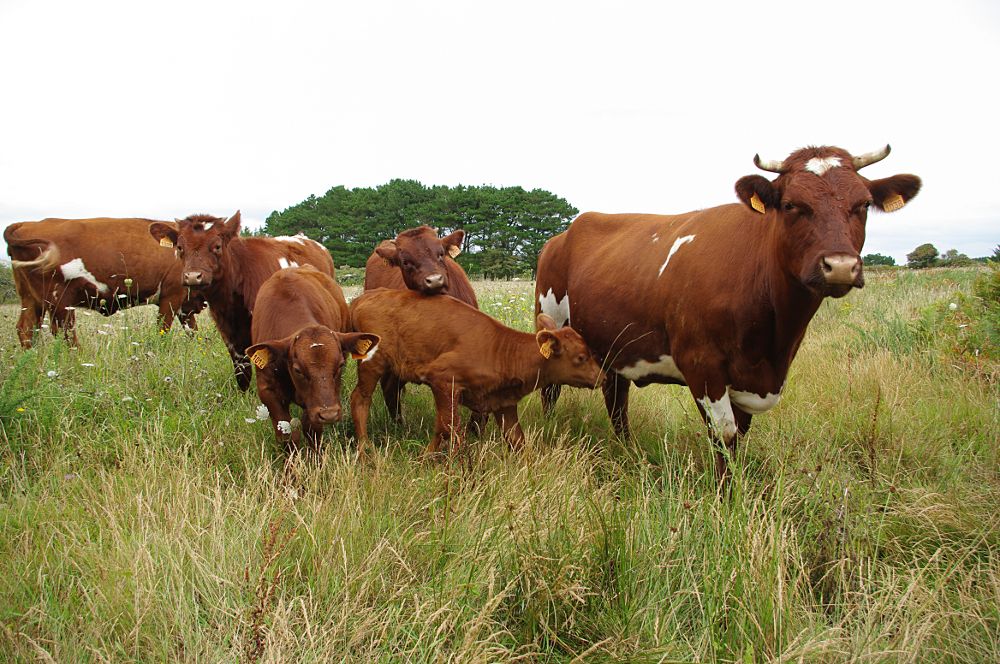
A French dual-purpose breed from Brittany, red-coated with white markings and short horns in both sexes. Cows stand about 138 cm and are kept for milk and meat; numbers fell to a few dozen before a recovery programme and semen stores saved the breed.
- Red coat with white markings and short horns in both sexes
- Cows stand about 138 cm and weigh some 650 kg
- By 1978 only forty cows were left; frozen semen found in the 1980s helped it recover
- Kept for milk and meat; a cow gives about 4,500 kg per lactation
- 1,799 animals on 82 farms in 2023
What do Armoricaine cattle look like?
The Armoricaine is red, with white markings over the coat, and pale skin underneath. Both bulls and cows have horns, and those horns are short. The breed is taurine, the humpless kind of cattle common in Europe, so there is no raised shoulder that would mark it as zebu. A cow in good condition stands about 138 cm at the withers, the point of the back between the shoulders, and weighs some 650 kg. Bulls are much heavier, running from 800 to 1000 kg. Across the breed, heights fall between 130 and 140 cm.
Where does the Armoricaine come from?
Brittany, in the north-west of France, is where this breed took shape during the nineteenth century. Farmers there crossed their local cattle, the Froment du Léon and the Pie Rouge de Carhaix, the second of which has since died out, with Durham animals brought over from the United Kingdom. Durham is the older name for the Shorthorn. A herd book opened in 1919, and the name Armoricaine came into use in 1923. Elsewhere, breeders drew on the Armoricaine when they put together the Pie Rouge des Plaines in the 1960s. Numbers then fell away until only a few dozen cows were left.
What the Armoricaine is known for
The reputation of the breed rests on growth and on survival. Calves put on weight quickly, and grown animals fatten without much trouble, which suits a herd kept for both milk and meat. It very nearly disappeared: by 1978 no more than forty cows were left. A reserve of frozen semen found in the 1980s opened the way to a recovery programme, and the population has since climbed from a few dozen to the low thousands. Keeping such a small group going depended on the work of many farms in Brittany.
How the Armoricaine is bred and kept
A herd book has recorded the breed since 1919. Semen has been collected and frozen for artificial insemination, the technique in which a cow is bred without a bull on the farm; by 2001 samples from eighteen bulls were held and in use. In 2023 the breed was kept on 82 farms, with 597 cows in breeding and 50 bulls at work. Its early history was one of crossing: local Froment du Léon and Pie Rouge de Carhaix cattle were matched with imported Durham stock, and later the Armoricaine itself went into the making of the Pie Rouge des Plaines.
Armoricaine, drawn
What the Armoricaine is kept for
The Armoricaine is classed as dual-purpose, which means a herd can be kept for both milk and meat rather than for one alone. Cows give about 4,500 kg across a lactation, the milking period that follows the birth of a calf, which runs for roughly 305 days. Calves grow quickly and older animals put on flesh readily, so the meat side of the breed is not an afterthought. In outline, it is a cow for the dairy and the beef herd at once.
Numbers, conservation and the herd book
Records tell the story of a narrow escape. Only 61 cows and 10 bulls were registered in 2001, with semen from 18 bulls stored for breeding. The FAO called the breed critically endangered in 2007. An estimate for 2005 put the total between 230 and 248 head. By 2020 there were 301 cows spread over 81 farms, and by 2023 the figure had risen to 1,799 animals on 82 farms, among them 597 breeding cows and 50 working bulls. The status given for 2025 is at risk, or endangered-maintained. Brittany remains its home.
Questions people ask about Armoricaine
Where does the Armoricaine come from?
Brittany, in north-west France. The breed was put together there in the nineteenth century, and its distribution is still Breton. A herd book opened in 1919, and the name Armoricaine came into use in 1923.
What is the Armoricaine kept for?
Milk and meat. It is classed as dual-purpose, so a herd can serve both. A cow gives around 4,500 kg over a lactation of some 305 days, and the calves grow quickly, with grown animals fattening without much trouble.
How many Armoricaine cattle are left?
The 2023 count was 1,799 animals on 82 farms, including 597 breeding cows and 50 bulls. The FAO called the breed critically endangered in 2007, and its 2025 status is at risk or endangered-maintained.
What does the breed look like?
Red with white markings, and pale-skinned. Horns are short and carried by both bulls and cows. A mature cow stands about 138 cm at the withers and weighs around 650 kg, while bulls range from 800 to 1000 kg.
Which breeds went into the Armoricaine?
Local Breton cattle, the Froment du Léon and the extinct Pie Rouge de Carhaix, were crossed with Durham, later called Shorthorn, brought from the United Kingdom. Later the Armoricaine itself helped form the Pie Rouge des Plaines in the 1960s.
Good reading and sources
- Armoricaine on WikipediaEncyclopedia
- More photos on Wikimedia CommonsPhotos and video
- Wikidata recordOpen data
The facts on this page come from the Wikipedia article "Armoricaine", written by its contributors and used under the CC BY-SA 4.0 licence, and from its Wikidata record (CC0). EveryCow rewrote the text in its own words, with AI assistance, and compares every page with the article to make sure no passage is copied. It may be reused under the same CC BY-SA 4.0 licence with a link back.
It may contain mistakes. Sizes, colours and customs differ from one herd, valley or breeder to the next. Folk beliefs are described as tradition, never as advice. If something is wrong, tell us. Last refreshed 2026-10-16.
More from France
All the breeds of France 🇨🇭 Switzerland and 5 moreSimmental
A large dual-purpose breed from the Swiss Simme valley, red and white with strong growth rates.Taurine · Dual-purpose · Docile
🇨🇭 Switzerland and 5 moreSimmental
A large dual-purpose breed from the Swiss Simme valley, red and white with strong growth rates.Taurine · Dual-purpose · Docile
 🇫🇷 France and 2 moreNormande
A large red-pied French dual-purpose breed, kept for rich milk and marbled beefTaurine · Dual-purpose · Rich milk
🇫🇷 France and 2 moreNormande
A large red-pied French dual-purpose breed, kept for rich milk and marbled beefTaurine · Dual-purpose · Rich milk
 🇫🇷 FranceSalersrace de Salers
A large dual-purpose breed from the Cantal mountains of France, red or black with lyre-shaped horns.Taurine · Dual-purpose · Docile
🇫🇷 FranceSalersrace de Salers
A large dual-purpose breed from the Cantal mountains of France, red or black with lyre-shaped horns.Taurine · Dual-purpose · Docile
 🇫🇷 France and 1 moreMaine-AnjouRouge des Prés
A red and white French beef breed from the Maine country, once a milk and meat animalTaurine · Beef
🇫🇷 France and 1 moreMaine-AnjouRouge des Prés
A red and white French beef breed from the Maine country, once a milk and meat animalTaurine · Beef
Its cousins elsewhere
All dual-purpose breeds 🇮🇳 IndiaHarianaहरियाना
A medium to large dual-purpose zebu from Haryana, white to grey with short horns.Zebu · Dual-purpose · Disease-resistant
🇮🇳 IndiaHarianaहरियाना
A medium to large dual-purpose zebu from Haryana, white to grey with short horns.Zebu · Dual-purpose · Disease-resistant
 🇵🇰 Pakistan and 1 moreTharparkarٿرپارڪر
A hardy zebu breed from the Thar Desert, white to grey with a firm hump, kept for milk and work.Zebu · Dual-purpose · Heat-tolerant
🇵🇰 Pakistan and 1 moreTharparkarٿرپارڪر
A hardy zebu breed from the Thar Desert, white to grey with a firm hump, kept for milk and work.Zebu · Dual-purpose · Heat-tolerant
 🇮🇳 IndiaDeoni
A horned draught breed from Maharashtra, kept for work and milkZebu · Dual-purpose
🇮🇳 IndiaDeoni
A horned draught breed from Maharashtra, kept for work and milkZebu · Dual-purpose