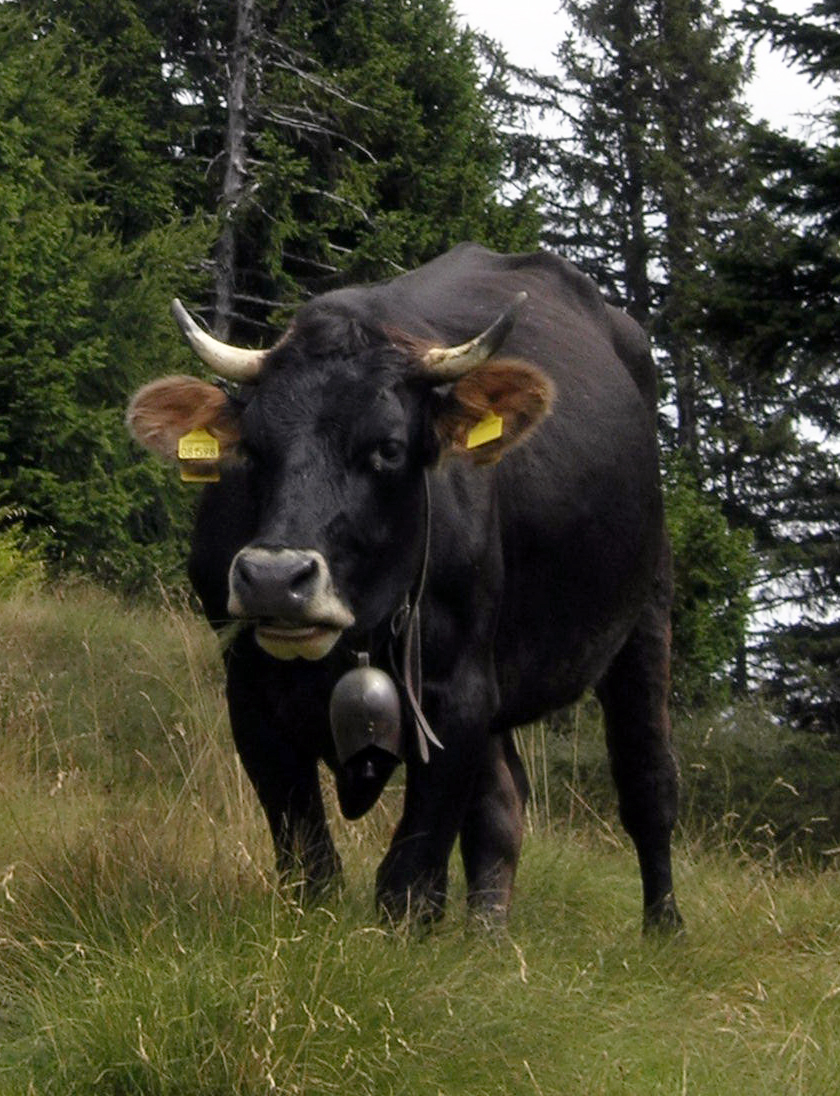
Rendena
A dual-purpose Alpine breed from the Val Rendena in Trentino, chestnut to near-black.
A dual-purpose dairy and beef breed from the Trentino in north-eastern Italy, chestnut to almost black with a pale muzzle. Nearly all the herds move up to mountain pasture each summer, and the milk goes into the region's cheeses.
- By around 1900 the breed had grown past 200,000 head; in 2007 the count was 6,986.
- A 1942 law barred Rendena bulls from service, and the breed sank to a few thousand animals.
- Cheese sold as Razza Rendena must come from Rendena milk alone.
- First-calf cows grazing alpine pasture for 100 days still average 4,733 kg of milk.
- Nearly the whole Trentino herd summers high in the Val Rendena.
What do Rendena cattle look like?
A mid-sized, horned cow of the Italian Alps. The coat shades from chestnut to nearly black, and two markings help pick the breed out: a light muzzle and a dorsal stripe, the line of hair that runs down the spine. Bulls measure 125 to 130 cm at the withers, the ridge between the shoulder blades, and weigh 500 to 600 kg. Cows are shorter, at 118 to 120 cm, and lighter, at about 490 kg. This is a dual-purpose animal by build and by use: expected to give a steady flow of milk, to finish well as beef, and to cope with a summer of grazing in the mountains.
Where does the Rendena come from?
The breed was shaped in the Val Rendena and the neighbouring Giudicarie, in the Trentino, and takes its name from the valley. The first written trace of its making is the arrival of Swiss stock in 1712. From there the cattle spread across the Trentino and the Veneto, and as the 1800s closed they had grown past 200,000 head, making them the main dairy cow of the region. The new century went badly for them: both world wars thinned the herds, and official policy pushed farmers towards the Bruna Alpina instead. A law of 1942 barred Rendena bulls from breeding service, and before long only a few thousand animals were left.
What the Rendena is known for
What the breed is known for is its fit with the alpine summer. It is described as particularly well suited to transhumant keeping, the routine of walking the herd up to high pasture for the warm months and back down for winter. Cows at their first calf, grazing the high pastures for a hundred days or more, still average 4,733 kg of milk per lactation, at 3.50% fat and 3.36% protein. Milk like that from mountain grass, and meat of good quality from young stock, are what keepers value in it.
Rendena, drawn
What the Rendena is kept for
Milk and meat share the work. Cows kept on a full ration all year round average over 6,000 kg of milk per lactation, the milking period between two calvings. The milk is cheese milk: cheese sold under the Razza Rendena name must come from Rendena milk alone, and Spressa delle Giudicarie, a DOP cheese of the Giudicarie, is made with it too. DOP is the European mark that ties a food to its home region. Calves are either taken for milk-fed veal or reared to 12 or 13 months, by which age they weigh 400 to 450 kg and yield 58 to 60% of good meat.
The land and climate of the Rendena
This is cattle country in the north-east of Italy, in the Trentino and the Veneto; most stock today is kept around Trento, Padova, Verona and Vicenza. The summer is spent at height. Almost the whole Trentino herd goes up to grazing on the mountains of the Val Rendena, while in the Veneto more than half the cattle spend the season on the Altopiano di Asiago, a high plateau. When the grazing year ends, the animals come down for winter.
At a glance: where it belongs
Land and climate
Celebrations
Numbers, conservation and the herd book
The breed has had its own national association since 1976, the Associazione Nazionale Allevatori Bovini di Razza Rendena. A count taken in 2007 put the population at 6,986 head, all of it in Italy's north-east. The agriculture ministry in Rome, the Ministero delle Politiche Agricole Alimentari e Forestali, looks after sixteen smaller Italian breeds that are thinly spread; the Rendena does not appear on that roll, so its keeping rests with its own association and its keepers. The 2007 figure sits far below the 200,000-odd of around 1900, yet well above the few thousand left after the mid-century decline.
Questions people ask about Rendena
Where do Rendena cattle come from?
The breed took shape in the Val Rendena and the Giudicarie, in the Trentino of north-eastern Italy, and stock from Switzerland is recorded there from 1712. Today most animals are kept around Trento, Padova, Verona and Vicenza.
What are Rendena cattle kept for?
Both milk and beef; the breed is run as dual-purpose. Cows give several thousand kilograms of milk per lactation, much of it made into Razza Rendena and Spressa delle Giudicarie DOP cheeses, while calves are raised for veal or for good-quality meat.
How big are Rendena cattle?
Mid-sized by cattle standards. Bulls stand 125 to 130 cm at the withers and weigh 500 to 600 kg, while cows come in at 118 to 120 cm and about 490 kg. Both sexes carry horns, and coats run from chestnut to nearly black.
Do the herds really move to the mountains each summer?
Yes. The breed suits transhumance well: nearly all the Trentino cattle summer on the high grazing of the Val Rendena, and more than half the Veneto herd does the same on the Altopiano di Asiago, a high plateau.
How many are left, and who looks after the breed?
A count in 2007 put the breed at 6,986 head, far below the 200,000-odd of around 1900 but above the few thousand left after the mid-century decline. Its national association has run affairs since 1976.
Good reading and sources
- Rendena on WikipediaEncyclopedia
- More photos on Wikimedia CommonsPhotos and video
- Wikidata recordOpen data
The facts on this page come from the Wikipedia article "Rendena", written by its contributors and used under the CC BY-SA 4.0 licence, and from its Wikidata record (CC0). EveryCow rewrote the text in its own words, with AI assistance, and compares every page with the article to make sure no passage is copied. It may be reused under the same CC BY-SA 4.0 licence with a link back.
It may contain mistakes. Sizes, colours and customs differ from one herd, valley or breeder to the next. Folk beliefs are described as tradition, never as advice. If something is wrong, tell us. Last refreshed 2026-10-16.
More from Italy
All the breeds of Italy 🇮🇹 Italy and 5 moreChianina
A massive white Italian breed known for beef production and historic draught work in Tuscany.Taurine · Beef · Heat-tolerant
🇮🇹 Italy and 5 moreChianina
A massive white Italian breed known for beef production and historic draught work in Tuscany.Taurine · Beef · Heat-tolerant
 🇮🇹 Italy and 2 morePiedmontesePiemontese
A white Italian beef breed known for double muscling and premium lean meat.Taurine · Beef · Marbled beef
🇮🇹 Italy and 2 morePiedmontesePiemontese
A white Italian beef breed known for double muscling and premium lean meat.Taurine · Beef · Marbled beef
 🇮🇹 ItalyMaremmana
A big grey Podolic beef breed from the old marshes of the Maremma in central ItalyTaurine · Beef · Thrifty foragers
🇮🇹 Italy and 3 morePustertaler SprinzenPustertaler Schecken
Rare colour-sided Alpine cattle from South Tyrol: white with brown or black flank patchesTaurine · Dual-purpose
🇮🇹 ItalyMaremmana
A big grey Podolic beef breed from the old marshes of the Maremma in central ItalyTaurine · Beef · Thrifty foragers
🇮🇹 Italy and 3 morePustertaler SprinzenPustertaler Schecken
Rare colour-sided Alpine cattle from South Tyrol: white with brown or black flank patchesTaurine · Dual-purpose
Its cousins elsewhere
All dual-purpose breeds 🇮🇳 IndiaHarianaहरियाना
A medium to large dual-purpose zebu from Haryana, white to grey with short horns.Zebu · Dual-purpose · Disease-resistant
🇮🇳 IndiaHarianaहरियाना
A medium to large dual-purpose zebu from Haryana, white to grey with short horns.Zebu · Dual-purpose · Disease-resistant
 🇵🇰 Pakistan and 1 moreTharparkarٿرپارڪر
A hardy zebu breed from the Thar Desert, white to grey with a firm hump, kept for milk and work.Zebu · Dual-purpose · Heat-tolerant
🇵🇰 Pakistan and 1 moreTharparkarٿرپارڪر
A hardy zebu breed from the Thar Desert, white to grey with a firm hump, kept for milk and work.Zebu · Dual-purpose · Heat-tolerant
 🇮🇳 IndiaDeoni
A horned draught breed from Maharashtra, kept for work and milkZebu · Dual-purpose
🇮🇳 IndiaDeoni
A horned draught breed from Maharashtra, kept for work and milkZebu · Dual-purpose