Savanna and bush: its breeds
Ankole, Nguni, Tuli and Africander: the grasslands and thornbush of Africa.
Savanna is open grassland with scattered trees, shaped by seasonal rain, grazing and fire. In Africa it is the home of the sanga cattle, the old blend of taurine and zebu with a small neck hump and often long horns: the Ankole of Uganda and Rwanda, the Nguni of southern Africa, the Tuli and Mashona of Zimbabwe and the Africander. Savanna country also includes the cerrado of Brazil, where the Nelore now grazes in great numbers, and the tropical north of Australia, worked by Brahman herds.
Grass, fire and rain
Savanna grass grows fast in the rains and dries to straw in the dry season. Herders and ranchers burn old grass to bring on a green flush, and move cattle to follow the new growth. Breeds that do well here can walk far, eat coarse dry grass, resist ticks and the diseases they carry, and keep their calves alive through a hard season. Small, hardy cows that calve every year often produce more over a lifetime than larger cows that need better feed.
The sanga cattle
Sanga cattle have lived in eastern and southern Africa for well over a thousand years. The Ankole, kept by the Bahima and Banyankole of Uganda and the Tutsi of Rwanda and Burundi, carries some of the largest horns of any breed and is prized for its looks as much as its milk. The Nguni, kept by Zulu, Swazi and Xhosa farmers, comes in a great range of coat patterns, each with its own name in isiZulu. The Tuli was developed in Zimbabwe from local yellow cattle from 1945.
Cattle and wildlife
In East Africa, cattle and wild animals have shared the savanna for a very long time. Maasai herds graze around the Maasai Mara and the Serengeti, and the herders' seasonal moves have shaped the grass that wildlife eats. The relationship is not always easy: lions take cattle, buffalo and wildebeest can carry disease to herds, and fences and farms have cut old routes. Many conservancies now work with herders on shared grazing plans.
Cerrado and northern Australia
The cerrado of central Brazil is one of the largest savannas in the world, and since the twentieth century it has become beef country. The Nelore, a white zebu descended from the Ongole of Andhra Pradesh, suits the heat, ticks and poor grass and is now Brazil's main beef breed. In northern Australia, Brahman and Brahman-cross herds run on the tropical savanna of the Kimberley, the Northern Territory and Queensland, often mustered by helicopter on very large stations.
Worth knowing
- Ankole-Watusi: Sanga cattle with very large horns
- Nguni: Many-coloured cattle of southern Africa
- Tuli: Yellow sanga breed developed in Zimbabwe
- Mashona: Small hardy cattle of Zimbabwe
- Africander: Red sanga breed of South Africa
- Nelore: Zebu of the Brazilian cerrado, from Indian Ongole stock
- Amrit Mahal kavals: Grassland reserves kept for the Amrit Mahal breed in Karnataka
Good to know
- Rotate grazing so that grass can seed in the rains.
- Control ticks; tick-borne disease is a main cause of loss on savanna.
- Plan for the dry season with standing grass or stored fodder.
- Protect calves at night where lions, leopards or hyenas are present.
Sources and further reading
Original text by the EveryCow desk, written with AI assistance and checked against the sources above. Customs are described as tradition, not as advice. If we have something wrong, tell us.
Savanna and bush on EveryCow
The breeds written up so far, best known first.
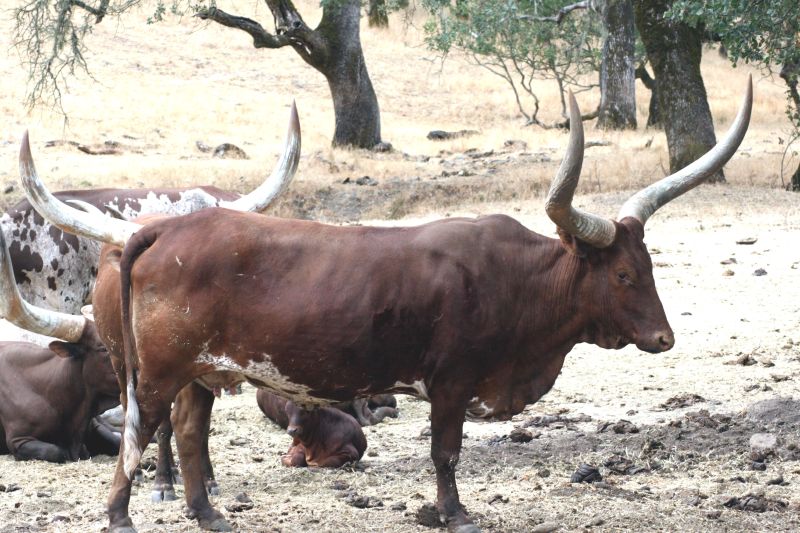 🇸🇩 Sudan and 4 moreSanga cattle
The umbrella name for native African cattle, mixing humpless taurine and zebu bloodTaurine · Disease-resistant
🇸🇩 Sudan and 4 moreSanga cattle
The umbrella name for native African cattle, mixing humpless taurine and zebu bloodTaurine · Disease-resistant
 🇧🇷 BrazilGuzerá
A Brazilian humped breed from Kankrej and Crioulo stock, usually grey or whiteZebu · Beef · Polled
🇨🇮 Ivory Coast and 1 moreBaoulé
A dwarf shorthorn of the Ivory Coast savanna, black-coated and kept by Fula herdersTaurine · Dairy
🇧🇷 BrazilGuzerá
A Brazilian humped breed from Kankrej and Crioulo stock, usually grey or whiteZebu · Beef · Polled
🇨🇮 Ivory Coast and 1 moreBaoulé
A dwarf shorthorn of the Ivory Coast savanna, black-coated and kept by Fula herdersTaurine · Dairy
Photo credits on this page
The small pictures above come from Wikimedia Commons under free licences. Some are cropped to fit.
- Guzerá: Jose Reynaldo da Fonseca, CC BY-SA 3.0, source
- Sanga cattle: Just chaos, CC BY 2.0, source