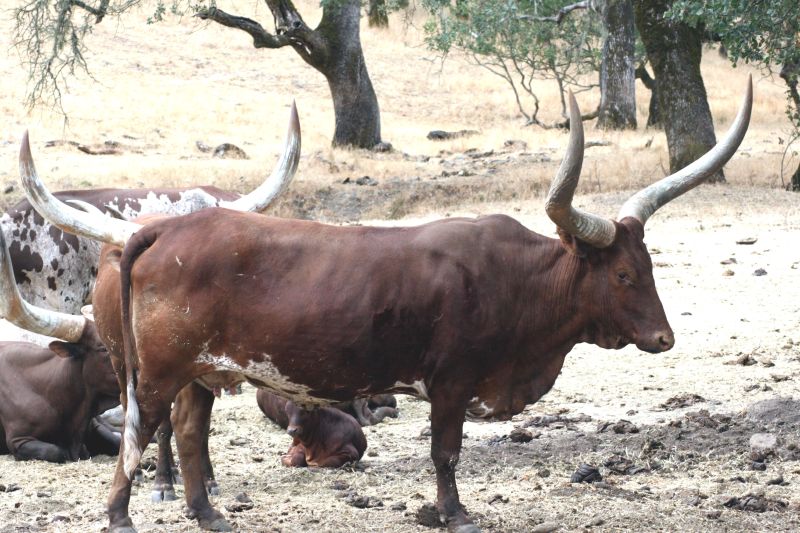
Sanga cattle
The umbrella name for native African cattle, mixing humpless taurine and zebu blood
Sanga is the umbrella term for native African cattle, from humpless taurine breeds to zebu crosses, sometimes classed as Bos taurus africanus. Researchers sort them into African taurine, sanga, zenga, sheko and indicine branches, with breeds such as N'Dama prized for withstanding tsetse-borne sickness.
- N'Dama rated two to three times as tsetse-resistant as Nguni cattle
- African taurines carry adaptations in 16 genes for immunity, heat tolerance and breeding
- Egyptian murals depict early sanga cattle with lyre-shaped horns
- A 50,000-year-old aurochs skull from Affad is the oldest known in Sudan
- Researchers date the zebu mixture in African herds to around 700 AD
What do Sanga cattle cattle look like?
Sanga is a broad label rather than one breed: the name gathers the long-established native cattle of parts of Africa under a single roof, and some zoologists list them as the subspecies Bos taurus africanus. Because humped Indian zebu and humpless taurine stock both contributed, looks vary widely. African taurine members, such as the N'Dama and Muturu, carry a low hump at the top of the neck above the withers, the highest line of the shoulders, rather than the tall hump over the shoulders that marks a zebu. The classic sanga sits between the two. Rock paintings and wall art from ancient Egypt show early cattle of this kind with lyre-shaped horns, sweeping sideways and curving up. Genetic work divides the group into African taurine, African indicine, zenga, sanga and sheko branches, with the Ankole as its sanga example.
Where does the Sanga cattle come from?
Where these cattle began is one of the open questions of African livestock history. One view holds that three waves came from western Asia: humpless longhorns around 5000 BC, humpless shorthorns some 2,500 years later, and humped zebu near 1500 BC. After landing in Egypt, herds crossed a Sahara that was still green and moved on into West Africa, picking up blood from wild aurochs along the way. The rival view argues cattle were tamed in Africa itself, probably in the Sudan, from local aurochs. Old bones feed the argument: aurochs remains at Affad and the Letti desert go back 50,000 years, and ancient cattle bones at Nabta Playa and Bir Kiseiba are almost as striking. Mitochondrial lineages called T1 and Y2 lean towards an African start. How much zebu entered is debated too: older writers said 1600 BCE onwards, today's consensus sits near 700 AD.
What the Sanga cattle is known for
Disease resistance is the headline quality. Tsetse flies pass on trypanosomosis, a blood-borne sickness that has long held back cattle keeping across West and Central Africa, and the African taurine lines cope with it. Trials run by ILRI in Kenya, Nigeria and the Democratic Republic of the Congo rated the N'Dama the toughest of the breeds tested: a resistance score near 25% against roughly 8% for the Nguni, with a first-generation N'Dama-Nguni cross at 16.5%, double the pure Nguni. Kenyan work at KALRO found a similar gain when N'Dama blood went into Boran herds. Sixteen genes underpin the package, covering immunity, heat tolerance and breeding performance.
How the Sanga cattle is bred and kept
A 2020 survey by Kim and colleagues, expanding on a 1999 scheme by Rege, sorts African humped cattle by how much zebu ancestry each carries. True sanga arise when African taurine stock meets zebu; the coined word zenga marks the next blend, zebu on sanga again. The four humped branches took shape when Asian zebu arrived, around 700 AD by most estimates, and mixed with taurine cows in differing ratios. Even cattle classed as African indicine keep a strong African taurine inheritance. Herd owners also cross on purpose: N'Dama-Nguni pairings raise disease resistance, and Kenyan trials repeated the result with the Boran. Alongside the traditional breeds, African cattle have been blended with outside stock to create composites.
Sanga cattle, drawn
What the Sanga cattle is kept for
Cattle of these lines are general farm stock across much of Africa, and their particular role is to make herding viable in fly country, where trypanosomosis otherwise restricts livestock development. The N'Dama is treated as a resource in its own right and as a source of hardiness for other herds, which is why research bodies test its crosses with the Nguni and the Boran. Farther back, the first African cattle may have been tamed as a dependable food supply for communities facing lean plant foods during dry spells of the green Sahara era.
The land and climate of the Sanga cattle
These cattle are built for heat and for sick-fly country. Genetic studies credit African taurine stock with tolerance of heat and of the parasites carried by tsetse flies, insects that infest wide belts of West and Central Africa. The ancient spread followed grass and water: after reaching Egypt roughly eight thousand years ago, herds moved across a Sahara that was then green and on into West Africa, the central desert acting as a corridor between east and west. Egyptian wall paintings show how long these cattle have been known in the northeast.
Who keeps the Sanga cattle
Herders, not the animals themselves, carried cattle into Africa, on the introduction reading of the evidence. Stock-raising peoples came up the Nile Valley and, by about eight thousand years ago, moved through Wadi Howar into the central desert, which relayed domestic animals from the eastern side to the west. North African herders let their tame cattle breed with wild aurochs of several regional kinds, on both the bull and the cow side, which helps explain why these animals differ so sharply from European and Indian stock. At Nabta Playa, in the Western Desert, semi-settled hunter-gatherers may have brought local aurochs under human control, seeking a steady food supply when edible plants thinned out. At the E-75-6 site, pastoralists tended cattle and kept a watering basin and well in use.
At a glance: where it belongs
Land and climate
Faith and tradition


Questions people ask about Sanga cattle
Where do sanga cattle come from?
From Africa itself, though the exact birthplace is argued over. One school traces them to Near Eastern stock brought through Egypt before spreading across a greener Sahara; another holds they were tamed independently, probably in the Sudan. Zebu blood from Asia entered the mix much later, near 700 AD.
What are sanga cattle kept for?
They are general farm cattle of Africa, and their special job is making herding possible in tsetse-fly country, where the disease carried there holds back livestock keeping. N'Dama stock is also used in crosses to toughen breeds such as the Nguni and Boran.
Why are they so resistant to disease?
African taurine lines built up defences in sixteen genes, covering immunity, heat tolerance and fertility. Tolerance of trypanosomosis, the tsetse-fly sickness, matters most, and even cattle counted as African indicine carry a good measure of these African adaptations.
What is the difference between sanga and zenga?
Sanga, in the narrow sense, are the offspring of African taurine and zebu parents. Zenga is a word coined for the next cross, between a zebu and a sanga. Fogera and Horro cattle are zenga examples, while the Ankole represents the sanga group.
Do they have humps?
It varies by line. African taurine members carry only a small hump at the top of the neck, above the withers, of the kind wild aurochs had. True zebu show a tall hump over the shoulders, and sanga and zenga cattle fall between the two.
Good reading and sources
- Sanga cattle on WikipediaEncyclopedia
- More photos on Wikimedia CommonsPhotos and video
- Wikidata recordOpen data
The facts on this page come from the Wikipedia article "Sanga cattle", written by its contributors and used under the CC BY-SA 4.0 licence, and from its Wikidata record (CC0). EveryCow rewrote the text in its own words, with AI assistance, and compares every page with the article to make sure no passage is copied. It may be reused under the same CC BY-SA 4.0 licence with a link back.
It may contain mistakes. Sizes, colours and customs differ from one herd, valley or breeder to the next. Folk beliefs are described as tradition, never as advice. If something is wrong, tell us. Last refreshed 2026-10-16.

Its cousins elsewhere
 🇺🇸 United States and 5 moreBrahman
An American beef breed with a hump and grey or red coat, bred from Indian zebu cattleComposite · Beef · Heat-tolerant
🇺🇸 United States and 5 moreBrahman
An American beef breed with a hump and grey or red coat, bred from Indian zebu cattleComposite · Beef · Heat-tolerant
 🇺🇸 United StatesTexas Longhorn
American beef cattle, once feral on Texas ranges, with horn spreads beyond 2.4 mTaurine · Beef · Heat-tolerant
🇺🇸 United StatesTexas Longhorn
American beef cattle, once feral on Texas ranges, with horn spreads beyond 2.4 mTaurine · Beef · Heat-tolerant
 🇮🇹 Italy and 5 moreChianina
A massive white Italian breed known for beef production and historic draught work in Tuscany.Taurine · Beef · Heat-tolerant
🇮🇹 Italy and 5 moreChianina
A massive white Italian breed known for beef production and historic draught work in Tuscany.Taurine · Beef · Heat-tolerant
 🇮🇳 India and 1 moreGir
A humped dairy breed from Gujarat, red and white with long drooping ears and a domed foreheadZebu · Dairy · Heat-tolerant
🇮🇳 India and 1 moreGir
A humped dairy breed from Gujarat, red and white with long drooping ears and a domed foreheadZebu · Dairy · Heat-tolerant