
Canchim
A Brazilian beef breed, white to cream, with a small hump, bred from zebu and Charolais
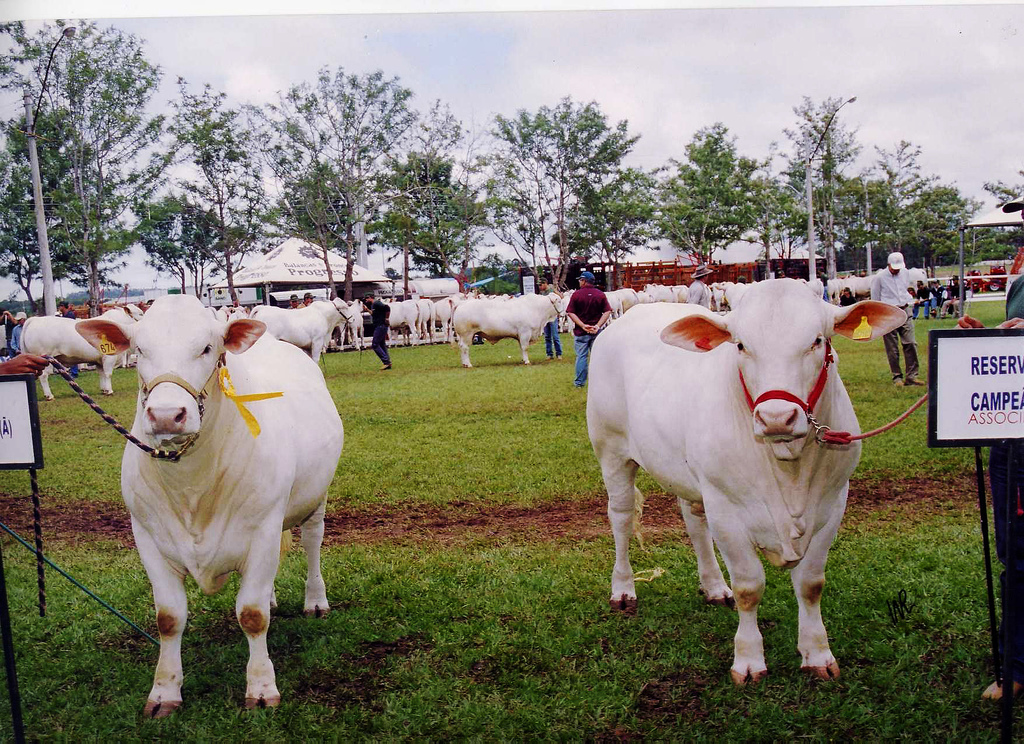
The Canchim is a modern beef breed from Brazil, created in São Paulo State from about 1940 by crossing zebu cattle with French Charolais bulls. The animals are white or cream in colour, bulls carry a small hump and weigh 800 to 1000 kg, and the breed is kept for meat.
- Built in São Paulo State from about 1940 by crossing Charolais bulls with zebu cows
- The first Canchim calves were born in 1953
- Bulls reach 800 to 1000 kg, cows 500 to 650 kg, one bull weighed 1360 kg
- Coat runs from white to cream and bulls have a small hump
- Classed as not at risk by the FAO in 2007 and by DAD-IS in 2025
What do Canchim cattle look like?
The Canchim is a modern beef breed. Its coat is white to cream, close to that of the Charolais, and bulls carry a small hump. Bulls are heavy animals, usually 800 to 1000 kg, though one has been recorded at 1360 kg; cows are lighter, at roughly 500 to 650 kg. The build is that of a beef breed with zebu blood behind it, and the breeding aim was to keep the growth rate and meat yield of the French parent while retaining the zebu's ability to cope with local conditions.
Where does the Canchim come from?
Charolais cattle reached Brazil in 1922, sent by the ministry of agriculture, and were kept at a government farm at Urutaí in Goiás. They were moved in 1936 to the Fazenda de Criação at São Carlos in São Paulo State, a farm once called Fazenda Canchim and later part of the Empresa Brasileira de Pesquisa Agropecuária as the Centro Nacional de Pesquisa do Sudeste. There Antônio Teixeira Viana led work that began about 1940, using Charolais bulls on cows of several zebu breeds. The first Canchim calves arrived in 1953. The herd then stayed closed until a second round of crossing started, given as 1986 or 1990.
What the Canchim is known for
Two candidate lines were compared in the early work. Stock carrying five eighths zebu blood proved rustic but uneven, and offered little improvement over the original zebu herds. Stock with five eighths Charolais blood was better put together, grew faster, was more consistent and tolerated heat and insects well. That second group became the foundation of the Canchim, and the cattle are known for coping with warm conditions.
How the Canchim is bred and kept
Both schemes began with a zebu cow mated to a Charolais bull, giving F1 animals with half of each. A Charolais bull on an F1 cow produced F2 stock with a quarter zebu; a zebu bull on those F2 cows gave three eighths European and five eighths zebu. Reversing the sires used in the second and third generations gave the opposite mix, five eighths European. The F3 animals were then bred among themselves. The F1 generation came from 368 zebu cows, nearly four fifths of them Indubrasil, the rest Guzerá and Nelore; under half of those cows appear in the pedigree, which also names 53 Charolais bulls, 8 Indubrasil and 4 Guzerá.
Canchim, drawn
What the Canchim is kept for
The Canchim is kept for beef. The crossing was planned around meat: faster growth, better carcass shape and a higher yield than the zebu cattle then in use in Brazil, while keeping the zebu's tolerance of heat and insects. The breed now makes up roughly 3% of the national beef herd, which puts it among the working commercial types rather than the scarce ones. Bulls are the heavy side of the breed and cows are moderate in size.
The land and climate of the Canchim
The cattle were made for warm country. The aim was to hold on to the zebu's way of coping with its surroundings while gaining the growth of a European beef breed, and the line that became the Canchim was noted for taking heat and insects well. The work was done in São Paulo State, on a government farm.
Numbers, conservation and the herd book
Official figures put the breed in no danger: the FAO classed it as not at risk in 2007, and DAD-IS gave the same verdict in 2025. Breeders formed the Associação Brasileira dos Criadores de Canchim in 1971 and started a register of pedigree animals the same year; official recognition followed in 1972. Around 3% of Brazil's beef herd is Canchim.
Questions people ask about Canchim
Where does the Canchim come from?
Brazil. The breeding work began in São Paulo State on a government farm at São Carlos, once called Fazenda Canchim. Charolais cattle had arrived in the country in 1922, and crosses with zebu cattle started there from about 1940.
What is the Canchim kept for?
Beef. The crossing was designed for faster growth, better carcasses and higher meat yield than the zebu cattle in use at the time, while keeping the zebu's tolerance of heat and insects. The breed supplies around 3% of Brazil's beef herd.
How was the Canchim made?
Zebu cows were put to Charolais bulls. The two schemes reached either five eighths zebu or five eighths Charolais blood. The Charolais-heavy line was more consistent and grew better, and it became the breed.
What does a Canchim look like?
The coat varies between white and cream, much like a Charolais. Bulls carry a small hump and are heavy, usually 800 to 1000 kg, with one recorded at 1360 kg. Cows are lighter, in the region of 500 to 650 kg.
Is the Canchim rare?
No. The FAO judged it not at risk in 2007 and DAD-IS agreed in 2025. It is a commercial breed that makes up roughly 3% of the national beef herd, and Brazilian breeders have recorded pedigree animals since 1971.
Good reading and sources
- Canchim on WikipediaEncyclopedia
- More photos on Wikimedia CommonsPhotos and video
- Wikidata recordOpen data
The facts on this page come from the Wikipedia article "Canchim", written by its contributors and used under the CC BY-SA 4.0 licence, and from its Wikidata record (CC0). EveryCow rewrote the text in its own words, with AI assistance, and compares every page with the article to make sure no passage is copied. It may be reused under the same CC BY-SA 4.0 licence with a link back.
It may contain mistakes. Sizes, colours and customs differ from one herd, valley or breeder to the next. Folk beliefs are described as tradition, never as advice. If something is wrong, tell us. Last refreshed 2026-10-16.
More from Brazil
All the breeds of Brazil 🇮🇳 India and 3 moreNelore
A large humped beef breed from India, now dominant in Brazil and known for heat tolerance and parasite resistance.Zebu · Beef · Heat-tolerant
🇮🇳 India and 3 moreNelore
A large humped beef breed from India, now dominant in Brazil and known for heat tolerance and parasite resistance.Zebu · Beef · Heat-tolerant
 🇧🇷 BrazilGuzerá
A Brazilian humped breed from Kankrej and Crioulo stock, usually grey or whiteZebu · Beef · Polled
🇧🇷 BrazilGuzerá
A Brazilian humped breed from Kankrej and Crioulo stock, usually grey or whiteZebu · Beef · Polled
 🇧🇷 BrazilCaracu
A solid-red Brazilian Criollo beef breed from Minas Gerais, humpless and hornedTaurine · Beef
🇧🇷 BrazilCaracu
A solid-red Brazilian Criollo beef breed from Minas Gerais, humpless and hornedTaurine · Beef
 🇵🇰 Pakistan and 5 moreZebu
Humped, heat-tolerant cattle of South Asia, kept for milk, meat, work and ridingZebu · Dairy · Heat-tolerant
🇵🇰 Pakistan and 5 moreZebu
Humped, heat-tolerant cattle of South Asia, kept for milk, meat, work and ridingZebu · Dairy · Heat-tolerant
Its cousins elsewhere
All beef breeds 🇺🇸 United States and 5 moreBrahman
An American beef breed with a hump and grey or red coat, bred from Indian zebu cattleComposite · Beef · Heat-tolerant
🇺🇸 United States and 5 moreBrahman
An American beef breed with a hump and grey or red coat, bred from Indian zebu cattleComposite · Beef · Heat-tolerant
 🇺🇸 United StatesTexas Longhorn
American beef cattle, once feral on Texas ranges, with horn spreads beyond 2.4 mTaurine · Beef · Heat-tolerant
🇺🇸 United StatesTexas Longhorn
American beef cattle, once feral on Texas ranges, with horn spreads beyond 2.4 mTaurine · Beef · Heat-tolerant
 🇮🇹 Italy and 5 moreChianina
A massive white Italian breed known for beef production and historic draught work in Tuscany.Taurine · Beef · Heat-tolerant
🇮🇹 Italy and 5 moreChianina
A massive white Italian breed known for beef production and historic draught work in Tuscany.Taurine · Beef · Heat-tolerant
 🇮🇳 India and 1 moreGir
A humped dairy breed from Gujarat, red and white with long drooping ears and a domed foreheadZebu · Dairy · Heat-tolerant
🇮🇳 India and 1 moreGir
A humped dairy breed from Gujarat, red and white with long drooping ears and a domed foreheadZebu · Dairy · Heat-tolerant