
Gir
A humped dairy breed from Gujarat, red and white with long drooping ears and a domed forehead
The Gir is a zebuine cattle breed originating in the Kathiawar peninsula of Gujarat, India. It is kept primarily for dairy production, yielding milk with high butterfat content.
- Domed forehead is unique among world breeds
- Milk yield averages 2110 kg per lactation
- Brazilian herd exceeds five million head
- Used to create the Girolando crossbreed
What do Gir cattle look like?
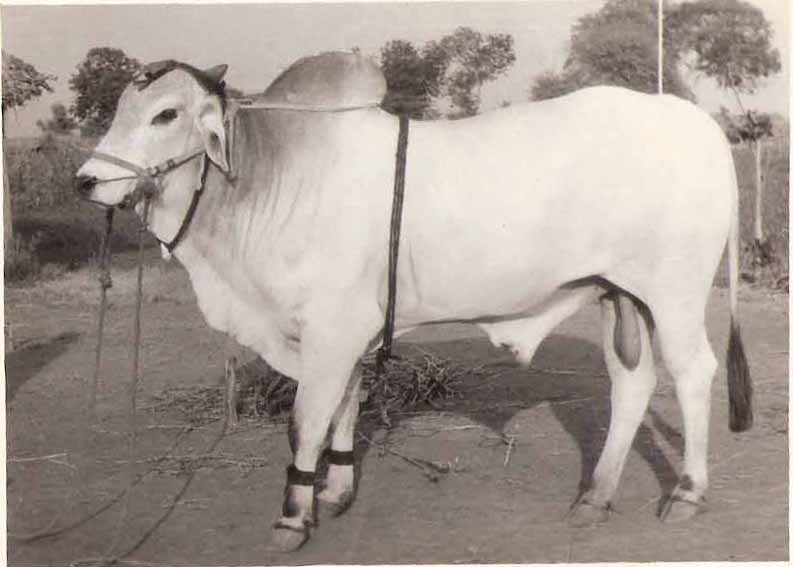
This zebuine breed displays a rounded, domed forehead that sets it apart as an ultraconvex type. Its coat features mottling in shades of red, yellow, and white, while black coats are considered unacceptable. The animals possess long, pendulous ears and horns that curve outward and backward. Cows typically stand around 130 cm tall and weigh approximately 385 kg. Bulls are larger, reaching about 140 cm in height and weighing roughly 545 kg. Calves begin life at a modest weight of 20 kg.
Where does the Gir come from?
The breed emerged in the Kathiawar peninsula within the Indian state of Gujarat. Its name comes directly from the Gir Hills located in this region. Historically, the breeding range covered the Amreli, Bhavnagar, Junagadh, and Rajkot districts. The animal has also been used to improve other local breeds such as the Red Sindhi and Sahiwal.
What the Gir is known for
As a Bos indicus type, the Gir handles hot temperatures well and shows resistance to tropical diseases. It is highly valued for its milk production capabilities. The breed is known for producing milk with a fat content of about 4.5%. This quality makes it suitable for crossing with other dairy types to create new strains.
How the Gir is bred and kept
Selective breeding efforts began in Brazil during the 1960s. These efforts created distinct dairy and beef lines within the population. In India, the breed contributes to genetic improvement programs. It is frequently crossed with Friesian cows to produce the Girolando breed, combining traits from both parent types.
Gir, drawn
What the Gir is kept for
The primary purpose of the Gir is dairy farming. In India, cows produce an average of 2110 kg of milk per lactation. The milk contains approximately 4.5% fat, making it rich and valuable. In Brazil, separate strains have been developed specifically for beef production alongside the dairy focus.
The land and climate of the Gir
The breed thrives in the tropical climate of western India. It is suited to the conditions found in Gujarat and neighboring states like Maharashtra and Rajasthan. The heat tolerance and disease resistance allow it to perform well in these warm environments.
Who keeps the Gir
They note its use by farmers in Gujarat and Brazil for agricultural and dairy purposes.
At a glance: where it belongs
Land and climate


The Gir at fairs and festivals
No festivals, fairs, or contests involving the Gir are mentioned in the provided material.
Numbers, conservation and the herd book
In India, the population reached about 917,000 in 2000, representing 37% of the Saurashtra cattle. In Brazil, numbers grew significantly, reaching approximately five million by 2010. The FAO listed the breed as not at risk in 2007.
From the Gir
Questions people ask about Gir
Where does the Gir breed come from?
It originates in the Kathiawar peninsula of Gujarat, India, named after the Gir Hills.
What is the Gir breed kept for?
It is primarily kept for dairy production, yielding milk with high butterfat content.
How much milk does a Gir cow produce?
In India, they average 2110 kg per lactation with about 4.5% fat content.
Is the Gir breed resistant to heat?
Yes, as a Bos indicus breed, it tolerates hot temperatures and resists tropical diseases.
Good reading and sources
- Gyr cattle on WikipediaEncyclopedia
- More photos on Wikimedia CommonsPhotos and video
- Wikidata recordOpen data
The facts on this page come from the Wikipedia article "Gyr cattle", written by its contributors and used under the CC BY-SA 4.0 licence, and from its Wikidata record (CC0). EveryCow rewrote the text in its own words, with AI assistance, and compares every page with the article to make sure no passage is copied. It may be reused under the same CC BY-SA 4.0 licence with a link back.
It may contain mistakes. Sizes, colours and customs differ from one herd, valley or breeder to the next. Folk beliefs are described as tradition, never as advice. If something is wrong, tell us. Last refreshed 2026-10-16.
More from India
All the breeds of India 🇵🇰 Pakistan and 5 moreZebu
Humped, heat-tolerant cattle of South Asia, kept for milk, meat, work and ridingZebu · Dairy · Heat-tolerant
🇵🇰 Pakistan and 5 moreZebu
Humped, heat-tolerant cattle of South Asia, kept for milk, meat, work and ridingZebu · Dairy · Heat-tolerant
 🇮🇳 India and 4 moreGayal
A semi-domesticated bovine of the Eastern Himalayas, kept for meat, milk and ceremonyMithun · Beef
🇮🇳 India and 4 moreGayal
A semi-domesticated bovine of the Eastern Himalayas, kept for meat, milk and ceremonyMithun · Beef
 🇵🇰 Pakistan and 4 moreSahiwal
A heat-tolerant zebu from the Punjab, kept for milk, meat and draught workZebu · Dairy · Heat-tolerant
🇵🇰 Pakistan and 4 moreSahiwal
A heat-tolerant zebu from the Punjab, kept for milk, meat and draught workZebu · Dairy · Heat-tolerant
 🇮🇳 India and 5 moreOngole
A short-horned zebu breed from Andhra Pradesh, white with dark markings, used for work and milk.Zebu · Draught · Heat-tolerant
🇮🇳 India and 5 moreOngole
A short-horned zebu breed from Andhra Pradesh, white with dark markings, used for work and milk.Zebu · Draught · Heat-tolerant
Its cousins elsewhere
All dairy breeds 🇺🇸 United States and 5 moreBrahman
An American beef breed with a hump and grey or red coat, bred from Indian zebu cattleComposite · Beef · Heat-tolerant
🇺🇸 United States and 5 moreBrahman
An American beef breed with a hump and grey or red coat, bred from Indian zebu cattleComposite · Beef · Heat-tolerant
 🇺🇸 United StatesTexas Longhorn
American beef cattle, once feral on Texas ranges, with horn spreads beyond 2.4 mTaurine · Beef · Heat-tolerant
🇺🇸 United StatesTexas Longhorn
American beef cattle, once feral on Texas ranges, with horn spreads beyond 2.4 mTaurine · Beef · Heat-tolerant
 🇮🇹 Italy and 5 moreChianina
A massive white Italian breed known for beef production and historic draught work in Tuscany.Taurine · Beef · Heat-tolerant
🇮🇹 Italy and 5 moreChianina
A massive white Italian breed known for beef production and historic draught work in Tuscany.Taurine · Beef · Heat-tolerant
 🇮🇳 India and 3 moreNelore
A large humped beef breed from India, now dominant in Brazil and known for heat tolerance and parasite resistance.Zebu · Beef · Heat-tolerant
🇮🇳 India and 3 moreNelore
A large humped beef breed from India, now dominant in Brazil and known for heat tolerance and parasite resistance.Zebu · Beef · Heat-tolerant