
Minhota
A tall beef breed from Minho in northern Portugal, once also worked and milked.
The Minhota, once widely called the Galega, is a tall beef breed from the old Minho province in northern Portugal. It was long kept for pulling work and milk as well as meat, and its herds remain concentrated in the north of the country.
- Bulls stand about 145 cm and cows about 140 cm at the withers
- Half of all cattle in Minho were Minhota in the mid-1800s, some 65,000 head
- Renamed from Galega in 2002 to avoid mix-ups with Spain's Rubia Gallega
- About 13,000 head in 2016, with over 7,000 breeding cows
- Closest relative by blood is the Ramo Grande breed of the Azores
What do Minhota cattle look like?
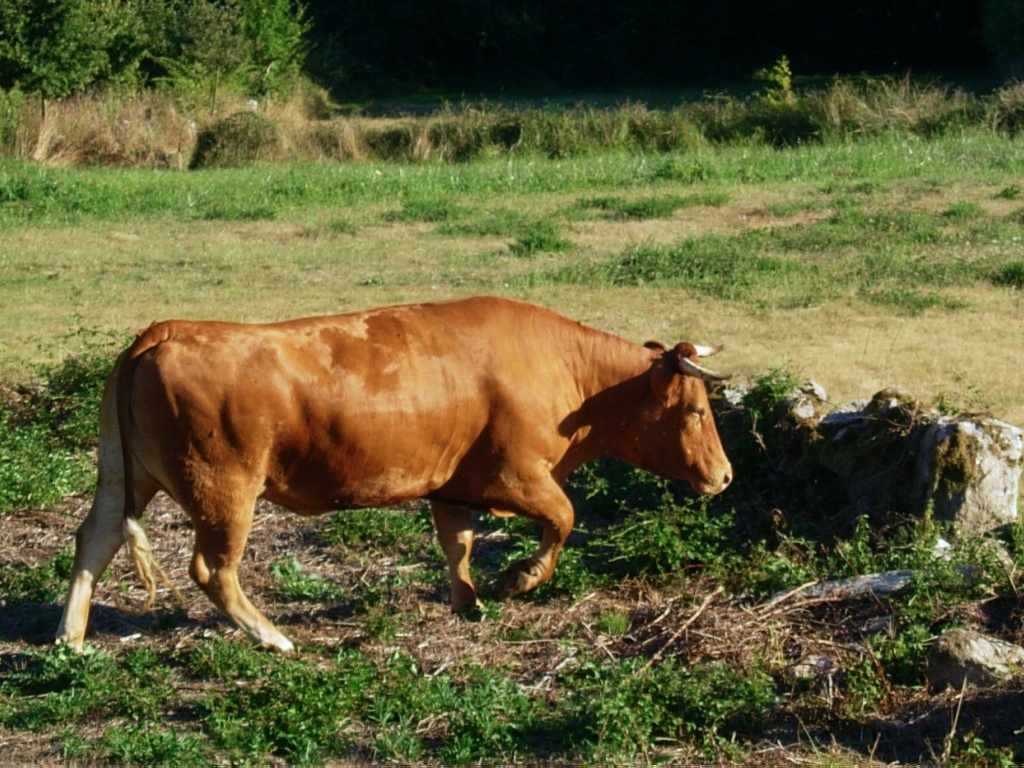
The Minhota is a European, humpless breed of Bos taurus, the cattle group without the fatty shoulder hump seen in zebu animals. It is tall: bulls reach about 145 cm at the withers, the high ridge between the shoulder blades, and cows about 140 cm, so a grown cow counts as a large animal. Her build is that of a meat animal, shaped by generations of beef keeping, though milk and pulling work were once part of her duties as well. Two names travel with the breed, Minhota and Galega, both long in use; Minhota is the official one today.
Where does the Minhota come from?
This breed takes its name from Minho, the old province in Portugal's north-west where it was formed, and above all from the far north of that province, the area now run from Viana do Castelo. For generations people used Minhota and Galega side by side, sometimes one, sometimes the other, sometimes both at once. It was once the common cattle of Minho: in the mid-1800s the count stood near 65,000 animals, roughly half of all cattle in the province. Numbers then slid, reaching about 9,500 by 1940. Official recognition came in 1996 under the name Galega, and in 2002 the official name became Minhota, to stop mix-ups with the Rubia Gallega of Galicia, the Spanish region just across the border.
How the Minhota is bred and kept
Formal recognition arrived in 1996, when the breed was listed as the Galega, and a breeders' association for it was founded in the same year. The herd-book, the register that records pedigrees, opened in 1997. In 2002 the official name changed from Galega to Minhota, because Galega sat too near the name of Spain's Rubia Gallega, kept just over the border in Galicia. The 2016 figures showed more than 7,000 breeding cows alongside 120 bulls. Registered stock remains concentrated near the breed's old home in the north-west of Portugal, with further animals in neighbouring northern districts.
Minhota, drawn
What the Minhota is kept for
Beef comes first for the Minhota. The breed is classed as a meat animal, and that is the purpose its keepers aim at today. Milk and work belong to its past. In earlier generations the cows were milked and the oxen, castrated males trained to pull, were put to haulage around the farm, so one animal might give meat, labour and milk over a lifetime. That triple role has narrowed to a single one, and the breed is now described with beef at the head of the list, the older duties remembered as history rather than practice.
Numbers, conservation and the herd book
The herd has seen sharp swings. From roughly 65,000 head in the mid-1800s, about half of all Minho cattle, it fell to some 9,500 by 1940, then recovered to around 13,000 by 2016, a figure that included more than 7,000 breeding cows and 120 bulls. The FAO judged the breed not at risk in 2007, but by 2021 the DAD-IS database listed it as at risk. Most animals live in the old Entre-Douro-e-Minho area, chiefly the Viana do Castelo and Braga districts, with others in the Porto and Vila Real districts further south and east.
Questions people ask about Minhota
Where do Minhota cattle come from?
They were formed in Minho, the former province in north-west Portugal, and especially in its northern part, the district around Viana do Castelo. The breed's very name comes from Minho, and its herds are still found mainly in that corner of the country.
What are Minhota cattle kept for?
Beef is the main purpose today. In the past the breed did more: the oxen pulled loads and the cows were milked, so one animal could serve meat, work and milk. Modern keepers treat it as a meat breed above all.
Why did the breed change its name from Galega?
Galega was the name used at formal recognition in 1996, but it sat uncomfortably close to Rubia Gallega, a Spanish breed from Galicia just north of the border. In 2002 the official name became Minhota, after the old home province, to keep the two apart.
How big is a Minhota?
It is a tall breed: bulls measure about 145 cm at the withers and cows about 140 cm. The withers are the ridge between the shoulder blades, the usual measuring point for a cow's height.
How many Minhota are there?
Numbers stood at about 13,000 head in 2016, with more than 7,000 breeding cows and 120 bulls. After being judged not at risk in 2007, the breed was listed as at risk in 2021, so its status is followed through the DAD-IS database.
Good reading and sources
- Minhota on WikipediaEncyclopedia
- More photos on Wikimedia CommonsPhotos and video
- Wikidata recordOpen data
The facts on this page come from the Wikipedia article "Minhota", written by its contributors and used under the CC BY-SA 4.0 licence, and from its Wikidata record (CC0). EveryCow rewrote the text in its own words, with AI assistance, and compares every page with the article to make sure no passage is copied. It may be reused under the same CC BY-SA 4.0 licence with a link back.
It may contain mistakes. Sizes, colours and customs differ from one herd, valley or breeder to the next. Folk beliefs are described as tradition, never as advice. If something is wrong, tell us. Last refreshed 2026-10-16.
More from Portugal
All the breeds of Portugal 🇵🇹 Portugal and 1 moreCachena
A small Iberian breed from northern Portugal and Galicia, kept for beef and formerly for draught work.Taurine · Beef · Docile
🇵🇹 Portugal and 1 moreCachena
A small Iberian breed from northern Portugal and Galicia, kept for beef and formerly for draught work.Taurine · Beef · Docile
 🇵🇹 PortugalAlentejana
A rustic, gentle meat breed from Portugal's Alentejo region, once used for field workTaurine · Beef · Docile
🇵🇹 PortugalAlentejana
A rustic, gentle meat breed from Portugal's Alentejo region, once used for field workTaurine · Beef · Docile
 🇵🇹 PortugalMertolenga
A southern Portuguese beef breed from Mértola, once a draught ox in the rice fieldsTaurine · Beef
🇵🇹 PortugalAlgarvia
A red or chestnut triple-purpose breed from the Algarve, rebuilt from survivorsTaurine · Dairy
🇵🇹 PortugalMertolenga
A southern Portuguese beef breed from Mértola, once a draught ox in the rice fieldsTaurine · Beef
🇵🇹 PortugalAlgarvia
A red or chestnut triple-purpose breed from the Algarve, rebuilt from survivorsTaurine · Dairy
Its cousins elsewhere
All beef breeds 🇮🇳 India and 4 moreGayal
A semi-domesticated bovine of the Eastern Himalayas, kept for meat, milk and ceremonyMithun · Beef
🇮🇳 India and 4 moreGayal
A semi-domesticated bovine of the Eastern Himalayas, kept for meat, milk and ceremonyMithun · Beef
 🇮🇩 Indonesia and 5 moreBantengbanṭéng (Javanese/Sundanese)
A wild Southeast Asian ox; its tame form, Bali cattle, runs feral in northern AustraliaBanteng · Beef · Drought-hardy
🇮🇩 Indonesia and 5 moreBantengbanṭéng (Javanese/Sundanese)
A wild Southeast Asian ox; its tame form, Bali cattle, runs feral in northern AustraliaBanteng · Beef · Drought-hardy
 🇮🇩 Indonesia and 4 moreBali cattle
A small humped breed from Indonesia, descended from wild banteng, kept for meat and plowing.Banteng · Beef · Disease-resistant
🇮🇩 Indonesia and 4 moreBali cattle
A small humped breed from Indonesia, descended from wild banteng, kept for meat and plowing.Banteng · Beef · Disease-resistant
 🇵🇰 Pakistan and 5 moreZebu
Humped, heat-tolerant cattle of South Asia, kept for milk, meat, work and ridingZebu · Dairy · Heat-tolerant
🇵🇰 Pakistan and 5 moreZebu
Humped, heat-tolerant cattle of South Asia, kept for milk, meat, work and ridingZebu · Dairy · Heat-tolerant