
Banteng
In its own language: banṭéng (Javanese/Sundanese)
A wild Southeast Asian ox; its tame form, Bali cattle, runs feral in northern Australia
The banteng is a wild bovine of Southeast Asian forests, closely related to cattle and also kept in tame form as Bali cattle. Bulls turn dark brown to black while cows stay light brown or chestnut red; the animals are raised mainly for meat and, less often, for work.
- Bulls darken to near black with age; cows keep a light brown or chestnut red coat
- Tame Bali cattle run feral in Sabah and Australia's Northern Territory
- A banteng clone was the second ever made from an endangered species, and the first to live on
- Wild cows can go days without drinking during a drought
- Gestation runs close to 285 days, about a week more than in taurine cattle
What do Banteng cattle look like?
A banteng has the general shape of ordinary cattle, but the two sexes differ so sharply they can look like separate animals. Bulls grow dark brown, turning nearly black with age, thickset and tall, while cows stay slim in a light brown to chestnut red coat. Both share a white rump patch, whitish legs below the knee and a pale face set off by a black muzzle; females and young also carry a dark stripe along the spine. A bull's shoulders ride high because his chest vertebrae grow unusually long, so his back rises like a hump. His horns are long, slim and smooth, sweeping up and a little forward; a cow's are shorter and curl in at the tips. Wild cows stand about 1.4 m at the shoulder and can weigh 670 kg; farm animals are far lighter.
Where does the Banteng come from?
The German naturalist Eduard d'Alton named the species in 1823 from a male and a female skull sent home from Java. The word banteng is the Javanese and Sundanese banṭéng. Early scholars squabbled over the pair of skulls: an 1830 name, Bos leucoprymnus, appears to rest on a wild-tame cross, while an 1845 revision called them Bos sondaicus and, in a mistake repeated by later writers, took the female for a young male. Fossils from Middle Pleistocene deposits in Thailand show the animal lived alongside gaur, Stegodon and wild water buffalo. Today three or four subspecies are accepted: Javan, Indochinese or Burma, Bornean, and the domestic Bali cattle. A 2015 genetic study found the Bornean form so distant from taurine and zebu cattle that it might count as a species in its own right.
What the Banteng is known for
Banteng shun people and are hard to approach in the wild, staying alert in herds of two to forty animals led by a single bull, while aged males wander in twos or threes. They are busy both day and night, more so at night where humans come and go, and rest and hide in thick forest. Cows and calves move briskly and slip through tangled growth with ease. Smell and hearing are sharp: scent warns of tigers and dholes, the Asian wild dogs that hunt adults, and keeps the herd in touch. Tame banteng are nervous creatures that fret under rough handling and need calm, careful stockmanship.
How the Banteng is bred and kept
Banteng breed all year in captivity and in Myanmar, but on the Cobourg Peninsula mating crowds into October and November, and in Thailand it peaks in May and June. A cow carries one calf for close to 285 days, roughly a week longer than taurine cattle. Bull calves weigh 16 to 17 kg at birth, heifers 14 to 15 kg, and the young may nurse for up to sixteen months. Domestic females can be fertile from thirteen months old; wild females mature at two to four years and males at three to four, bulls filling out fully at five or six. Losses among young calves run high in the first six months, then fall away quickly as the animals grow. Banteng can reach twenty-six years of age.
Banteng, drawn
What the Banteng is kept for
Where people keep banteng, they keep them chiefly for beef. The meat of the tame Bali cattle is much sought after, and this demand accounts for most keeping of the animal, whether on Bali itself, across the eastern Indonesian islands of Sulawesi, Sumbawa and Sumba, or in Malaysia, New Guinea and Australia. Work comes second: banteng do serve as draught animals, pulling and carrying where oxen are wanted, but far fewer are worked. Wild herds are another matter altogether; those in Java, Cambodia, Kalimantan and Thailand survive as protected wildlife rather than stock, and the feral groups of Sabah and Australia's Northern Territory live untended, descended from escaped or turned-out domestic animals.
The land and climate of the Banteng
Banteng manage on a wide spread of country: open deciduous woodland, semi-evergreen forest, woods on lower mountain slopes, grassland and even farms gone fallow. They graze mostly by night in open ground, pausing every two or three hours to chew the cud, and climb to higher forest when the rains come. Their food is grass, sedges, young shoots, leaves, flowers and fruit, with bamboo and tree bark turning up in droppings studied in Sabah. Drought bothers them less than it would most stock: they can go days without drinking, though they take water freely when pools are about. They seek out salt licks, and where none exist they have learned to drink sea water, even browsing seaweed in northern Australia.
At a glance: where it belongs
Land and climate
Celebrations


Keeping Banteng cattle
Tame banteng startle readily, so gentle, unhurried handling matters more than with ordinary cattle. Breeding performance is nonetheless good: conception rates of 80 to 90 per cent have been recorded in northern Australia. Cows nurse their young for many months, sometimes until the next calf arrives. Wild instincts linger in the tame ones too; they stay watchful and do best in calm, quiet surroundings rather than busy yards.
Numbers, conservation and the herd book
The wild banteng is in deep trouble: the IUCN Red List gives it the most severe of its ratings, critically endangered, and numbers have more than halved over recent decades. Hunters take animals for meat, sport, horns and supposed medicine, while farms and settlements chop the forest into ever smaller pieces; disease adds further pressure. Every country within its range grants the animal legal protection, and most surviving herds are crowded into reserves, Cambodia possibly excepted. The strongest wild populations remain on Java and in Cambodia, with sizeable numbers likely too in East and North Kalimantan and in Thailand. A banteng clone made history as the second created from an endangered species and the first to live past infancy.
Questions people ask about Banteng
Where does the banteng come from?
It is native to Southeast Asia. The biggest wild herds are on Java and in Cambodia, with likely strong numbers in parts of Kalimantan and Thailand. Its tame form, Bali cattle, is spread through Bali and the eastern Indonesian islands and runs feral in northern Australia.
What are banteng kept for?
Mainly meat: the beef of domestic Bali cattle is in high demand wherever the animals are raised. They also serve as draught animals, though less often. Wild banteng are not kept at all; they are protected wildlife in every country of their range.
How can you tell a banteng bull from a cow?
The difference is striking. Adult bulls are dark brown to black, taller and heavier, while cows are slim, light brown or chestnut red, with a dark line down the spine. Both sexes have a white rump patch and horns, but a bull's are longer and sweep upward.
Are banteng endangered?
Yes, the wild form is in serious trouble. The IUCN gives it its most severe rating, critically endangered, and numbers have more than halved in recent decades through poaching, shrinking and broken-up habitat, and disease. Every range country protects it by law; domestic Bali cattle, though, remain widespread.
What do banteng eat?
They graze and browse, taking grasses and sedges, plus shoots, leaves, flowers and fruit, mostly at night in open ground. They visit salt licks when these exist, and where none are found they can drink sea water; animals in northern Australia have even been seen eating seaweed.
Good reading and sources
- Encyclopaedia BritannicaArticle
- The increasingly realistic prospect of ‘extinct animal’ zoosBBC, Article
- Livestock report 2006FAO, Article
- Banteng on WikipediaEncyclopedia
- More photos on Wikimedia CommonsPhotos and video
- Wikidata recordOpen data
The facts on this page come from the Wikipedia article "Banteng", written by its contributors and used under the CC BY-SA 4.0 licence, and from its Wikidata record (CC0). EveryCow rewrote the text in its own words, with AI assistance, and compares every page with the article to make sure no passage is copied. It may be reused under the same CC BY-SA 4.0 licence with a link back.
It may contain mistakes. Sizes, colours and customs differ from one herd, valley or breeder to the next. Folk beliefs are described as tradition, never as advice. If something is wrong, tell us. Last refreshed 2026-10-16.
More from Indonesia
All the breeds of Indonesia 🇮🇩 Indonesia and 4 moreBali cattle
A small humped breed from Indonesia, descended from wild banteng, kept for meat and plowing.Banteng · Beef · Disease-resistant
🇮🇩 Indonesia and 4 moreBali cattle
A small humped breed from Indonesia, descended from wild banteng, kept for meat and plowing.Banteng · Beef · Disease-resistant
 🇮🇩 IndonesiaMaduraSapi madura
A small reddish-brown Indonesian hybrid of zebu and banteng, raced with a sledZebu · Sport · Quick and strong
🇮🇩 IndonesiaMaduraSapi madura
A small reddish-brown Indonesian hybrid of zebu and banteng, raced with a sledZebu · Sport · Quick and strong
Its cousins elsewhere
All beef breeds 🇺🇸 United StatesTexas Longhorn
American beef cattle, once feral on Texas ranges, with horn spreads beyond 2.4 mTaurine · Beef · Heat-tolerant
🇺🇸 United StatesTexas Longhorn
American beef cattle, once feral on Texas ranges, with horn spreads beyond 2.4 mTaurine · Beef · Heat-tolerant
 🇮🇳 IndiaKhillari
A draft breed from Maharashtra and Karnataka, compact with sweeping horns and grey-white coats.Zebu · Draught · Heat-tolerant
🇮🇳 IndiaKhillari
A draft breed from Maharashtra and Karnataka, compact with sweeping horns and grey-white coats.Zebu · Draught · Heat-tolerant
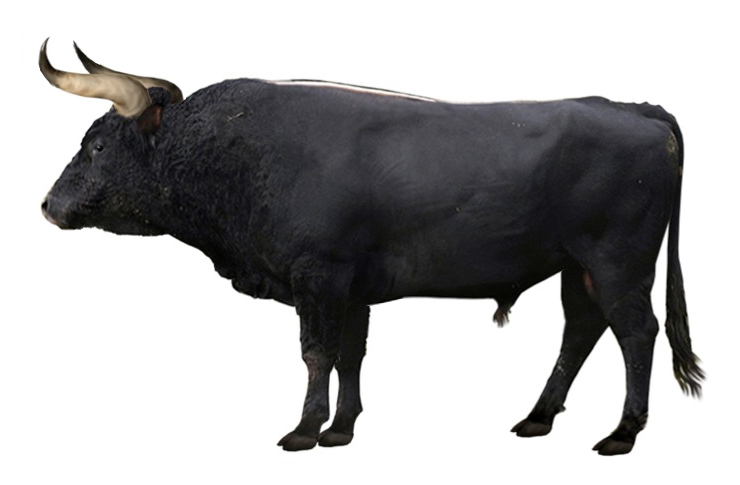 🇵🇱 Poland and 5 moreAurochs
The wild ancestor of all domestic cattle, extinct since 1627Wild · Long-horned
🇵🇱 Poland and 5 moreAurochs
The wild ancestor of all domestic cattle, extinct since 1627Wild · Long-horned
 🇲🇳 Mongolia and 4 moreYakགཡག་
A shaggy, cold-hardy highland bovine kept across the Himalayas and Tibetan PlateauYak · Triple-purpose · Cold-hardy
🇲🇳 Mongolia and 4 moreYakགཡག་
A shaggy, cold-hardy highland bovine kept across the Himalayas and Tibetan PlateauYak · Triple-purpose · Cold-hardy