Dung, hide and horn
Bone china
White, translucent porcelain made with ash of cattle bone, developed in Staffordshire around 1800.
Bone china is a porcelain made with bone ash, china clay and china stone. The bone ash, from cattle bones, makes it white, strong and translucent when held to the light, and allows it to be fired at a lower temperature than hard porcelain. It was developed in England in the late eighteenth century and became the standard for fine English tableware.
What goes in
- Cattle bone ash545%, Gives whiteness and translucency.
- China clay327%, Kaolin from Cornwall.
- China stone327%, Feldspathic rock.
Rough parts by weight. The ring shows each input's share of the product.
Made step by step
Each drawing shows the operation for that step. Quantities and timings differ from house to house and herd to herd; this is one traditional way, in outline.
Step 1: Cook Clean cattle bones and heat them to burn off all organic matter. Step 2: Shape Grind the calcined bone to a fine ash. Step 3: Shape Mix the ash with china clay, china stone and water. Step 4: Dry Cast or throw the pieces and dry them. Step 5: Cook Fire, glaze and fire again. Finished Bone china, by share.
Staffordshire
English potters were trying to match Chinese porcelain through the eighteenth century, and bone ash was used in some early experiments. Josiah Spode in Stoke-on-Trent is usually credited with the standard recipe by about 1800. The Potteries of Staffordshire, close to coal and with clay brought in by canal, became the centre of the trade.
The bone
Cattle bones, a by-product of the meat trade, are cleaned, heated to remove all organic matter and ground to a fine white ash, which is mixed with the clays. British standards require at least thirty per cent bone ash in ware sold as bone china. Some modern makers use substitutes and sell it under other names.
Where it is used
The breeds behind it


More on EveryCow
No breeds here yet. New pages are added every day.
Sources and further reading
Original text and drawings by the EveryCow desk, written with AI assistance and checked against the sources above. The shares are a rough, illustrative ratio, not a recipe: every family and dairy makes it differently. If we have something wrong, tell us.
Photo credits on this page
The small pictures above come from Wikimedia Commons under free licences. Some are cropped to fit.
- Hereford: Hayden Soloviev, CC BY 4.0, source
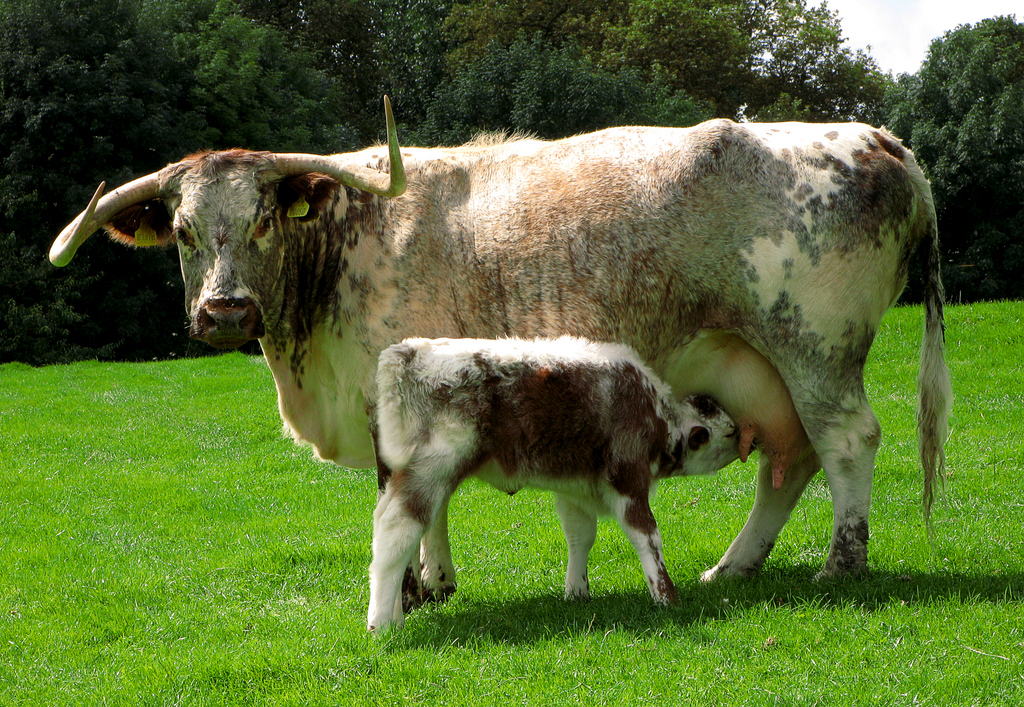
- English Longhorn: Dave, CC BY-SA 2.0, source
- Shorthorn: Unknown author, CC BY-SA 2.0, source