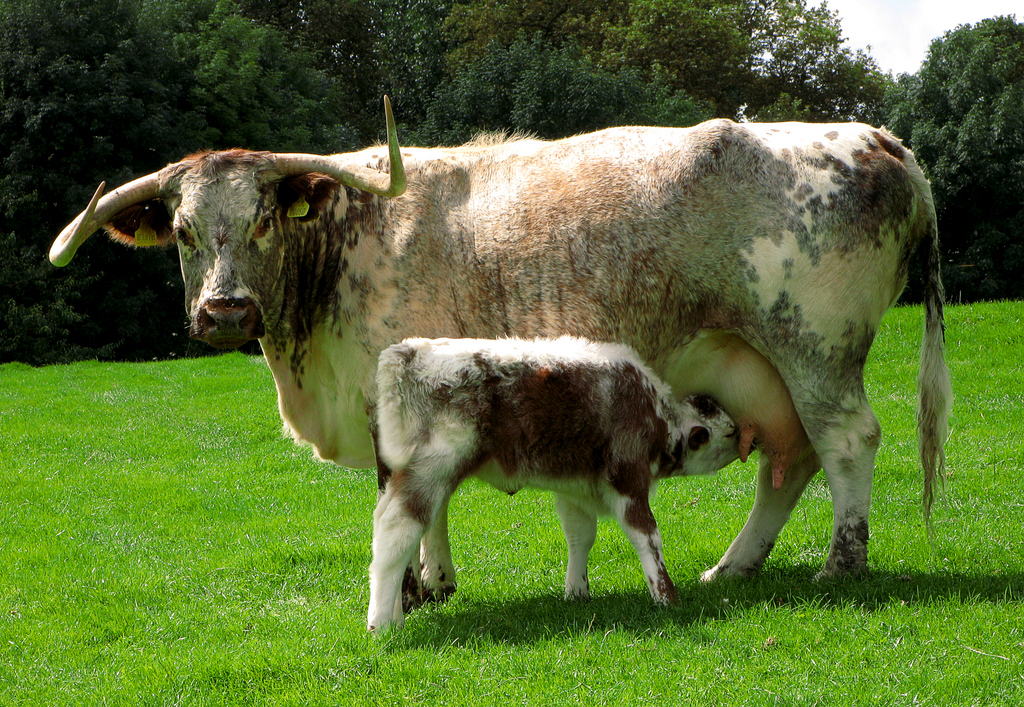
English Longhorn
A large horned beef breed from northern England, marked by a white line along the spine
A big British beef breed from northern England, known for long, curving horns and a white stripe down the spine. Once a plough ox and a Cheshire cheese cow, it now works mainly as a meat animal and a conservation grazer.
- Robert Bakewell improved the breed at Dishley in Leicestershire during the 1700s
- A white stripe runs down the spine, tail and belly of every animal
- The breed society and its herd-book both began in 1878
- Mature bulls usually weigh 750 to 900 kg, the heaviest over 1,000 kg
- Herds graze nature parks and Sites of Special Scientific Interest today
What do English Longhorn cattle look like?
This is a large British beef animal with a bold head of horns. Bulls stand about 150 cm at the withers, the ridge between the shoulder blades, and usually weigh 750 to 900 kg, with the heaviest passing a full tonne. Cows are markedly smaller at roughly 130 to 140 cm and 500 to 600 kg. Coats differ from beast to beast, in shades of red, brown or grey mixed with white, yet one marking never varies: a broad white stripe runs the length of the back, carries down the tail and continues under the belly. Fanciers call this finched. The horns are long and curve as they grow. Apart from size, cows and bulls look much alike.
Where does the English Longhorn come from?
The breed grew up in the north of England, above all in northern Lancashire, southern Westmorland and Yorkshire's Craven district in the old West Riding. From those hills keepers carried it to the English Midlands and over the sea to Ireland. Its great moment came in the eighteenth century, when Robert Bakewell, a Leicestershire improver working at Dishley, began pairing his cattle deliberately, generation after generation, to sharpen the type. His strain, remembered as the Dishley Longhorn, succeeded so well that for a while it led all British livestock. Once Bakewell died in 1795 the tide turned, the Shorthorn took the top place, and numbers and quality sank through the 1800s and much of the 1900s.
What the English Longhorn is known for
Two marks make the breed easy to spot in a field: the long, curving horns and the white line along the spine. As workers these were heavy, unhurried oxen rather than quick ones, valued for steady pull at the plough. The cows never gave much milk, yet theirs was so fatty that cheesemakers sought it out. In its heyday this was a complete farm animal, expected to labour in the field, give cream for the dairy and end its days as meat.
How the English Longhorn is bred and kept
The Longhorn Cattle Society looks after the breed and issues a written standard setting out what members should aim for. Its herd-book, the register in which pedigree animals are entered, began in 1878, the year the society started. Bakewell's eighteenth-century work remains the founding chapter of the breed's improvement: by deciding which bulls would sire which cows, he turned a regional ploughing type into a national leader. After the long decline that followed, the society and its records now give keepers a fixed reference point when they plan matings.
English Longhorn, drawn
What the English Longhorn is kept for
For most of its history this was a draught animal, one worked in harness: oxen hauled ploughs, slow but powerful. The milk flowed sparingly, yet it was fatty enough that from the eighteenth century it went into cheesemaking, in Cheshire above all. When an ox's working days were over, it was fattened and sent off to slaughter. Today the balance has shifted. Beef is the main product, and the cattle have taken on a new role in conservation, grazing nature parks and Sites of Special Scientific Interest, the protected wildlife sites of Britain, where their keeping of plant growth helps wildlife.
At a glance: where it belongs
Celebrations


Numbers, conservation and the herd book
The Rare Breeds Survival Trust once placed the breed in the priority band of its watchlist; since 2021 it has sat in the trust's wider company of UK native breeds. Official global views differ: the FAO judged it not at risk in 2007, while DAD-IS listed it as at risk in 2021. Overseas, the cattle have travelled well beyond Britain. Australia holds a population, the Netherlands and New Zealand keep a few each, and the group once kept in Belgium has apparently died out.
From the English Longhorn
Questions people ask about English Longhorn
Where does the English Longhorn come from?
It grew up in northern England, chiefly in northern Lancashire, southern Westmorland and the Craven district of Yorkshire's West Riding. It later moved into the English Midlands and into Ireland, and from the eighteenth century Bakewell's improved Dishley strain made it briefly the leading breed of Britain.
What is the breed kept for today?
Beef comes first in the twenty-first century. The cattle also earn their keep as conservation grazers, holding back plant growth in nature parks and on Sites of Special Scientific Interest, which are protected wildlife areas in Britain. Their older jobs, pulling ploughs and supplying cheesemaking milk, belong mostly to the past.
How can I recognise an English Longhorn?
Look for long horns that curve as they grow, and for the finched pattern: a wide white line down the spine, along the tail and under the belly. The rest of the coat varies among red, brown and grey, always blended with white.
How big do they get?
Mature bulls stand close to 150 cm and usually weigh 750 to 900 kg, with the heaviest passing a tonne. Cows reach roughly 130 to 140 cm at the shoulder and 500 to 600 kg, so this is a big, heavily built beef animal.
What was the Dishley Longhorn?
That was the improved strain Robert Bakewell created at Dishley in Leicestershire during the eighteenth century. By choosing matings carefully he raised the cattle's quality so far that they briefly led British livestock keeping, though the breed lost that lead soon after his death in 1795.
Good reading and sources
- English Longhorn on WikipediaEncyclopedia
- More photos on Wikimedia CommonsPhotos and video
- Wikidata recordOpen data
The facts on this page come from the Wikipedia article "English Longhorn", written by its contributors and used under the CC BY-SA 4.0 licence, and from its Wikidata record (CC0). EveryCow rewrote the text in its own words, with AI assistance, and compares every page with the article to make sure no passage is copied. It may be reused under the same CC BY-SA 4.0 licence with a link back.
It may contain mistakes. Sizes, colours and customs differ from one herd, valley or breeder to the next. Folk beliefs are described as tradition, never as advice. If something is wrong, tell us. Last refreshed 2026-10-16.
More from the United Kingdom
All the breeds of the United Kingdom 🇳🇱 Netherlands and 3 moreHolstein Friesian
A black and white dairy breed kept worldwide, with red and white lines tooTaurine · Dairy
🇳🇱 Netherlands and 3 moreHolstein Friesian
A black and white dairy breed kept worldwide, with red and white lines tooTaurine · Dairy
 🇬🇧 United Kingdom and 5 moreHereford
A red and white beef breed from Herefordshire, England, known for its white face and hardiness.Taurine · Beef · Docile
🇬🇧 United Kingdom and 5 moreHereford
A red and white beef breed from Herefordshire, England, known for its white face and hardiness.Taurine · Beef · Docile
 🇧🇪 Belgium and 3 moreBelgian BlueBlanc-Bleu Belge / Belgisch Witblauw
A muscular beef breed from Belgium known for its blue-grey coat and double-muscling gene.Taurine · Beef · Docile
🇧🇪 Belgium and 3 moreBelgian BlueBlanc-Bleu Belge / Belgisch Witblauw
A muscular beef breed from Belgium known for its blue-grey coat and double-muscling gene.Taurine · Beef · Docile
 🇬🇧 United Kingdom and 4 moreGalloway
A polled black beef breed from south-west Scotland with a thick double coatTaurine · Beef · Cold-hardy
🇬🇧 United Kingdom and 4 moreGalloway
A polled black beef breed from south-west Scotland with a thick double coatTaurine · Beef · Cold-hardy
Its cousins elsewhere
All beef breeds 🇲🇳 Mongolia and 4 moreYakགཡག་
A shaggy, cold-hardy highland bovine kept across the Himalayas and Tibetan PlateauYak · Triple-purpose · Cold-hardy
🇲🇳 Mongolia and 4 moreYakགཡག་
A shaggy, cold-hardy highland bovine kept across the Himalayas and Tibetan PlateauYak · Triple-purpose · Cold-hardy
 🇮🇩 Indonesia and 5 moreBantengbanṭéng (Javanese/Sundanese)
A wild Southeast Asian ox; its tame form, Bali cattle, runs feral in northern AustraliaBanteng · Beef · Drought-hardy
🇮🇩 Indonesia and 5 moreBantengbanṭéng (Javanese/Sundanese)
A wild Southeast Asian ox; its tame form, Bali cattle, runs feral in northern AustraliaBanteng · Beef · Drought-hardy
 🇺🇸 United StatesTexas Longhorn
American beef cattle, once feral on Texas ranges, with horn spreads beyond 2.4 mTaurine · Beef · Heat-tolerant
🇺🇸 United StatesTexas Longhorn
American beef cattle, once feral on Texas ranges, with horn spreads beyond 2.4 mTaurine · Beef · Heat-tolerant
 🇺🇸 United StatesAnkole-Watusi
A large-horned American breed derived from African Sanga cattle, kept for its distinctive horns and hardy build.Sanga · Heritage · Long-horned
🇺🇸 United StatesAnkole-Watusi
A large-horned American breed derived from African Sanga cattle, kept for its distinctive horns and hardy build.Sanga · Heritage · Long-horned