Draught breeds
Hallikar, Amrit Mahal, Kangayam and the Podolic grey oxen: cattle for the plough and the cart.
Draught cattle pull ploughs, carts, logs and water wheels. For thousands of years oxen and bullocks were the main source of farm power in much of the world, and in much of South Asia, Africa and Southeast Asia they still do. India bred some of the finest working cattle anywhere: the fast trotting Hallikar and Amrit Mahal of Karnataka, the Kangayam of the Kongu country, the Khillari of the Deccan and the Ongole of Andhra. Europe had its own, from the grey Podolic oxen of Hungary and Italy to the Chianina of Tuscany.
What a working bullock needs
A draught animal needs a strong frame, hard feet, a good hump or withers to take the yoke, and a calm but willing temper. Speed matters for cart and road work, raw strength for heavy ploughing. Most draught cattle are castrated males, called oxen in Europe and bullocks in South Asia, trained in pairs from a young age. A well-matched pair learns its words and pace together and can work for ten years or more. In many villages a pair of good bullocks was a family's largest asset after the land.
The draught breeds of India
Indian breeders long sorted cattle into milk breeds, draught breeds and dual-purpose breeds that give some of each. The draught group is large. Hallikar is the Mysore breed of long, upright horns and quick feet, and the Amrit Mahal was developed from it by the rulers of Mysore to haul army transport. Kangayam bullocks from Tamil Nadu are compact and strong, Umblachery work the wet paddy of the Kaveri delta, Khillari and Nagori are known for trotting, and Ongole for sheer power.
Europe and the Podolic grey cattle
Across southern and eastern Europe, long-horned grey cattle of the Podolic type did the farm and road work for centuries. The Hungarian Grey was walked in great droves to the markets of Vienna and southern Germany. In Italy, the Chianina, Marchigiana, Maremmana and Romagnola pulled ploughs and wagons until tractors arrived after the Second World War, and were then turned to beef. Spain, Portugal and the Balkans kept similar working breeds, and some are now rare.
Work today
Tractors replaced oxen across Europe and North America in the twentieth century, and the number of working bullocks in India has fallen sharply in recent decades. Yet animal traction still matters on small farms in Ethiopia, the Sahel, Myanmar, Cambodia and parts of India, where a pair of oxen costs less than a machine and breeds its own replacements. Draught breeds also live on in contests, cart races and ploughing matches, and in conservation herds that keep the old working lines alive.
Worth knowing
- Hallikar: Karnataka draught breed with long upright horns, known for speed
- Amrit Mahal: Mysore breed developed for army transport
- Kangayam: Strong, compact working cattle of the Kongu region of Tamil Nadu
- Khillari: Grey-white trotting bullocks of Maharashtra and Karnataka
- Ongole: Large, powerful bullocks of Andhra Pradesh
- Umblachery: Draught cattle of the wet paddy fields of the Kaveri delta
- Hungarian Grey: Long-horned Podolic ox of the Hungarian plain
- Chianina: Very tall white Tuscan breed, once a plough ox
Good to know
- A yoke must fit the neck or hump of the animal; a poorly fitted yoke causes sores and loses pulling power.
- Working animals need rest in the heat of the day and water at every break.
- Hooves wear on hard roads; many working cattle in India are shod with iron plates.
Sources and further reading
- Ox on Wikipedia
- Working animal, Wikipedia
- Hallikar, Wikipedia
- Amrit Mahal, Wikipedia
- Hungarian Grey, Wikipedia
Original text by the EveryCow desk, written with AI assistance and checked against the sources above. Customs are described as tradition, not as advice. If we have something wrong, tell us.
Draught on EveryCow
The breeds written up so far, best known first.
 🇵🇰 Pakistan and 5 moreZebu
Humped, heat-tolerant cattle of South Asia, kept for milk, meat, work and ridingZebu · Dairy · Heat-tolerant
🇵🇰 Pakistan and 5 moreZebu
Humped, heat-tolerant cattle of South Asia, kept for milk, meat, work and ridingZebu · Dairy · Heat-tolerant
 🇮🇹 Italy and 5 moreChianina
A massive white Italian breed known for beef production and historic draught work in Tuscany.Taurine · Beef · Heat-tolerant
🇮🇹 Italy and 5 moreChianina
A massive white Italian breed known for beef production and historic draught work in Tuscany.Taurine · Beef · Heat-tolerant
 🇵🇰 Pakistan and 4 moreSahiwal
A heat-tolerant zebu from the Punjab, kept for milk, meat and draught workZebu · Dairy · Heat-tolerant
🇵🇰 Pakistan and 4 moreSahiwal
A heat-tolerant zebu from the Punjab, kept for milk, meat and draught workZebu · Dairy · Heat-tolerant
 🇿🇦 South Africa and 2 moreAfrikaner
A Sanga-type breed from South Africa, deep red with long horns, kept for beef and draught work.Sanga · Beef · Heat-tolerant
🇿🇦 South Africa and 2 moreAfrikaner
A Sanga-type breed from South Africa, deep red with long horns, kept for beef and draught work.Sanga · Beef · Heat-tolerant
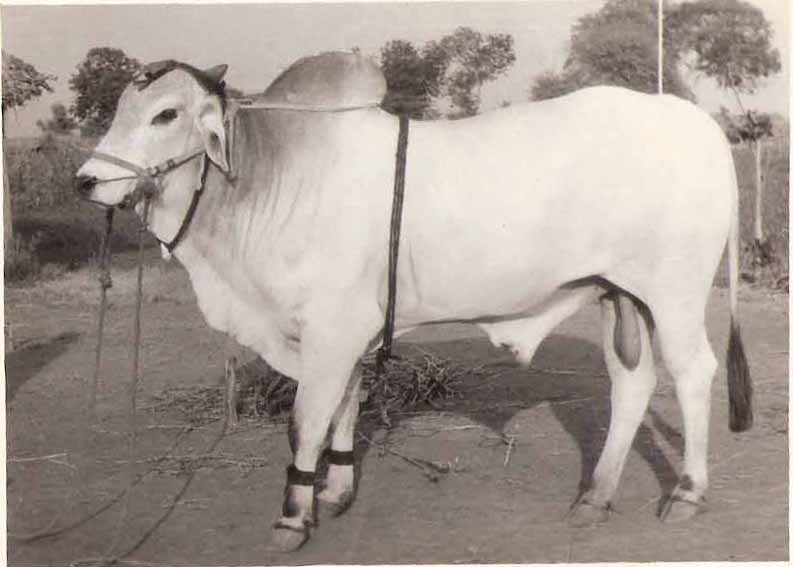 🇮🇳 India and 5 moreOngole
A short-horned zebu breed from Andhra Pradesh, white with dark markings, used for work and milk.Zebu · Draught · Heat-tolerant
🇮🇳 India and 5 moreOngole
A short-horned zebu breed from Andhra Pradesh, white with dark markings, used for work and milk.Zebu · Draught · Heat-tolerant
 🇮🇳 IndiaKhillari
A draft breed from Maharashtra and Karnataka, compact with sweeping horns and grey-white coats.Zebu · Draught · Heat-tolerant
🇮🇳 IndiaKhillari
A draft breed from Maharashtra and Karnataka, compact with sweeping horns and grey-white coats.Zebu · Draught · Heat-tolerant
 🇮🇳 India and 2 moreKankrej
A grey zebu from the dry Rann of Kutch, kept for milk and for work oxenZebu · Dual-purpose · Heat-tolerant
🇮🇳 India and 2 moreKankrej
A grey zebu from the dry Rann of Kutch, kept for milk and for work oxenZebu · Dual-purpose · Heat-tolerant
 🇵🇹 Portugal and 1 moreCachena
A small Iberian breed from northern Portugal and Galicia, kept for beef and formerly for draught work.Taurine · Beef · Docile
🇵🇹 Portugal and 1 moreCachena
A small Iberian breed from northern Portugal and Galicia, kept for beef and formerly for draught work.Taurine · Beef · Docile
 🇫🇷 FranceMirandaise
A large, heat-tolerant draught breed from the Gers, now raised for vealTaurine · Draught · Heat-tolerant
🇫🇷 FranceMirandaise
A large, heat-tolerant draught breed from the Gers, now raised for vealTaurine · Draught · Heat-tolerant
 🇮🇳 IndiaJavariಜವಾರಿ
A medium-built dual-purpose zebu from Kalyana-Karnataka, gentle and heat-tolerantZebu · Dairy · Heat-tolerant
🇮🇳 IndiaJavariಜವಾರಿ
A medium-built dual-purpose zebu from Kalyana-Karnataka, gentle and heat-tolerantZebu · Dairy · Heat-tolerant
Photo credits on this page
The small pictures above come from Wikimedia Commons under free licences. Some are cropped to fit.
- Kankrej: Pavanaja, CC BY-SA 3.0, source
- Cachena: Rosino, CC BY-SA 2.0, source
- Mirandaise: PANDA 81, CC0, source
- Khillari: Pavanaja, CC BY-SA 3.0, source
- Chianina: Monica, CC BY 2.0, source
- Sahiwal: Harvinder Chandigarh, CC BY-SA 4.0, source
- Afrikaner: Amada44, Public domain, source
- Ongole: DMR Sekhar, CC BY-SA 3.0, source
- Zebu: A. J. T. Johnsingh, WWF-India and NCF, CC BY-SA 4.0, source
- Javari: Pavanaja, CC BY-SA 3.0, source