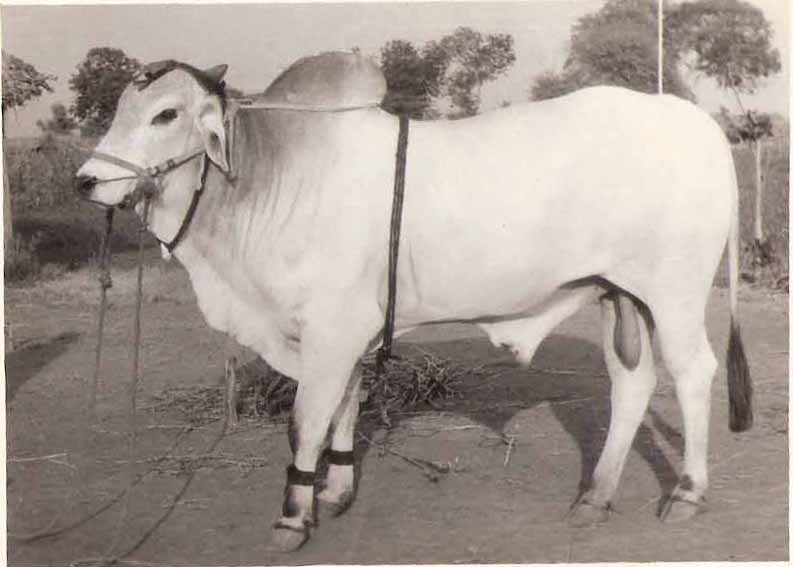
Ongole
A short-horned zebu breed from Andhra Pradesh, white with dark markings, used for work and milk.
The Ongole is a traditional Indian zebu cattle breed originating in the Prakasam District of Andhra Pradesh. It is kept primarily for draught work and dairy production, valued for its strength and heat tolerance.
- Short, thick horns distinguish this zebu breed.
- White coat often marked with black on legs and head.
- Bulls can reach 570 kg in weight.
- Milk yield ranges from 407 to 778 kg per lactation.
- Record cow sold for $4.82 million in Brazil.
What do Ongole cattle look like?
The Ongole is a zebu breed from south-east India, distinguished by its short, thick horns and prominent hump. Cows typically stand around 130 cm tall and weigh roughly 268 kg, while bulls are larger, reaching about 150 cm and 570 kg. The coat is mostly white or light grey, often marked with black on the head, neck, hump, and feet. Males may also show grey shading on the forequarters. Red or red-and-white individuals occur but are less common. The breed belongs to the southernmost group of short-horned zebu cattle.
Where does the Ongole come from?
This breed comes from what is now the Prakasam District in Andhra Pradesh, named after the city of Ongole. Because the area was once part of Nellore District, it was historically called the Nellore. A cattle show began in Addanki in 1858 and ran until 1872, reviving later in Guntur in 1997. The Indian Ongole Cattle Breeders' Association was established in 1981 to support the lineage.
What the Ongole is known for
Ongole cattle are well suited to tropical climates and show resistance to insect-borne diseases. They are strong draft animals capable of heavy work, though they move slowly. Bulls have been sold for record prices abroad, including a cow fetching $4.82 million in Brazil in 2024. The breed is known for its hardiness and adaptability in hot conditions.
How the Ongole is bred and kept
The breed society formed in 1981 helps maintain standards. Stock has been exported widely, influencing breeds like the American Brahman and Nelore. In the Philippines, local sub-breeds such as the Peranakan Ongole and Sumba Ongole developed from these exports. Selection focuses on maintaining the characteristic short horns and tropical resilience.
Ongole, drawn
What the Ongole is kept for
Primarily bred for draught work in agriculture and transport, providing powerful but slow oxen. Cows are also kept for milk, yielding between 407 and 778 kg per lactation, with fat content ranging from 3% to 5%. Milk yields have decreased compared to mid-twentieth century figures, which were higher.
The land and climate of the Ongole
Suited to tropical environments, the Ongole thrives in the heat of south-east India. Its resistance to insect-borne diseases makes it ideal for regions where pests are prevalent. The breed copes well with the climate of its origin and similar tropical zones abroad.
Who keeps the Ongole
The breed is traditionally kept by farmers in Andhra Pradesh for agricultural labour. Export history shows adoption by herders in Brazil, the United States, Sri Lanka, Cuba, Indonesia, Fiji, and the Philippines. These communities value the animal for both field work and dairy production.
At a glance: where it belongs
Land and climate
Celebrations

![Ongole Bull of Moses after winning the Andhra Prdesh State Award in 1988 with Sri NT Rama Rao [green turban] the then Chief Minister of Andhra Pradesh and Sri Balaram Jhakar [red turban] the then Agricultural Minister, G](https://upload.wikimedia.org/wikipedia/commons/f/f4/Bull_of_Moses_with_Balram_Jhakad_and_NT_Rama_Rao.jpg)


Faith and ritual
The mascot for the 2002 National Games of India featured a bull figure representing this breed, highlighting its cultural significance.
The Ongole at fairs and festivals
Annual cattle shows were held in Addanki from 1858 to 1872, and revived later in Guntur. These fairs celebrate the breed's qualities. High-profile auctions, such as the 2024 sale in Brazil, also serve as notable events showcasing the breed's value.
Custom and folk tradition
Historical records note the long-standing tradition of cattle shows in the region. The breed's name change from Nellore to Ongole reflects administrative shifts. Local lore includes the use of the bull as a national symbol, linking the animal to broader cultural narratives.
Keeping Ongole cattle
Feeding and handling rely on traditional methods suited to tropical grazing. Calving and health management benefit from the breed's natural disease resistance. No specific modern housing requirements are detailed beyond general adaptation to local conditions.
Numbers, conservation and the herd book
Millions exist in Brazil, with significant populations in India, Cuba, and the Philippines. FAO status lists the breed as not at risk. Export data indicates ongoing international presence, though exact global numbers vary by region.
From the Ongole
Questions people ask about Ongole
Where does the Ongole breed come from?
It originates in the Prakasam District of Andhra Pradesh, India, named after the city of Ongole. It was previously known as Nellore due to earlier district boundaries.
What is the Ongole cattle kept for?
It is primarily used for draught work in agriculture and transport. Cows are also kept for dairy production, providing milk with 3-5% fat content.
How large do Ongole cattle get?
Cows average 130 cm height and 268 kg weight. Bulls are larger, standing about 150 cm tall and weighing approximately 570 kg.
Is the Ongole breed endangered?
No, the FAO lists it as not at risk. It has many millions in Brazil and established herds in India, Cuba, and the Philippines.
What colours do Ongole cattle have?
They are predominantly white or light grey. Some have red coats or red-and-white patterns, with males sometimes showing grey markings on the forequarters.
Good reading and sources
- ‘The world’s most expensive cattle’: Booming in Brazil, dwindling in IndiaThe Indian Express, Article
- For sheer love of the majestic bullThe Hindu, Article
- Ongole cattle on WikipediaEncyclopedia
- More photos on Wikimedia CommonsPhotos and video
- Wikidata recordOpen data
The facts on this page come from the Wikipedia article "Ongole cattle", written by its contributors and used under the CC BY-SA 4.0 licence, and from its Wikidata record (CC0). EveryCow rewrote the text in its own words, with AI assistance, and compares every page with the article to make sure no passage is copied. It may be reused under the same CC BY-SA 4.0 licence with a link back.
It may contain mistakes. Sizes, colours and customs differ from one herd, valley or breeder to the next. Folk beliefs are described as tradition, never as advice. If something is wrong, tell us. Last refreshed 2026-10-16.
More from India
All the breeds of India 🇵🇰 Pakistan and 5 moreZebu
Humped, heat-tolerant cattle of South Asia, kept for milk, meat, work and ridingZebu · Dairy · Heat-tolerant
🇵🇰 Pakistan and 5 moreZebu
Humped, heat-tolerant cattle of South Asia, kept for milk, meat, work and ridingZebu · Dairy · Heat-tolerant
 🇮🇳 India and 4 moreGayal
A semi-domesticated bovine of the Eastern Himalayas, kept for meat, milk and ceremonyMithun · Beef
🇮🇳 India and 4 moreGayal
A semi-domesticated bovine of the Eastern Himalayas, kept for meat, milk and ceremonyMithun · Beef
 🇵🇰 Pakistan and 4 moreSahiwal
A heat-tolerant zebu from the Punjab, kept for milk, meat and draught workZebu · Dairy · Heat-tolerant
🇵🇰 Pakistan and 4 moreSahiwal
A heat-tolerant zebu from the Punjab, kept for milk, meat and draught workZebu · Dairy · Heat-tolerant
 🇮🇳 India and 1 moreGir
A humped dairy breed from Gujarat, red and white with long drooping ears and a domed foreheadZebu · Dairy · Heat-tolerant
🇮🇳 India and 1 moreGir
A humped dairy breed from Gujarat, red and white with long drooping ears and a domed foreheadZebu · Dairy · Heat-tolerant
Its cousins elsewhere
All draught breeds 🇺🇸 United States and 5 moreBrahman
An American beef breed with a hump and grey or red coat, bred from Indian zebu cattleComposite · Beef · Heat-tolerant
🇺🇸 United States and 5 moreBrahman
An American beef breed with a hump and grey or red coat, bred from Indian zebu cattleComposite · Beef · Heat-tolerant
 🇺🇸 United StatesTexas Longhorn
American beef cattle, once feral on Texas ranges, with horn spreads beyond 2.4 mTaurine · Beef · Heat-tolerant
🇺🇸 United StatesTexas Longhorn
American beef cattle, once feral on Texas ranges, with horn spreads beyond 2.4 mTaurine · Beef · Heat-tolerant
 🇮🇹 Italy and 5 moreChianina
A massive white Italian breed known for beef production and historic draught work in Tuscany.Taurine · Beef · Heat-tolerant
🇮🇹 Italy and 5 moreChianina
A massive white Italian breed known for beef production and historic draught work in Tuscany.Taurine · Beef · Heat-tolerant
 🇮🇳 India and 3 moreNelore
A large humped beef breed from India, now dominant in Brazil and known for heat tolerance and parasite resistance.Zebu · Beef · Heat-tolerant
🇮🇳 India and 3 moreNelore
A large humped beef breed from India, now dominant in Brazil and known for heat tolerance and parasite resistance.Zebu · Beef · Heat-tolerant