
Khillari
A draft breed from Maharashtra and Karnataka, compact with sweeping horns and grey-white coats.
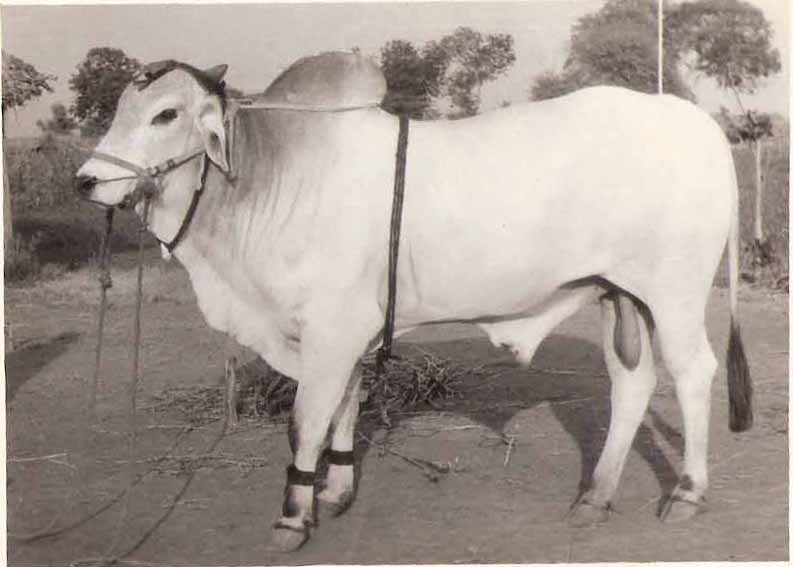
The Khillari is a zebu breed native to western India, found in Maharashtra and Karnataka. Kept mainly for draught work, it has a compact build, long sweeping horns, and coats ranging from grey-white to brick-dust.
- Compact build with squarely developed hindquarters.
- Horns sweep back and curve upward to a fine point.
- Classified as a medium-fast draft animal.
- Population is declining due to low milk production.
What do Khillari cattle look like?
The Khillari is a Bos indicus breed known for its compact frame and tight skin. It stands between four and a half and five and a half feet tall, weighing three hundred and fifty to four hundred and fifty kilograms. The body is stout with strong limbs and squarely developed hindquarters, often sitting slightly higher at the pelvis than the shoulders. Coats vary by type; Deccan and Mhaswad varieties are greyish white, while males may show deeper shading and mottling on the face. The Tapti type is white with a reddish nose, and the Nakali is grey with tawny forequarters. They possess a long narrow head, small pointed ears with yellow interiors, and distinctive long horns that sweep backward before curving upward to a fine point.
Where does the Khillari come from?
Native to western India, the breed inhabits the Satara, Sangli, and Kolhapur districts of Maharashtra alongside the Bijapur, Dharwad, and Belagavi districts of Karnataka. Its name derives from the word Khillar, referring to a herd, and Khillari, meaning the herdsman. Some accounts suggest an ancestral link to the Hallikar breed of Mysore State. The population splits into distinct local types such as the Hanam, Mhaswad, Tapi, and Nakali varieties, each adapted to specific regions like the Satpura hills or southern Maharashtra.
What the Khillari is known for
Farmers value the Khillari primarily for its resilience in tropical and drought-prone environments. It is classified as a medium-fast draft animal, capable of enduring the rigours of agricultural labour. While robust and suited to hard work, the breed suffers from a reputation for low milk production. This limited dairy output has led to a reduction in numbers as farmers seek alternative income sources, marking the breed as currently declining despite its strength and adaptability.
How the Khillari is bred and kept
Breeding practices differ across regions. In southern Maharashtra and Solapur, Sangli, and Satara, cultivators maintain small herds of one or two cows. In the Satpura ranges, professional breeders called Thillaris produce bulls and bullocks. Government intervention supports genetic improvement through breeding stations located at Hingoli, Jath, and Junoni in Maharashtra, as well as Bankapur in Karnataka. These efforts aim to preserve the lineages of the various Khillari types.
Khillari, drawn
What the Khillari is kept for
The primary purpose of the Khillari is draught work. It serves as a working animal for farming communities, handling the physical demands of cultivation in difficult terrain. The breed is noted for its ability to manage the hardships of agricultural life in dry climates. Unlike dual-purpose breeds kept for both milk and meat, the Khillari is valued almost exclusively for its utility as a draft ox, though its economic viability is challenged by poor milk yields.
The land and climate of the Khillari
This breed thrives in the tropical and arid conditions of the Deccan plateau and the Satpura mountain ranges. It is well adapted to drought-prone areas where water and fodder may be scarce. The environment spans across the districts of western Maharashtra and northern Karnataka, requiring animals that can withstand high temperatures and dry seasons while maintaining their strength for field work.
Who keeps the Khillari
The breed is kept by local farming communities and cultivators who rely on them for agricultural labour. In the Satpura region, a specific group of professional breeders known as Thillaris manages the stock, focusing on producing draught animals. These groups maintain the different varieties within their respective territories, passing down husbandry knowledge tailored to the local landscape and climate.
At a glance: where it belongs
Land and climate
Peoples

Numbers, conservation and the herd book
The Khillari population is currently in decline. This reduction is attributed largely to the breed's low milk yield, which limits its appeal to modern farmers looking for diversified income streams. Despite its historical presence in Maharashtra and Karnataka, the shrinking numbers reflect a shift away from traditional draught breeds towards those offering better dairy returns. No specific census figures are provided in the records.
From the Khillari
Questions people ask about Khillari
Where does the Khillari come from?
The Khillari originates in western India, specifically in the Satara, Sangli, and Kolhapur districts of Maharashtra, as well as the Bijapur, Dharwad, and Belagavi districts of Karnataka.
What is the Khillari used for?
The breed is kept primarily for draught work. It is valued by farmers for its ability to handle the physical demands of cultivation in tropical and drought-prone environments.
What do Khillari cattle look like?
They have a compact build, grey-white coats, and long horns that curve upward. Males often display mottling on the face, while other types may have reddish noses or tawny forequarters.
Why is the breed declining?
The Khillari is in decline because it produces low milk yields. Modern farmers often prefer breeds that offer better dairy returns or alternative income streams.
Good reading and sources
- Khillari cattle on WikipediaEncyclopedia
- More photos on Wikimedia CommonsPhotos and video
- Wikidata recordOpen data
The facts on this page come from the Wikipedia article "Khillari cattle", written by its contributors and used under the CC BY-SA 4.0 licence, and from its Wikidata record (CC0). EveryCow rewrote the text in its own words, with AI assistance, and compares every page with the article to make sure no passage is copied. It may be reused under the same CC BY-SA 4.0 licence with a link back.
It may contain mistakes. Sizes, colours and customs differ from one herd, valley or breeder to the next. Folk beliefs are described as tradition, never as advice. If something is wrong, tell us. Last refreshed 2026-10-16.
More from India
All the breeds of India 🇵🇰 Pakistan and 5 moreZebu
Humped, heat-tolerant cattle of South Asia, kept for milk, meat, work and ridingZebu · Dairy · Heat-tolerant
🇵🇰 Pakistan and 5 moreZebu
Humped, heat-tolerant cattle of South Asia, kept for milk, meat, work and ridingZebu · Dairy · Heat-tolerant
 🇵🇰 Pakistan and 4 moreSahiwal
A heat-tolerant zebu from the Punjab, kept for milk, meat and draught workZebu · Dairy · Heat-tolerant
🇵🇰 Pakistan and 4 moreSahiwal
A heat-tolerant zebu from the Punjab, kept for milk, meat and draught workZebu · Dairy · Heat-tolerant
 🇮🇳 India and 5 moreOngole
A short-horned zebu breed from Andhra Pradesh, white with dark markings, used for work and milk.Zebu · Draught · Heat-tolerant
🇮🇳 India and 5 moreOngole
A short-horned zebu breed from Andhra Pradesh, white with dark markings, used for work and milk.Zebu · Draught · Heat-tolerant
 🇮🇳 India and 2 moreKankrej
A grey zebu from the dry Rann of Kutch, kept for milk and for work oxenZebu · Dual-purpose · Heat-tolerant
🇮🇳 India and 2 moreKankrej
A grey zebu from the dry Rann of Kutch, kept for milk and for work oxenZebu · Dual-purpose · Heat-tolerant
Its cousins elsewhere
All draught breeds 🇮🇩 Indonesia and 5 moreBantengbanṭéng (Javanese/Sundanese)
A wild Southeast Asian ox; its tame form, Bali cattle, runs feral in northern AustraliaBanteng · Beef · Drought-hardy
🇮🇩 Indonesia and 5 moreBantengbanṭéng (Javanese/Sundanese)
A wild Southeast Asian ox; its tame form, Bali cattle, runs feral in northern AustraliaBanteng · Beef · Drought-hardy
 🇺🇸 United StatesTexas Longhorn
American beef cattle, once feral on Texas ranges, with horn spreads beyond 2.4 mTaurine · Beef · Heat-tolerant
🇺🇸 United StatesTexas Longhorn
American beef cattle, once feral on Texas ranges, with horn spreads beyond 2.4 mTaurine · Beef · Heat-tolerant
 🇮🇹 Italy and 5 moreChianina
A massive white Italian breed known for beef production and historic draught work in Tuscany.Taurine · Beef · Heat-tolerant
🇮🇹 Italy and 5 moreChianina
A massive white Italian breed known for beef production and historic draught work in Tuscany.Taurine · Beef · Heat-tolerant
 🇫🇷 France and 2 moreAbondance
A red and white dairy breed from the French Alps, kept for milk and mountain grazing.Taurine · Dairy · Heat-tolerant
🇫🇷 France and 2 moreAbondance
A red and white dairy breed from the French Alps, kept for milk and mountain grazing.Taurine · Dairy · Heat-tolerant