Arado
A small red and black zebu from the north Ethiopian highlands, kept first for ploughing
Small, hardy zebu cattle with red and black coats, native to the northern highlands of Ethiopia and classed within the Zenga group. They are kept above all for draught work, especially ploughing, and also supply meat and milk.
- Red and black coat, small frame, medium horns
- Kept first as a draught animal for tillage, then for meat and milk
- Belongs to the Zenga group of zebu-sanga cattle
- Feeds mainly on crop residues and copes with seasonal feed shortage
- Oxen average 254 kg; cows 201 kg, about 115 cm at the withers
What do Arado cattle look like?
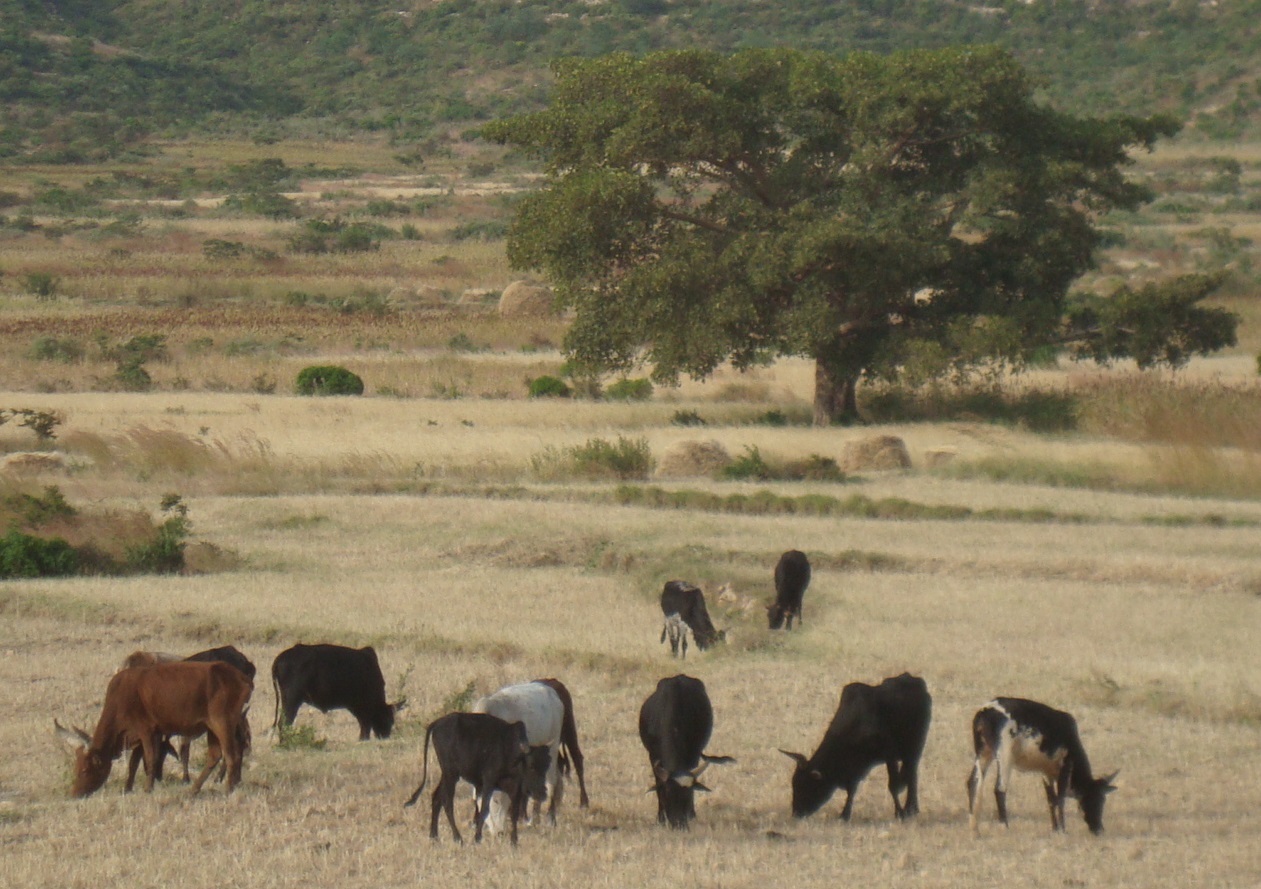
Arado are small, sturdy zebu cattle. Their coats are red and black, and the horns are not long: bulls and working oxen carry thick, short horns, while cows have thinner, medium-length ones. Over the front of the body, where the neck meets the chest, males have a hump, one of the signs of zebu blood. Working oxen average about 254 kg and stand roughly 120 cm at the withers, the ridge between the shoulder blades; cows are lighter, around 201 kg and 115 cm. Figures for the breed put bulls between 240 and 270 kg and cows between 180 and 220 kg.
Where does the Arado come from?
Ethiopia has long been a meeting place for cattle moving into Africa. Zebu arrived from Arabia and India, taurine cattle came from Europe and the Near East, and pastoral movement mixed West African taurine into local herds. Varied soils and climates produced varied farming, and the country became a second centre where livestock diversified. Sanga cattle, the long-horned local taurine crossed with Arabian zebu, began in Ethiopia. The Arado belong to the Zenga group, zebu-sanga animals that arose when Indian zebu entered the region a second time.
What the Arado is known for
The breed is valued for being hardy rather than large. It lives largely on crop residues left after harvest and manages through the lean months when feed is short, a quality that suits smallholder farms with little spare fodder. Arado are worked hard, so fitness and the ability to fit a range of farms and climates matter more in breeding than size.
How the Arado is bred and kept
Mating usually happens on the grazing land, or a cow is walked to a bull kept nearby. Breeders also use bulls and artificial insemination, in which semen is placed in the cow by hand rather than by a bull. Farmers aim to improve their Arado by crossing them with other local breeds. Such crossing allows selection for fitness and for animals that suit a wider range of farming systems and environments.
Arado, drawn
What the Arado is kept for
The first job of an Arado is draught: pulling a plough for tillage. Meat comes next, and milk third. Oxen, the castrated males trained to work, average about 254 kg. Cows, lighter at around 201 kg, supply a household's milk and raise the next generation of calves. Farmers put the order of use as work, then meat, then milk, so a herd is judged above all on the animals it can put to the plough.
The land and climate of the Arado
Arado country is the highland zone of northern Ethiopia. Fields there are cropped, and the cattle graze the aftermath: the stubble and regrowth left once the crop has been cut. Crop residues form the backbone of their diet. The breed copes with the sharp seasonal swings in feed, going through periods when fodder is scarce and then picking up again when harvest leftovers are available.
At a glance: where it belongs
Land and climate
Keeping Arado cattle
Keeping an Arado is mostly a matter of making the most of what the farm grows. The cattle eat crop residues and graze the aftermath of harvested fields, and they are expected to hold condition through the lean season. Mating is arranged either on the grazing grounds or by taking the cow to a neighbour's bull, and insemination services are also used to bring in new blood.
Numbers, conservation and the herd book
The breed faces pressure from several directions. War and the spread of towns disturb farming and grazing. Cattle plague, a fast-spreading disease of cattle, has struck herds. Drought and damage to ecosystems make feed harder to find. Farmers answer this by crossing Arado with other indigenous breeds, choosing for fitness and for animals suited to more farming systems and environments.
Questions people ask about Arado
Where does the Arado come from?
It belongs to the highlands of northern Ethiopia. Ethiopia has been a crossroads for cattle entering Africa, and the Arado sit within the Zenga group, zebu-sanga animals that came out of a second influx of Indian zebu into local herds.
What is it kept for?
Work comes first: Arado oxen pull the plough for tillage. The breed is also reared for meat and for milk, in that order of importance, with cows supplying the household and raising the next generation of calves.
What do Arado cattle look like?
They are small and sturdy, with red and black coats. Bulls and working oxen have a hump over the neck and chest and thick, short horns; cows have thinner horns of medium length. Oxen weigh about 254 kg, cows about 201 kg.
How are they fed?
Mainly on crop residues, the plant material left after harvest, plus aftermath grazing on harvested fields. The breed is adapted to periods when feed runs short, which is why it suits mixed farms in the highlands.
Are they crossed with other breeds?
Yes. Farmers commonly improve Arado by crossing with other indigenous Ethiopian breeds, and both natural mating with a bull and artificial insemination are used. The aim is fitness and animals that fit a range of farming systems and environments.
Good reading and sources
The facts on this page come from the Wikipedia article "Arado cattle", written by its contributors and used under the CC BY-SA 4.0 licence, and from its Wikidata record (CC0). EveryCow rewrote the text in its own words, with AI assistance, and compares every page with the article to make sure no passage is copied. It may be reused under the same CC BY-SA 4.0 licence with a link back.
It may contain mistakes. Sizes, colours and customs differ from one herd, valley or breeder to the next. Folk beliefs are described as tradition, never as advice. If something is wrong, tell us. Last refreshed 2026-10-16.
More from Ethiopia
All the breeds of Ethiopia 🇪🇹 Ethiopia and 1 moreAbigar
A hardy sanga breed of western Ethiopia and Sudan, kept for milk and beefSanga · Dairy · Heat-tolerant
🇪🇹 EthiopiaAfar
A long-horned, humped Ethiopian breed kept mainly for milkTaurine · Dairy
🇪🇹 EthiopiaRaya
A red and black Sanga ox breed from Tigray, with heavy horns in the malesSanga · Draught · Long-horned
🇪🇹 Ethiopia and 1 moreAbigar
A hardy sanga breed of western Ethiopia and Sudan, kept for milk and beefSanga · Dairy · Heat-tolerant
🇪🇹 EthiopiaAfar
A long-horned, humped Ethiopian breed kept mainly for milkTaurine · Dairy
🇪🇹 EthiopiaRaya
A red and black Sanga ox breed from Tigray, with heavy horns in the malesSanga · Draught · Long-horned
 🇲🇱 Mali and 5 moreRed Bororo
A red-brown Sanga cattle of the Sahel, with long lyre-shaped hornsSanga · Dairy · Heat-tolerant
🇲🇱 Mali and 5 moreRed Bororo
A red-brown Sanga cattle of the Sahel, with long lyre-shaped hornsSanga · Dairy · Heat-tolerant
Its cousins elsewhere
All draught breeds 🇵🇰 Pakistan and 5 moreZebu
Humped, heat-tolerant cattle of South Asia, kept for milk, meat, work and ridingZebu · Dairy · Heat-tolerant
🇵🇰 Pakistan and 5 moreZebu
Humped, heat-tolerant cattle of South Asia, kept for milk, meat, work and ridingZebu · Dairy · Heat-tolerant
 🇲🇳 Mongolia and 4 moreYakགཡག་
A shaggy, cold-hardy highland bovine kept across the Himalayas and Tibetan PlateauYak · Triple-purpose · Cold-hardy
🇲🇳 Mongolia and 4 moreYakགཡག་
A shaggy, cold-hardy highland bovine kept across the Himalayas and Tibetan PlateauYak · Triple-purpose · Cold-hardy
 🇮🇩 Indonesia and 4 moreBali cattle
A small humped breed from Indonesia, descended from wild banteng, kept for meat and plowing.Banteng · Beef · Disease-resistant
🇮🇩 Indonesia and 4 moreBali cattle
A small humped breed from Indonesia, descended from wild banteng, kept for meat and plowing.Banteng · Beef · Disease-resistant
 🇬🇧 United Kingdom and 5 moreHereford
A red and white beef breed from Herefordshire, England, known for its white face and hardiness.Taurine · Beef · Docile
🇬🇧 United Kingdom and 5 moreHereford
A red and white beef breed from Herefordshire, England, known for its white face and hardiness.Taurine · Beef · Docile