
Charolais
In its own language: Charolaise
A large French taurine beef breed from eastern France, white to cream with pink noses and curved horns.
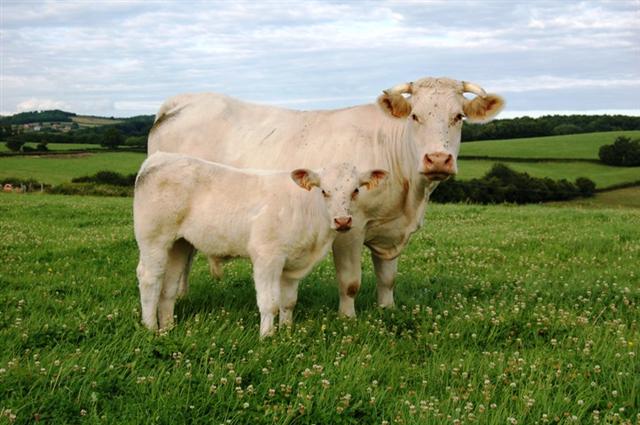
The Charolais is a heavy-set taurine breed raised for meat in eastern France. It has a thick white or wheaten coat, a pink nose, and sturdy horns on both sexes.
- Bulls weigh up to 1650 kg and cows up to 1200 kg.
- Coat ranges from white to pale wheaten with a pink nose.
- Originates from the Charolles area in eastern France.
- Used to create the Brazilian Canchim composite breed.
- Introduced to the southern US from Mexico in 1934.
What do Charolais cattle look like?
This is a substantial taurine breed developed for meat production in eastern France. The animals display a dense coat that ranges from pure white to a pale wheaten shade. A distinctive feature is the uniformly pink nose. Both male and female cattle carry sturdy, curved horns. They are among the heaviest of all cattle breeds, with bulls reaching over one tonne and cows weighing up to twelve hundred kilograms.
Where does the Charolais come from?
The breed takes its name from the historic Charolais area surrounding the town of Charolles in Saône-et-Loire. This region lies within the modern Bourgogne-Franche-Comté area of eastern France. Its traditional range also stretched into the neighbouring Nivernais district to the north-west. It remains a staple of French agriculture, ranking second only to the Prim'Holstein in total numbers within the country.
What the Charolais is known for
Farmers value this breed primarily for its ability to produce high-quality beef. The animals are known for their docile nature, which makes them easier to manage in herds. They are also noted for their rich milk production, supporting calf growth before slaughter. Their large frame and steady temperament contribute to their widespread adoption across different farming systems globally.
How the Charolais is bred and kept
The breed is maintained through strict selection for meat quality and size. It has been crossed with other breeds to create new lines, such as the Canchim in Brazil and the Charbray in North America. These crosses often combine the hardiness of zebu cattle with the meat yield of the Charolais. Breed societies keep detailed records to preserve the genetic integrity of the pure line.
Charolais, drawn
What the Charolais is kept for
The primary purpose of raising these cattle is for beef. They are prized for their muscle development and carcass yield. While mainly kept for meat, some farmers may use them for cross-breeding programs to improve the growth rates of other local breeds. The calves grow quickly, making them efficient for commercial meat production cycles.
The land and climate of the Charolais
The breed thrives in the temperate climate of eastern France. It is well-suited to the grassy pastures and rolling hills of the Saône-et-Loire region. The animals have adapted to various environments worldwide, including the drier conditions found in parts of Mexico and the United States. Their thick coat provides protection against cooler weather.
Who keeps the Charolais
The breed is deeply rooted in the farming communities of eastern France. Farmers in the Charolais and Nivernais regions have raised these cattle for generations. The breed's success has led to its adoption by agriculturalists in many other countries, including those in Central Europe and North America, where it serves as a foundation for commercial beef herds.
At a glance: where it belongs
Land and climate



Faith and ritual
There are no specific spiritual rituals or religious festivals associated with this breed. It is treated as a standard agricultural animal focused on economic productivity rather than ceremonial significance. The breed does not hold a special place in local folklore or temple traditions.
The Charolais at fairs and festivals
The breed is showcased at major agricultural exhibitions, such as the Salon de l'Agriculture in Paris. These events allow farmers to display their best specimens and compete for awards. There are no specific annual festivals dedicated solely to this breed, but it features prominently in general livestock shows.
Custom and folk tradition
In the past, efforts were made to designate the Charolais-Brionnais Country as a UNESCO World Heritage Site due to its cultural landscape for cattle rearing. Although the application was unsuccessful, the tradition of raising these cattle remains a key part of the region's identity and rural heritage.
Keeping Charolais cattle
Proper care involves providing ample grazing land and shelter during harsh weather. Farmers monitor the health of the herd closely to prevent disease and ensure optimal growth. Calving is managed carefully due to the large size of the calves, though the breed is generally considered easy-calving.
Numbers, conservation and the herd book
At the end of 2014, France reported approximately 4.22 million head of Charolais cattle, including 1.56 million cows. Globally, the population is estimated at around 730,000. The largest populations outside France are found in the Czech Republic and Mexico. The breed is listed as not at risk by the FAO.
Questions people ask about Charolais
Where did the Charolais breed originate?
It originated in the Charolais area surrounding the town of Charolles in Saône-et-Loire, eastern France. It is named after this historic region.
What is the Charolais breed kept for?
It is primarily raised for beef production. It is valued for its large size, muscle development, and high-quality meat yield.
What colour is a Charolais cow?
The coat varies from pure white to a pale wheaten or cream colour. The nose is uniformly pink.
Is the Charolais breed endangered?
No, the FAO lists it as not at risk. It remains one of the most common beef breeds in France and is widely distributed globally.
Has the Charolais been used to create other breeds?
Yes, it has been crossed with zebu cattle to create breeds like the Brazilian Canchim and the American Charbray.
Good reading and sources
- Charolais cattle on WikipediaEncyclopedia
- More photos on Wikimedia CommonsPhotos and video
- Wikidata recordOpen data
The facts on this page come from the Wikipedia article "Charolais cattle", written by its contributors and used under the CC BY-SA 4.0 licence, and from its Wikidata record (CC0). EveryCow rewrote the text in its own words, with AI assistance, and compares every page with the article to make sure no passage is copied. It may be reused under the same CC BY-SA 4.0 licence with a link back.
It may contain mistakes. Sizes, colours and customs differ from one herd, valley or breeder to the next. Folk beliefs are described as tradition, never as advice. If something is wrong, tell us. Last refreshed 2026-10-16.
More from France
All the breeds of France 🇫🇷 France and 2 moreBlonde d'Aquitaine
A big wheat-coated beef breed from south-west France, born of three old draught linesTaurine · Beef
🇫🇷 France and 2 moreBlonde d'Aquitaine
A big wheat-coated beef breed from south-west France, born of three old draught linesTaurine · Beef
 🇫🇷 France and 2 moreAbondance
A red and white dairy breed from the French Alps, kept for milk and mountain grazing.Taurine · Dairy · Heat-tolerant
🇫🇷 France and 2 moreAbondance
A red and white dairy breed from the French Alps, kept for milk and mountain grazing.Taurine · Dairy · Heat-tolerant
 🇫🇷 France and 1 moreMaine-AnjouRouge des Prés
A red and white French beef breed from the Maine country, once a milk and meat animalTaurine · Beef
🇫🇷 France and 1 moreMaine-AnjouRouge des Prés
A red and white French beef breed from the Maine country, once a milk and meat animalTaurine · Beef
 🇫🇷 France and 1 moreTarentaise
A French alpine breed from the Tarentaise valley, kept for cheese and for crossingTaurine · Dairy · Docile
🇫🇷 France and 1 moreTarentaise
A French alpine breed from the Tarentaise valley, kept for cheese and for crossingTaurine · Dairy · Docile
Its cousins elsewhere
All beef breeds 🇺🇸 United States and 1 moreBeefalo
A cattle and bison hybrid raised for beef in the United StatesComposite · Beef · Cold-hardy
🇺🇸 United States and 1 moreBeefalo
A cattle and bison hybrid raised for beef in the United StatesComposite · Beef · Cold-hardy
 🇺🇸 United States and 3 moreBrown Swiss
A medium-sized American dairy breed descended from the Alpine Braunvieh, kept for high milk yield and cheese-making.Composite · Dairy · Rich milk
🇺🇸 United States and 3 moreBrown Swiss
A medium-sized American dairy breed descended from the Alpine Braunvieh, kept for high milk yield and cheese-making.Composite · Dairy · Rich milk
 🇮🇳 India and 1 moreGir
A humped dairy breed from Gujarat, red and white with long drooping ears and a domed foreheadZebu · Dairy · Heat-tolerant
🇮🇳 India and 1 moreGir
A humped dairy breed from Gujarat, red and white with long drooping ears and a domed foreheadZebu · Dairy · Heat-tolerant
 🇰🇷 South Korea and 1 moreHanwoo한우
A small, brown taurine breed from Korea, once used for work and now prized for its premium beef.Taurine · Beef · Docile
🇰🇷 South Korea and 1 moreHanwoo한우
A small, brown taurine breed from Korea, once used for work and now prized for its premium beef.Taurine · Beef · Docile