Disease-resistant breeds
Tick resistance and the trypanosome tolerance of the N'Dama and West African shorthorns.
Some breeds resist or tolerate diseases and parasites that devastate others. The best known example is trypanotolerance: the N'Dama and the West African shorthorns can live and stay productive where tsetse flies spread trypanosomes, which kill or weaken most other cattle. Many zebu breeds, including Indian breeds such as Sahiwal, Gir and Tharparkar, carry fewer ticks than European cattle. The Nguni of southern Africa is known for tick resistance too. These traits matter most to farmers who cannot afford drugs or dips, and to breeders who want to use fewer of them.
Trypanotolerance in West Africa
Animal trypanosomiasis, spread by tsetse flies, is one of the main limits on cattle keeping across a wide belt of humid and sub-humid Africa. Over thousands of years, some West African taurine cattle have become able to control the parasite in their blood and keep working and breeding. The N'Dama, a long-horned breed from the Fouta Djallon highlands of Guinea, and short-horned breeds such as the Baoulé and Lagune are the best known. Zebu cattle introduced into the same areas generally do poorly without treatment.
Tick resistance
Ticks spread several cattle diseases and weaken animals by feeding on them. Zebu and sanga cattle usually carry far fewer ticks than European breeds. Their skin reaction and grooming help remove ticks before they feed, and their coats make it harder for ticks to settle. This is part of why Indian breeds became so important in tropical Australia and Brazil, and why the Nguni and Bonsmara are valued in southern Africa.
Breeding for health
Breed differences are not the whole story: management, feed and exposure all matter, and no breed is immune. But where disease pressure is high, a breed that tolerates it can be the difference between a herd that survives and one that does not. Researchers in India, Africa and Australia study the genes behind these traits, and conservation of local breeds is often argued for on this basis.
Worth knowing
- N'Dama: Trypanotolerant long-horned breed of West Africa
- Baoulé: Small West African shorthorn, tolerant of trypanosomes
- Nguni: Southern African sanga known for tick resistance
- Sahiwal: Indian dairy zebu with good tick resistance
- American Brahman: Zebu breed that carries fewer ticks than European cattle
- Gir: Indian zebu kept in tick country in Brazil
Good to know
- Resistance lowers risk but does not replace vaccination, parasite control and a vet's advice.
- Moving a resistant breed to a new region can expose it to diseases it has never met.
Sources and further reading
- Trypanotolerance on Wikipedia
- N'Dama, Wikipedia
- Animal trypanosomiasis, Wikipedia
- Nguni cattle, Wikipedia
Original text by the EveryCow desk, written with AI assistance and checked against the sources above. Customs are described as tradition, not as advice. If we have something wrong, tell us.
Disease-resistant on EveryCow
The breeds written up so far, best known first.
 🇮🇩 Indonesia and 4 moreBali cattle
A small humped breed from Indonesia, descended from wild banteng, kept for meat and plowing.Banteng · Beef · Disease-resistant
🇮🇩 Indonesia and 4 moreBali cattle
A small humped breed from Indonesia, descended from wild banteng, kept for meat and plowing.Banteng · Beef · Disease-resistant
 🇺🇸 United States and 5 moreBrahman
An American beef breed with a hump and grey or red coat, bred from Indian zebu cattleComposite · Beef · Heat-tolerant
🇺🇸 United States and 5 moreBrahman
An American beef breed with a hump and grey or red coat, bred from Indian zebu cattleComposite · Beef · Heat-tolerant
 🇺🇸 United StatesTexas Longhorn
American beef cattle, once feral on Texas ranges, with horn spreads beyond 2.4 mTaurine · Beef · Heat-tolerant
🇺🇸 United StatesTexas Longhorn
American beef cattle, once feral on Texas ranges, with horn spreads beyond 2.4 mTaurine · Beef · Heat-tolerant
 🇮🇹 Italy and 5 moreChianina
A massive white Italian breed known for beef production and historic draught work in Tuscany.Taurine · Beef · Heat-tolerant
🇮🇹 Italy and 5 moreChianina
A massive white Italian breed known for beef production and historic draught work in Tuscany.Taurine · Beef · Heat-tolerant
 🇮🇳 India and 1 moreGir
A humped dairy breed from Gujarat, red and white with long drooping ears and a domed foreheadZebu · Dairy · Heat-tolerant
🇮🇳 India and 1 moreGir
A humped dairy breed from Gujarat, red and white with long drooping ears and a domed foreheadZebu · Dairy · Heat-tolerant
 🇺🇸 United States and 5 moreSanta Gertrudis
A red American beef breed created from zebu and European cattle in Texas.Composite · Beef · Heat-tolerant
🇺🇸 United States and 5 moreSanta Gertrudis
A red American beef breed created from zebu and European cattle in Texas.Composite · Beef · Heat-tolerant
 🇮🇳 India and 3 moreNelore
A large humped beef breed from India, now dominant in Brazil and known for heat tolerance and parasite resistance.Zebu · Beef · Heat-tolerant
🇮🇳 India and 3 moreNelore
A large humped beef breed from India, now dominant in Brazil and known for heat tolerance and parasite resistance.Zebu · Beef · Heat-tolerant
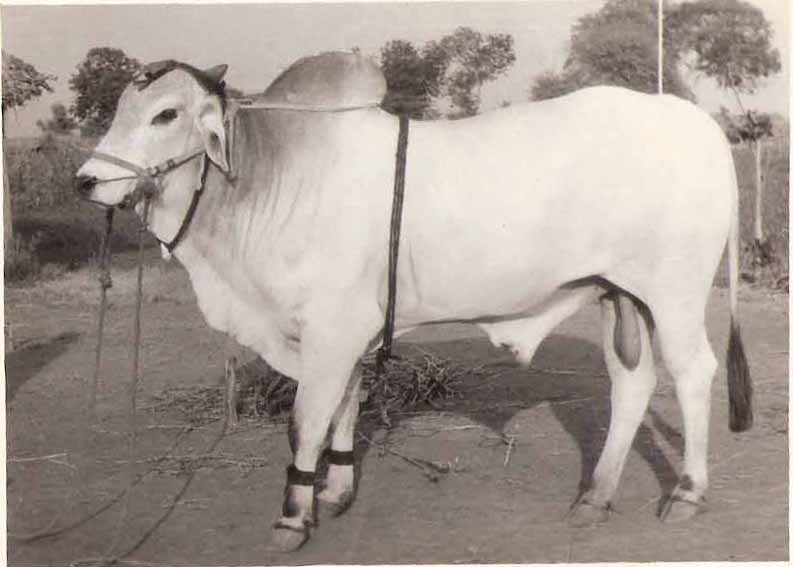 🇮🇳 India and 5 moreOngole
A short-horned zebu breed from Andhra Pradesh, white with dark markings, used for work and milk.Zebu · Draught · Heat-tolerant
🇮🇳 India and 5 moreOngole
A short-horned zebu breed from Andhra Pradesh, white with dark markings, used for work and milk.Zebu · Draught · Heat-tolerant
 🇵🇰 Pakistan and 3 moreRed Sindhi
A humped dairy zebu from Sindh in Pakistan, deep red, with short curved hornsZebu · Dairy · Heat-tolerant
🇵🇰 Pakistan and 3 moreRed Sindhi
A humped dairy zebu from Sindh in Pakistan, deep red, with short curved hornsZebu · Dairy · Heat-tolerant
 🇿🇦 South Africa and 2 moreAfrikaner
A Sanga-type breed from South Africa, deep red with long horns, kept for beef and draught work.Sanga · Beef · Heat-tolerant
🇿🇦 South Africa and 2 moreAfrikaner
A Sanga-type breed from South Africa, deep red with long horns, kept for beef and draught work.Sanga · Beef · Heat-tolerant
 🇬🇳 Guinea and 5 moreN'Dama
A West African breed that can live where tsetse flies carry trypanosomiasisTaurine · Disease-resistant
🇬🇳 Guinea and 5 moreN'Dama
A West African breed that can live where tsetse flies carry trypanosomiasisTaurine · Disease-resistant
 🇮🇳 IndiaHarianaहरियाना
A medium to large dual-purpose zebu from Haryana, white to grey with short horns.Zebu · Dual-purpose · Disease-resistant
🇮🇳 IndiaHarianaहरियाना
A medium to large dual-purpose zebu from Haryana, white to grey with short horns.Zebu · Dual-purpose · Disease-resistant
 🇭🇷 Croatia and 5 moreBuša
A little mountain cow of the Balkans with short horns, kept for milk, meat and workTaurine · Triple-purpose · Disease-resistant
🇺🇿 UzbekistanBestuzhevБестужевская
A dual-purpose Uzbek breed of the Soviet era, resistant to bovine leukosisComposite · Dual-purpose · Disease-resistant
🇭🇷 Croatia and 5 moreBuša
A little mountain cow of the Balkans with short horns, kept for milk, meat and workTaurine · Triple-purpose · Disease-resistant
🇺🇿 UzbekistanBestuzhevБестужевская
A dual-purpose Uzbek breed of the Soviet era, resistant to bovine leukosisComposite · Dual-purpose · Disease-resistant
 🇪🇸 SpainMenorquina
A red, hornless dairy breed from the Spanish island of Menorca, prized for Mahón cheese production.Taurine · Dairy · Disease-resistant
🇪🇸 SpainMenorquina
A red, hornless dairy breed from the Spanish island of Menorca, prized for Mahón cheese production.Taurine · Dairy · Disease-resistant
 🇮🇳 IndiaMalnad Giddaಮಲೆನಾಡು ಗಿಡ್ಡ
A small, dark humpless breed from the Western Ghats of Karnataka, kept for milk and draught work.Taurine · Dairy · Disease-resistant
🇮🇳 IndiaMalnad Giddaಮಲೆನಾಡು ಗಿಡ್ಡ
A small, dark humpless breed from the Western Ghats of Karnataka, kept for milk and draught work.Taurine · Dairy · Disease-resistant
 🇺🇸 United States and 5 moreSenepol
A polled red beef breed from St Croix, built for heat and insectsTaurine · Beef · Heat-tolerant
🇺🇸 United States and 5 moreSenepol
A polled red beef breed from St Croix, built for heat and insectsTaurine · Beef · Heat-tolerant
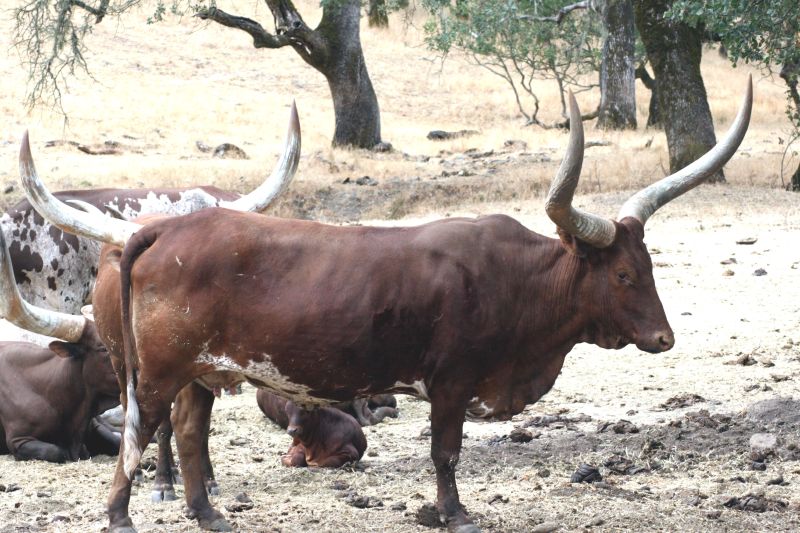 🇸🇩 Sudan and 4 moreSanga cattle
The umbrella name for native African cattle, mixing humpless taurine and zebu bloodTaurine · Disease-resistant
🇸🇩 Sudan and 4 moreSanga cattle
The umbrella name for native African cattle, mixing humpless taurine and zebu bloodTaurine · Disease-resistant
 🇿🇦 South Africa and 5 moreNguni
A multi-coloured Sanga breed from Southern Africa, valued for disease resistance and hardiness.Sanga · Dual-purpose · Disease-resistant
🇿🇦 South Africa and 5 moreNguni
A multi-coloured Sanga breed from Southern Africa, valued for disease resistance and hardiness.Sanga · Dual-purpose · Disease-resistant
 🇪🇹 Ethiopia and 1 moreAbigar
A hardy sanga breed of western Ethiopia and Sudan, kept for milk and beefSanga · Dairy · Heat-tolerant
🇪🇹 Ethiopia and 1 moreAbigar
A hardy sanga breed of western Ethiopia and Sudan, kept for milk and beefSanga · Dairy · Heat-tolerant
 🇮🇳 IndiaJavariಜವಾರಿ
A medium-built dual-purpose zebu from Kalyana-Karnataka, gentle and heat-tolerantZebu · Dairy · Heat-tolerant
🇮🇳 IndiaJavariಜವಾರಿ
A medium-built dual-purpose zebu from Kalyana-Karnataka, gentle and heat-tolerantZebu · Dairy · Heat-tolerant
Photo credits on this page
The small pictures above come from Wikimedia Commons under free licences. Some are cropped to fit.
- Menorquina: Discasto, CC BY-SA 4.0, source
- Malnad Gidda: Pavanaja, CC BY-SA 3.0, source
- Buša: P.Cikovac, CC BY-SA 4.0, source
- Abigar: Bertramz, CC BY-SA 3.0, source
- Brahman: AlejandroLinaresGarcia, CC BY-SA 4.0, source
- Senepol: Buenoperez, Public domain, source
- Sanga cattle: Just chaos, CC BY 2.0, source
- Bali cattle: Gsarwa, CC BY-SA 3.0, source
- Gir: Pavanaja, CC BY-SA 3.0, source
- Chianina: Monica, CC BY 2.0, source
- Nelore: Jose Reynaldo da Fonseca, CC BY-SA 3.0, source
- Afrikaner: Amada44, Public domain, source
- Ongole: DMR Sekhar, CC BY-SA 3.0, source
- N'Dama: ILRI, CC BY 2.0, source
- Santa Gertrudis: Cgoodwin, CC BY-SA 3.0, source
- Hariana: Pavanaja, CC BY-SA 3.0, source
- Red Sindhi: LunaticFringe97, CC BY-SA 4.0, source
- Nguni: arboresce, CC BY-SA 2.0, source
- Texas Longhorn: Clinton & Charles Robertson, CC BY 2.0, source
- Javari: Pavanaja, CC BY-SA 3.0, source