
Kazakh Whiteheaded
In its own language: Қазақтың ақбас сиыры
A Hereford-like beef breed from Kazakhstan and the lower Volga, horned and hardy
The Kazakh Whiteheaded is a beef breed, put together in the Soviet period in Kazakhstan and along the lower Volga. It carries the Hereford's colour and build along with the toughness of the local Kazakh and Kalmyk cattle, and it is horned, with cows about 124 cm and 550 kg and bulls about 133 cm and 820 kg.
- Beef breed of Kazakhstan and Russia, developed in the 1930s to 1950s
- Hereford bulls were used on Kazakh and Kalmyk cows
- Cows average 124 cm and 550 kg; bulls 133 cm and 820 kg
- About 1,334,000 head were counted in Kazakhstan in 1990
- Horned, red with a white head, and kept for meat
What do Kazakh Whiteheaded cattle look like?
The Kazakh Whiteheaded is a beef breed. It is horned, and its coat follows the Hereford pattern, a red body with a white face and head. Its build is a beef build as well, deep and compact rather than rangy, so the Hereford side of its ancestry shows in the shape and not only in the colour. There is no hump over the shoulders. Cows stand about 124 cm at the withers, the ridge between the shoulder blades, and weigh about 550 kg. Bulls are the larger sex, averaging 133 cm and 820 kg, clearly heavier in the body than the cows.
Where does the Kazakh Whiteheaded come from?
The breed belongs to Kazakhstan and Russia. It was put together in the Soviet period, with the work running from 1930 to 1950. The setting was the state farms of the Kazakh republic and of the lower Volga country, where Hereford bulls were mated with cows from the local herds, the Kazakh cattle and the Kalmyk cattle of the area. The aim was a beef animal suited to local conditions. Breeders wanted the Hereford's colour and conformation but did not want to lose the ability of the native stock to live and produce in that part of the world. The result is a breed that passes for a Hereford at a glance and is hardier than one.
What the Kazakh Whiteheaded is known for
Hardiness is what this breed is known for. The local Kazakh and Kalmyk cattle passed on their ability to cope with conditions in the Kazakh republic and the lower Volga, and that is what breeders kept when they chose which animals to breed from. In appearance and in the carcass it stays close to the Hereford, so the tough constitution comes without much change of type. It is a meat breed throughout; milk and work played no part in its making.
How the Kazakh Whiteheaded is bred and kept
The breed was formed on state farms, large holdings run by the state, over roughly two decades in the 1930s and 1940s. Local cows were served by Hereford bulls, and the offspring that came closest to the Hereford in colour and conformation while keeping the toughness of the native cattle were kept on as breeding stock. That two-sided selection is what produced the breed. Hereford and local blood were combined in this way until the resulting animals were consistent enough to be treated as a breed in their own right.
Kazakh Whiteheaded, drawn
What the Kazakh Whiteheaded is kept for
Meat is the purpose of this breed; its use is given as meat. The weights suit that, with cows averaging 550 kg and bulls 820 kg, so a modest-sized cow carries a good beef body. It is not a dairy animal and it was not developed as a draught breed. Over a million head were kept in Kazakhstan by 1990, a commercial scale of beef farming rather than a few house cows.
Who keeps the Kazakh Whiteheaded
The stock behind the breed was local, described as Kazakh and Kalmyk cattle, so the herds of those two peoples lie in its background. The breeding work itself belonged to the state farms rather than to any single herding community, and no one people is tied to the breed today. It is kept on farms in Kazakhstan and Russia, and there are herds as well in Azerbaijan, Mongolia, Tajikistan and Uzbekistan.
At a glance: where it belongs
Numbers, conservation and the herd book
Numbers were once very large. In 1990 Kazakhstan held about 1,334,000 head of this breed, the figure given in the record, and it is the only count recorded. From its home in Kazakhstan and Russia the breed has travelled: herds are listed in Azerbaijan, Mongolia, Tajikistan and Uzbekistan. It also appears in the Food and Agriculture Organisation's study of animal genetic resources. The figure shows a breed that was kept on a very wide scale in Kazakhstan during the twentieth century.
From the Kazakh Whiteheaded
Questions people ask about Kazakh Whiteheaded
Where does the Kazakh Whiteheaded come from?
It comes from Kazakhstan and Russia. The breeding work was done on Soviet state farms in the Kazakh republic and along the lower Volga, beginning in 1930 and finishing around 1950.
What is it kept for?
Meat. It is a beef breed, with cows around 550 kg and bulls around 820 kg. It was not developed as a dairy breed or as a draught animal.
Which breeds went into it?
Hereford bulls were put to native Kazakh cows and to Kalmyk cows. The aim was to hold on to the Hereford's colour and shape while keeping the hardiness of the local stock.
How many Kazakh Whiteheaded cattle are there?
About 1,334,000 head were counted in Kazakhstan in 1990, the only figure recorded here. Herds are also listed in Russia, Azerbaijan, Mongolia, Tajikistan and Uzbekistan.
Does it have horns?
Yes, the breed is horned. It carries the Hereford's colouring and build, with the hardiness of the Kazakh and Kalmyk cattle worked into it.
Good reading and sources
The facts on this page come from the Wikipedia article "Kazakh Whiteheaded", written by its contributors and used under the CC BY-SA 4.0 licence, and from its Wikidata record (CC0). EveryCow rewrote the text in its own words, with AI assistance, and compares every page with the article to make sure no passage is copied. It may be reused under the same CC BY-SA 4.0 licence with a link back.
It may contain mistakes. Sizes, colours and customs differ from one herd, valley or breeder to the next. Folk beliefs are described as tradition, never as advice. If something is wrong, tell us. Last refreshed 2026-10-16.
More from Kazakhstan
All the breeds of Kazakhstan 🇲🇳 Mongolia and 3 moreKalmykКалмыцкая
A compact red beef breed of the old Soviet Union, noted for exceptional toughnessTaurine · Beef · Thrifty foragers
🇰🇿 KazakhstanAlatau
A dual-purpose beef and dairy breed from Kazakhstan, named after the Alatau MountainsDual-purpose
🇰🇿 KazakhstanAulie-Ata
A dairy breed from Kazakhstan, made from native stock and Dutch Black PiedComposite · Dairy
🇲🇳 Mongolia and 3 moreKalmykКалмыцкая
A compact red beef breed of the old Soviet Union, noted for exceptional toughnessTaurine · Beef · Thrifty foragers
🇰🇿 KazakhstanAlatau
A dual-purpose beef and dairy breed from Kazakhstan, named after the Alatau MountainsDual-purpose
🇰🇿 KazakhstanAulie-Ata
A dairy breed from Kazakhstan, made from native stock and Dutch Black PiedComposite · Dairy
Its cousins elsewhere
All beef breeds 🇳🇱 Netherlands and 5 moreTauros
A breeding-back project building hardy cattle to stand in for the extinct aurochsWild · Grazing · Cold-hardy
🇳🇱 Netherlands and 5 moreTauros
A breeding-back project building hardy cattle to stand in for the extinct aurochsWild · Grazing · Cold-hardy
 🇨🇳 China and 2 moreWild yak
A massive, shaggy wild bovine native to the high plateaux and peaks of the HimalayasYak · Beef · Cold-hardy
🇨🇳 China and 2 moreWild yak
A massive, shaggy wild bovine native to the high plateaux and peaks of the HimalayasYak · Beef · Cold-hardy
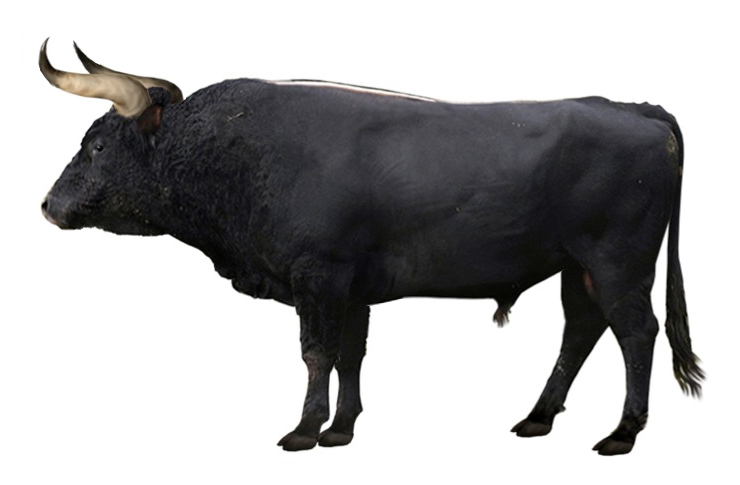 🇵🇱 Poland and 5 moreAurochs
The wild ancestor of all domestic cattle, extinct since 1627Wild · Long-horned
🇵🇱 Poland and 5 moreAurochs
The wild ancestor of all domestic cattle, extinct since 1627Wild · Long-horned
 🇬🇧 United Kingdom and 2 moreAyrshire
Red-and-white dairy cattle from south-west Scotland, hardy, long-lived and easy calversTaurine · Dairy · Easy calving
🇬🇧 United Kingdom and 2 moreAyrshire
Red-and-white dairy cattle from south-west Scotland, hardy, long-lived and easy calversTaurine · Dairy · Easy calving