Aurochs
The wild ancestor of all domestic cattle, extinct since 1627
The aurochs was the wild ox from which all taurine cattle and zebu descend, roaming from western Europe and North Africa to India and East Asia. Bulls stood up to 1.8 m with horns 80 cm long; the last one died in Poland in 1627.
- The last aurochs died in Poland's Jaktorów forest in 1627
- Bulls stood up to 1.8 m at the shoulder, with horns 80 cm long
- Two domestications: taurine cattle in the Fertile Crescent, zebu in India
- Bulls were black with a pale eel stripe; cows stayed reddish-brown
- Painted in Palaeolithic caves and carved on Egyptian reliefs
What do Aurochs cattle look like?
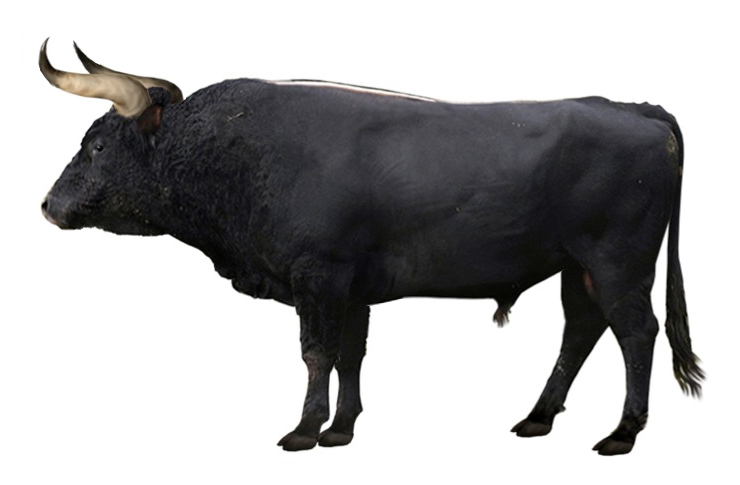
The aurochs was a wild ox, the species from which taurine cattle descend. It stood tall and long-legged, with a body that leaned toward the front: heavy neck and shoulder muscle, an udder so small it hardly showed from the side, and a long skull carrying huge horns. Bulls in the north reached 1.8 metres at the shoulder, cows 1.35 to 1.55 metres, and heavy animals weighed around 700 kg. Bulls were black with a pale stripe of hair down the spine, often called the eel stripe; cows kept a reddish-brown coat and calves began chestnut. Both sexes had a light muzzle. The horns, up to 80 cm long, first swept up and outward, then forward and in, then up again.
Where does the Aurochs come from?
Where the species first appeared is still argued over, with both African and Asian origins proposed. A likely early ancestor, Bos acutifrons, left a skull in India's Sivalik Hills about 2 million years old. The oldest well-dated aurochs fossil, roughly 780,000 years old, came from Tunisia, and other early remains were dug from Saharan rock in the Hoggar Mountains. The animal reached Europe by the Middle Pleistocene, with the oldest accepted records at Ponte Molle near Rome, and was in Britain by about 400,000 years ago. From there its range ran from western Europe across North Africa to India and East Asia. Hunting and a shrinking landscape then cut it back, country by country, until only Poland held wild herds.
What the Aurochs is known for
The aurochs was built as a wild animal, athletic and strongly made toward the shoulders, in the manner of other wild bovines. Bulls grew far larger than cows, one of the clearest size gaps among cattle. Its power impressed early people everywhere: Palaeolithic painters drew it on cave walls, and in the ancient faiths of the Near East the bull became an emblem of strength. Old southern European breeds still echo its look, with dark bulls, pale muzzles and cows of a lighter shade.
How the Aurochs is bred and kept
The aurochs was never a managed breed, but two tame lines came from it. During the Neolithic, aurochs in the Fertile Crescent were brought under human control and became taurine cattle, which spread into Europe through the Balkans and along the Mediterranean coast. A separate domestication on the Indian subcontinent produced the zebu. Wild blood kept entering the herds: aurochs and early domestic stock interbred in the early Holocene, and taurine and zebu lines met and mixed in the Near East roughly 4,000 years ago. That old mixture is why some breeds still carry wild colouring, and horn shapes like the aurochs' survive in the Spanish fighting bull.
Aurochs, drawn
What the Aurochs is kept for
As a wild animal the aurochs was hunted rather than herded, and people had dealings with it from Neanderthal times onward. After death almost everything found a use: horns became trophies, votive gifts and drinking horns. The species' greatest contribution came through its descendants. Taurine cattle from the Fertile Crescent and zebu from India together make up virtually all the world's farm cattle, so its real service to farming began only once it was gone. A few primitive breeds still show its old colours and horn shapes today.
The land and climate of the Aurochs
This was an animal of wide open ground. Spreading grassland in the Pliocene is thought to have favoured big grazers, and after the last glaciation its range grew to cover Denmark and southern Sweden by about 12,000 to 11,000 years ago. It lived from Atlantic Europe across Saharan mountains to the humid lands of ancient Sudan and on to China and India. On Sicily and Kythira, cut-off herds shrank into dwarf forms. In the end, loss of habitat and hunting, not cold, confined it to the forests of eastern Europe.
Who keeps the Aurochs
Human dealings with the aurochs reach back to Neanderthals and other archaic hominins. Palaeolithic painters, Neolithic carvers of petroglyphs, Egyptian relief makers and Bronze Age figurine modellers all portrayed the wild bull. Among the last to describe a living animal was Sigismund von Herberstein, writing in the 16th century: he received a culled aurochs in Mazovia and cut a woodcarving of it in 1556, recording a pitch-black coat with a greyish line down the back. Scientists later fixed the species' name: Bos primigenius was proposed by Ludwig Heinrich Bojanus in 1825 after he compared aurochs and domestic skeletons.
At a glance: where it belongs
Land and climate
Faith and tradition
Celebrations
![Painting thought to either depict an aurochs, a cattle/aurochs cross, or simply an aurochs like cattle breed. [1] This painting is a copy of the original that was present at a merchant in Augsburg in the 19th century. Th](https://thumb.wikimedia.org/wikipedia/commons/thumb/6/6e/Ur-painting.jpg/960px-Ur-painting.jpg)


Faith and ritual
In the old religions of the Near East the wild bull stood for strength, virility and valour. Its horns were placed in votive offerings and carved into drinking horns, and hung up as trophies. The image travelled widely: painted in Palaeolithic caves, scratched as Neolithic petroglyphs, chiselled into Egyptian reliefs and modelled in Bronze Age figurines. Few animals have meant so much to so many early cultures.
Custom and folk tradition
The name is itself a piece of old lore. Aur and ur are Germanic or Celtic words for wild ox; joined with ohso, the Old High German word for ox, they gave ūrohso, which hardened into aurochs. Latin writers wrote of the urus from the Gallic Wars onward. English speakers built the plural aurochsen by copying ox and oxen. In Poland, where the animal lasted longest, 16th-century writers left the fullest eyewitness accounts of how it looked.
Numbers, conservation and the herd book
The aurochs is extinct and has been for centuries. Its range shrank steadily through the Holocene as habitat vanished and hunters closed in. The last confirmed animal died in Jaktorów forest, Poland, in 1627, though scattered reports hint that it held on in southeastern Europe for up to another hundred years. Today it survives as bones and DNA: a well-preserved bone gave up its mitochondrial genome in 2010, some 16,338 base pairs, and whole-genome studies have since traced how the Indian aurochs split from other populations roughly 300,000 to 166,000 years ago. In 2003 the International Commission on Zoological Nomenclature confirmed the name Bos primigenius for the wild species.
From the Aurochs
Questions people ask about Aurochs
Where did the aurochs come from?
Its birthplace is debated, with Africa and Asia both proposed. A possible ancestor, Bos acutifrons, is known from India's Sivalik Hills, and the oldest well-dated fossil, about 780,000 years old, was found in Tunisia. The species later spread across Europe, North Africa, India and East Asia.
What was the aurochs kept for?
Nothing was farmed from it directly; it was hunted, and its horns served as trophies, votive offerings and drinking horns. Its lasting value is ancestral: taurine cattle were domesticated from it in the Fertile Crescent and zebu cattle in India, so all domestic cattle descend from the aurochs.
When did the aurochs go extinct?
The last confirmed animal died in Poland, in the Jaktorów forest, in 1627, after a long decline driven by hunting and the loss of its habitat. Some reports suggest small numbers survived in southeastern Europe for up to another century.
How big was an aurochs compared with modern cattle?
Far larger than most modern cattle. Northern European bulls reached 1.8 metres at the shoulder and cows 1.35 to 1.55 metres, with heavy animals around 700 kg. The legs were longer and slimmer, and the horns reached 80 cm.
Do any aurochs-like cattle survive today?
No living aurochs survives, but its descendants are everywhere, since all taurine and zebu cattle come from it. Primitive breeds, particularly in southern Europe, still show aurochs-like traits: black bulls with a pale back stripe, light muzzles, and horn shapes like the Spanish fighting bull's.
Good reading and sources
- Aurochs on WikipediaEncyclopedia
- More photos on Wikimedia CommonsPhotos and video
- Wikidata recordOpen data
The facts on this page come from the Wikipedia article "Aurochs", written by its contributors and used under the CC BY-SA 4.0 licence, and from its Wikidata record (CC0). EveryCow rewrote the text in its own words, with AI assistance, and compares every page with the article to make sure no passage is copied. It may be reused under the same CC BY-SA 4.0 licence with a link back.
It may contain mistakes. Sizes, colours and customs differ from one herd, valley or breeder to the next. Folk beliefs are described as tradition, never as advice. If something is wrong, tell us. Last refreshed 2026-10-16.


Its cousins elsewhere
 🇲🇳 Mongolia and 4 moreYakགཡག་
A shaggy, cold-hardy highland bovine kept across the Himalayas and Tibetan PlateauYak · Triple-purpose · Cold-hardy
🇲🇳 Mongolia and 4 moreYakགཡག་
A shaggy, cold-hardy highland bovine kept across the Himalayas and Tibetan PlateauYak · Triple-purpose · Cold-hardy
 🇮🇩 Indonesia and 5 moreBantengbanṭéng (Javanese/Sundanese)
A wild Southeast Asian ox; its tame form, Bali cattle, runs feral in northern AustraliaBanteng · Beef · Drought-hardy
🇮🇩 Indonesia and 5 moreBantengbanṭéng (Javanese/Sundanese)
A wild Southeast Asian ox; its tame form, Bali cattle, runs feral in northern AustraliaBanteng · Beef · Drought-hardy
 🇨🇳 China and 2 moreWild yak
A massive, shaggy wild bovine native to the high plateaux and peaks of the HimalayasYak · Beef · Cold-hardy
🇨🇳 China and 2 moreWild yak
A massive, shaggy wild bovine native to the high plateaux and peaks of the HimalayasYak · Beef · Cold-hardy
 🇺🇸 United StatesTexas Longhorn
American beef cattle, once feral on Texas ranges, with horn spreads beyond 2.4 mTaurine · Beef · Heat-tolerant
🇺🇸 United StatesTexas Longhorn
American beef cattle, once feral on Texas ranges, with horn spreads beyond 2.4 mTaurine · Beef · Heat-tolerant