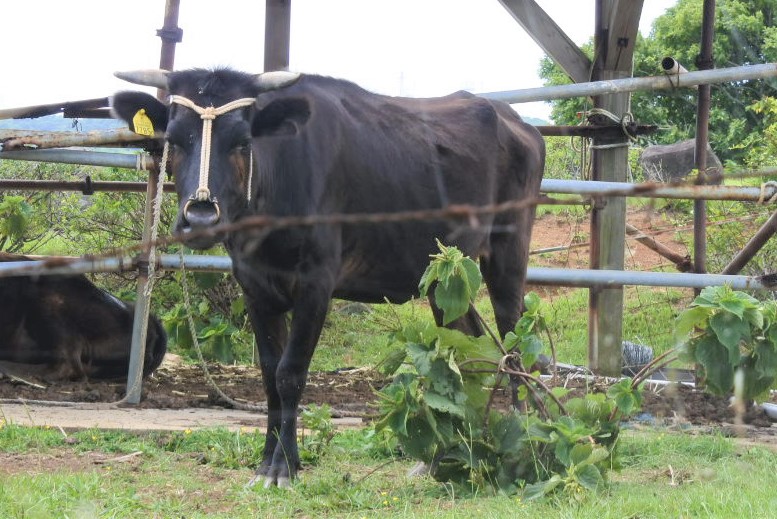
Mishima
In its own language: 見島牛
A small black beef breed that survives only on Mishima Island, Japan
A critically endangered Japanese beef breed, found only on Mishima Island in Yamaguchi Prefecture. The cattle are black and horned in both sexes, standing about 115 cm at the withers, and they belong to the native stock of Japan that was never crossed with Western breeds.
- Lives only on Mishima Island, about 50 km north-west of Hagi in Yamaguchi Prefecture
- Named a Japanese National Treasure in 1928
- 108 animals reported in 2004; FAO listed the breed as critical in 2007
- Black coat, horns in both sexes, cows about 115 cm tall and 400 kg
- One of only two Japanese cattle groups never crossed with Western stock
What do Mishima cattle look like?
The Mishima is a black beef breed, small in build and horned in both sexes. A grown cow measures roughly 115 cm at the withers, the bony ridge between the shoulders, and weighs about 400 kg. Bulls are larger, at about 125 cm and 600 kg. The coat is plain black. The cattle are kept for meat. The whole breed lives on one small Japanese island, and the herd has stayed closed to outside blood, which is why it still looks like the old native cattle of the country. Its numbers are tiny, and the FAO classes the breed as critical.
Where does the Mishima come from?
Cattle reached Japan from China together with rice growing, in the Yayoi period, around the second century AD. For centuries they were working animals, used for draught in farming, forestry, mining and haulage, and their dung was the fertiliser. Milk was not part of the diet then, and meat was avoided for cultural and religious reasons. From 1635 to 1854 Japan was closed to outsiders, so no foreign blood entered its cattle. Between 1868 and 1887 about 2,600 imported cattle arrived. Crossing, slow at first, spread from about 1900 and was stopped in 1910, when the crosses proved taller and better for milk but poorer at work and at meat. Four resulting strains were recognised as breeds in 1944. The Mishima, on its island, missed all of this.
What the Mishima is known for
What the breed is known for is rarity and an unbroken native line. In 1910 the authorities stopped crossing native Japanese cattle with imported stock, having found that the crosses were taller and better for milk but weaker at work and worse for beef. The island herd had been left out of that programme altogether. The Mishima is small, black and horned in both sexes, and it is one of only two Japanese groups that Western bulls never touched.
How the Mishima is bred and kept
No cross-breeding has ever taken place on Mishima Island. Along with the Kuchinoshima herd of the Tokara Islands, this breed is the last surviving piece of Japan's original cattle. Numbers are small and were reported at 108 animals in 2004. In 1928 the breed was named a Japanese National Treasure, a designation that marks it as part of the country's heritage. Calves are raised within the island herd, which has stayed closed to outside blood.
Mishima, drawn
What the Mishima is kept for
Meat is the use given for the Mishima today. Earlier Japanese cattle, the ancestors of this herd, were work animals: they hauled in fields, forests and mines, carried loads, and supplied manure for crops. Milk was not drunk and meat was not eaten, for cultural and religious reasons, so the old cattle were not kept for the table. That changed after the Meiji Restoration of 1868 and the imports that followed. The Mishima itself survives as a small herd kept on its island.
The land and climate of the Mishima
The Mishima belongs to Mishima Island, a small island in the Sea of Japan lying about 50 km north-west of Hagi, in Yamaguchi Prefecture. The sea crossing is the reason the breed still exists in its old form: while mainland herds were being crossed with imported bulls, this one stayed out of reach. The cattle graze the island, and the whole breed lives there.
At a glance: where it belongs
Land and climate
Faith and ritual
For centuries cattle in Japan were not eaten. Meat was avoided for cultural and religious reasons, and milk was not drunk either. The Mishima comes out of that older world, where a beast was a worker and a source of manure rather than food. Later the breed was made a Japanese National Treasure, in 1928. That is a national honour rather than a religious one, and it marks the herd as something the country chose to keep.
Custom and folk tradition
On the old Japanese farm a cow was a costly possession, more than a poor household could buy, and it earned its keep at the yoke and in the dung heap. The Mishima herd belongs to that farming past, kept on a small island where the same working cattle were raised for generations. Since 1928 the breed has carried the status of a National Treasure, so the island herd is now looked after as a piece of the country's livestock history.
Numbers, conservation and the herd book
The FAO put the Mishima in its critical category in 2007. A count in 2004 gave 108 animals as the total population. Japan has six native cattle breeds, and the Mishima is one of them. It has been a Japanese National Treasure since 1928, which brings it recognition at national level. All the cattle live on Mishima Island, about 50 km north-west of Hagi in Yamaguchi Prefecture.
Questions people ask about Mishima
Where does the Mishima come from?
It belongs to Mishima Island, about 50 km north-west of Hagi in Yamaguchi Prefecture, Japan, and lives nowhere else. Japanese cattle first arrived from China with rice farming in the Yayoi period, roughly the second century AD, and the Mishima is descended from that old native stock.
What is the Mishima kept for?
Beef. In earlier centuries Japanese cattle worked as draught animals in farming, forestry, mining and transport, and their manure fed the fields. Milk was not drunk and meat was not eaten, for cultural and religious reasons. Those habits changed after 1868, and meat is the use given for the breed now.
How many Mishima cattle are left?
A count in 2004 put the total population at 108 animals, and the FAO listed the breed as critical in 2007. They are all on Mishima Island, where the herd has been recognised as a Japanese National Treasure since 1928.
What do Mishima cattle look like?
They are small, black and horned in both sexes. Cows stand about 115 cm at the withers and weigh around 400 kg, while bulls reach roughly 125 cm and 600 kg. The breed is kept for meat.
Why were they never crossed with other breeds?
Japan stayed closed to the outside world from 1635 to 1854, so no foreign cattle genes came in. When imports and crossing began after 1868, this island herd was too isolated to be included. The other group that escaped is the Kuchinoshima of the Tokara Islands.
Good reading and sources
- Mishima cattle on WikipediaEncyclopedia
- More photos on Wikimedia CommonsPhotos and video
- Wikidata recordOpen data
The facts on this page come from the Wikipedia article "Mishima cattle", written by its contributors and used under the CC BY-SA 4.0 licence, and from its Wikidata record (CC0). EveryCow rewrote the text in its own words, with AI assistance, and compares every page with the article to make sure no passage is copied. It may be reused under the same CC BY-SA 4.0 licence with a link back.
It may contain mistakes. Sizes, colours and customs differ from one herd, valley or breeder to the next. Folk beliefs are described as tradition, never as advice. If something is wrong, tell us. Last refreshed 2026-10-16.
More from Japan
All the breeds of Japan 🇰🇷 South Korea and 1 moreHanwoo한우
A small, brown taurine breed from Korea, once used for work and now prized for its premium beef.Taurine · Beef · Docile
🇰🇷 South Korea and 1 moreHanwoo한우
A small, brown taurine breed from Korea, once used for work and now prized for its premium beef.Taurine · Beef · Docile
 🇯🇵 JapanJapanese Black黒毛和種
A black-coated Japanese beef breed whose Tajima strain supplies Kobe beefTaurine · Beef
🇯🇵 JapanJapanese Black黒毛和種
A black-coated Japanese beef breed whose Tajima strain supplies Kobe beefTaurine · Beef
 🇯🇵 JapanJapanese Polled無角和種
A small black Japanese beef breed, hornless in both sexesTaurine · Beef · Polled
🇯🇵 JapanJapanese Brown褐毛和種
A small brown beef breed from Kōchi and Kumamoto, one of the four wagyūTaurine · Beef
🇯🇵 JapanJapanese Polled無角和種
A small black Japanese beef breed, hornless in both sexesTaurine · Beef · Polled
🇯🇵 JapanJapanese Brown褐毛和種
A small brown beef breed from Kōchi and Kumamoto, one of the four wagyūTaurine · Beef
Its cousins elsewhere
All beef breeds 🇮🇳 India and 4 moreGayal
A semi-domesticated bovine of the Eastern Himalayas, kept for meat, milk and ceremonyMithun · Beef
🇮🇳 India and 4 moreGayal
A semi-domesticated bovine of the Eastern Himalayas, kept for meat, milk and ceremonyMithun · Beef
 🇮🇩 Indonesia and 4 moreBali cattle
A small humped breed from Indonesia, descended from wild banteng, kept for meat and plowing.Banteng · Beef · Disease-resistant
🇮🇩 Indonesia and 4 moreBali cattle
A small humped breed from Indonesia, descended from wild banteng, kept for meat and plowing.Banteng · Beef · Disease-resistant
 🇮🇩 Indonesia and 5 moreBantengbanṭéng (Javanese/Sundanese)
A wild Southeast Asian ox; its tame form, Bali cattle, runs feral in northern AustraliaBanteng · Beef · Drought-hardy
🇮🇩 Indonesia and 5 moreBantengbanṭéng (Javanese/Sundanese)
A wild Southeast Asian ox; its tame form, Bali cattle, runs feral in northern AustraliaBanteng · Beef · Drought-hardy
 🇵🇰 Pakistan and 5 moreZebu
Humped, heat-tolerant cattle of South Asia, kept for milk, meat, work and ridingZebu · Dairy · Heat-tolerant
🇵🇰 Pakistan and 5 moreZebu
Humped, heat-tolerant cattle of South Asia, kept for milk, meat, work and ridingZebu · Dairy · Heat-tolerant