Ancient worlds: cattle and tradition
Apis and Hathor in Egypt, Minoan bull-leaping, the aurochs of the cave walls and the bulls of old gods.
Cattle stood at the centre of many ancient religions. The aurochs, the great wild ancestor of all domestic cattle, was painted on the walls of Lascaux. In Egypt, the Apis bull of Memphis was worshipped as a living god, and the goddess Hathor took the form of a cow. On Crete, Minoan frescoes show young people leaping over charging bulls. The Indus valley seals carry the zebu bull, and the Roman soldier's god Mithras is shown slaying a bull. The bull was a sign of strength and fertility across the ancient world.
The aurochs and the cave walls
The aurochs, Bos primigenius, was a huge wild ox that ranged across Europe, Asia and North Africa. Painters in the caves of Lascaux in France drew aurochs bulls, one of them more than five metres long, in the chamber known as the Hall of the Bulls, about 17,000 years ago. The aurochs was hunted and revered for thousands of years. The last known animal, a cow, died in the Jaktorów forest in Poland in 1627.
Apis and Hathor
In Egypt, the Apis bull was a living animal chosen by special markings and kept at a temple in Memphis as the sacred animal of the god Ptah. When an Apis bull died, it was mummified and buried with great ceremony, and later bulls were laid in huge stone sarcophagi in the Serapeum at Saqqara. Hathor, goddess of love, music and motherhood, was shown as a cow or as a woman with cow's horns holding the sun disc.
Minoan Crete and the Near East
The Bull-Leaping Fresco from the palace of Knossos on Crete shows a young person somersaulting over the back of a charging bull while two others stand at its head and tail. Bull horns in stone crowned Minoan buildings. Further east, the Mesopotamian epic of Gilgamesh tells of the Bull of Heaven, and winged bulls with human heads guarded the gates of Assyrian palaces. At Çatalhöyük in Anatolia, bull skulls and horns were set into the walls of houses.
The Indus valley and Mithras
Seals from the Indus valley cities of Harappa and Mohenjo-daro often carry a bull, including the humped zebu and a single-horned animal. Zebu cattle were first domesticated in this region, and the Rigveda later praised cattle as wealth. In the Roman Empire, the god Mithras was worshipped in underground temples where the central image showed him slaying a bull, a scene called the tauroctony, whose meaning is still debated by scholars.
Worth knowing
- Apis: Sacred bull of Memphis
- Hathor: Egyptian goddess in the form of a cow
- Bull-Leaping Fresco: Minoan painting from Knossos
- Hall of the Bulls, Lascaux: Aurochs painted in a French cave
- Bull of Heaven: From the epic of Gilgamesh
- Lamassu: Human-headed winged bulls of Assyria
- Indus valley seals: Zebu and bull images of Harappa
- Tauroctony: Mithras slaying the bull
Sources and further reading
Original text by the EveryCow desk, written with AI assistance and checked against the sources above. Customs are described as tradition, not as advice. If we have something wrong, tell us.
Ancient worlds on EveryCow
The breeds written up so far, best known first.
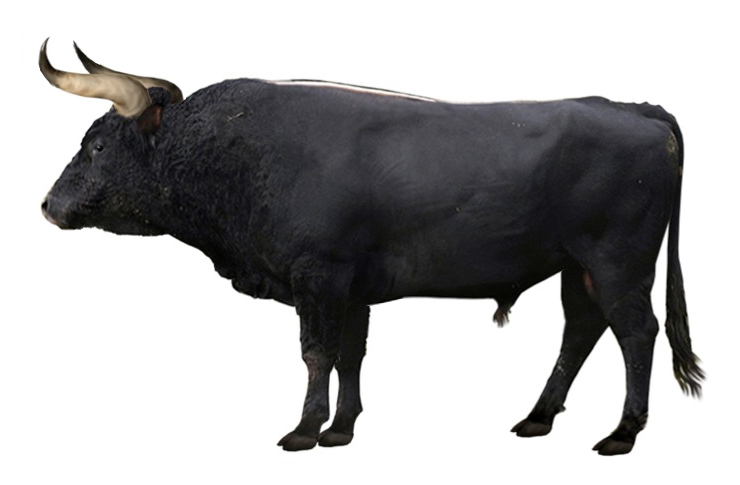 🇵🇱 Poland and 5 moreAurochs
The wild ancestor of all domestic cattle, extinct since 1627Wild · Long-horned
🇵🇱 Poland and 5 moreAurochs
The wild ancestor of all domestic cattle, extinct since 1627Wild · Long-horned
 🇵🇰 Pakistan and 5 moreZebu
Humped, heat-tolerant cattle of South Asia, kept for milk, meat, work and ridingZebu · Dairy · Heat-tolerant
🇵🇰 Pakistan and 5 moreZebu
Humped, heat-tolerant cattle of South Asia, kept for milk, meat, work and ridingZebu · Dairy · Heat-tolerant
 🇰🇷 South Korea and 1 moreHanwoo한우
A small, brown taurine breed from Korea, once used for work and now prized for its premium beef.Taurine · Beef · Docile
🇰🇷 South Korea and 1 moreHanwoo한우
A small, brown taurine breed from Korea, once used for work and now prized for its premium beef.Taurine · Beef · Docile
Photo credits on this page
The small pictures above come from Wikimedia Commons under free licences. Some are cropped to fit.
- Hanwoo: mycrefun, CC0, source
- Aurochs: Jaap Rouwenhorst (photograph) DFoidl (GIMP modifications), CC BY-SA 3.0, source
- Zebu: A. J. T. Johnsingh, WWF-India and NCF, CC BY-SA 4.0, source