Long-horned breeds
Great sweeping horns: Ankole, Texas Longhorn, Highland, Hungarian Grey and Kankrej.
Long-horned cattle carry great sweeping horns, sometimes far wider than the animal itself. The Ankole of Uganda and Rwanda, and the Ankole-Watusi bred from them in America, have some of the largest horns of any cattle. The Texas Longhorn, the Highland of Scotland, the Hungarian Grey and the English Longhorn all have their own shapes. In India, the Kankrej carries lyre-shaped horns, and the Hallikar, Amrit Mahal and Khillari have long, upward and backward sweeping horns. The Kuri of Lake Chad has unusually thick, bulbous horns.
Shapes and sizes
Horns come in many shapes. Lyre horns rise and curve outward, then up, like the frame of the instrument. Texas Longhorns spread horizontally, sometimes well over two metres from tip to tip in record animals. Highland horns sweep out and up. The English Longhorn's horns curve down and around the face. Ankole horns are thick at the base and rise high, while the Kuri's horns are thick and bulbous for much of their length.
Horns and heat
Horns are made of a bony core covered with keratin, and the core carries blood vessels. In large-horned breeds of hot countries, such as the Ankole, the horns are thought to help lose body heat, as blood running through them cools. Horns are also used in defence, and in herding cultures they are a mark of beauty and status, shaped and trained by their keepers.
Indian horns
Indian breeds are often recognised first by their horns. The Kankrej has large, lyre-shaped horns. The Hallikar and Amrit Mahal have long horns rising close together and curving back, ending in sharp points. The Khillari horns are long and pointed, and the Gir's horns curl back and down from a domed forehead. At Mattu Pongal and Pola, these horns are painted, capped with brass and decorated with tassels.
Longhorns in the Americas
The Texas Longhorn descends from the cattle brought by Spanish settlers to the Americas, which ran half-wild in Texas and were driven north in great numbers after the American Civil War. It was nearly lost in the early twentieth century and saved by a small number of breeders and a federal wildlife refuge herd. Today it is valued for hardiness, easy calving and lean beef as well as its horns.
Worth knowing
- Ankole-Watusi: American breed from Ankole cattle, with very large horns
- Texas Longhorn: Spanish-descended American breed with wide horns
- Highland: Scottish breed with sweeping horns
- Hungarian Grey: Grey Podolic cattle with long lyre horns
- English Longhorn: Old English breed with downward curving horns
- Kankrej: Gujarat zebu with lyre-shaped horns
- Hallikar: Karnataka breed with long, backward sweeping horns
- Kuri: Lake Chad cattle with thick, bulbous horns
Good to know
- Long-horned cattle need wider gates, troughs and crushes than polled cattle.
- Check that feed barriers and trailers leave room for the horns.
Sources and further reading
Original text by the EveryCow desk, written with AI assistance and checked against the sources above. Customs are described as tradition, not as advice. If we have something wrong, tell us.
Long-horned on EveryCow
The breeds written up so far, best known first.
 🇺🇸 United StatesTexas Longhorn
American beef cattle, once feral on Texas ranges, with horn spreads beyond 2.4 mTaurine · Beef · Heat-tolerant
🇺🇸 United StatesTexas Longhorn
American beef cattle, once feral on Texas ranges, with horn spreads beyond 2.4 mTaurine · Beef · Heat-tolerant
 🇭🇺 HungaryHungarian GreyMagyar Szürke
A tall, long-horned Podolic breed from the Hungarian plains, kept for beef and draught work.Taurine · Beef · Marbled beef
🇭🇺 HungaryHungarian GreyMagyar Szürke
A tall, long-horned Podolic breed from the Hungarian plains, kept for beef and draught work.Taurine · Beef · Marbled beef
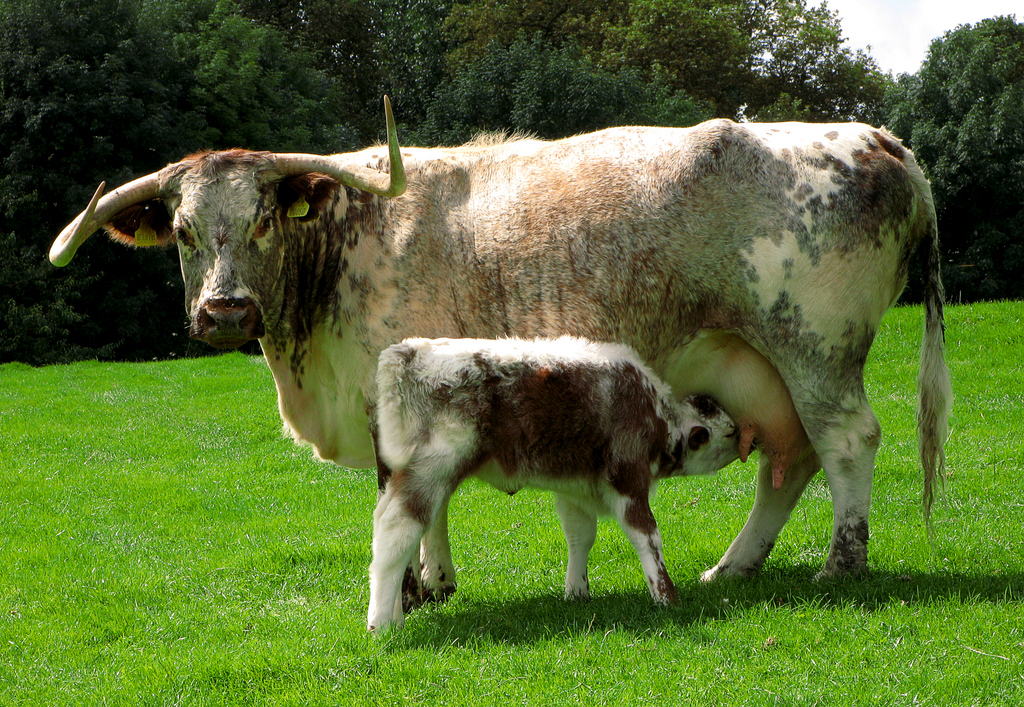 🇬🇧 United Kingdom and 3 moreEnglish Longhorn
A large horned beef breed from northern England, marked by a white line along the spineTaurine · Beef · Long-horned
🇬🇧 United Kingdom and 3 moreEnglish Longhorn
A large horned beef breed from northern England, marked by a white line along the spineTaurine · Beef · Long-horned
 🇬🇧 United KingdomVaynolFaenol
A rare Welsh park breed, white with black points or all blackTaurine · Beef · Thrifty foragers
🇬🇧 United KingdomVaynolFaenol
A rare Welsh park breed, white with black points or all blackTaurine · Beef · Thrifty foragers
Photo credits on this page
The small pictures above come from Wikimedia Commons under free licences. Some are cropped to fit.
- Hungarian Grey: The original uploader was Faludi at Hungarian Wikipedia ., CC BY-SA 3.0, source
- English Longhorn: Dave, CC BY-SA 2.0, source
- Texas Longhorn: Clinton & Charles Robertson, CC BY 2.0, source
- Vaynol: Claire.cojean.05, CC BY-SA 4.0, source