
Hungarian Grey
In its own language: Magyar Szürke
A tall, long-horned Podolic breed from the Hungarian plains, kept for beef and draught work.
The Hungarian Grey is a robust taurine breed native to Hungary, belonging to the Podolic group. It features a pale grey coat and distinctive lyre-shaped horns, and is raised primarily for its lean beef and as a working animal on the open steppe.
- Bulls stand 150 cm tall and weigh 800 kg
- Coat ranges from silvery-white to ash-grey
- Calves are born reddish, turning grey at six months
- Supplies 12% of local beef in Hungary
- Included in the Slow Food Ark of Taste
What do Hungarian Grey cattle look like?
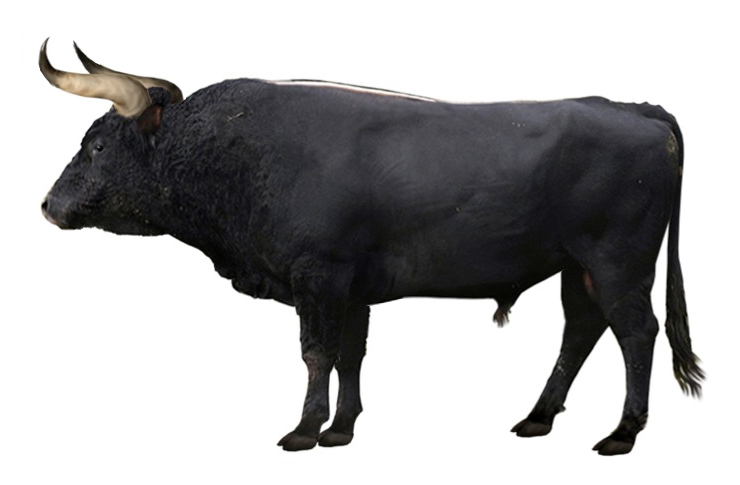
This breed presents a tall, slender frame with high muscle density. The coat ranges from silvery-white to ash-grey, while the skin remains pigmented grey. Calves are born reddish but turn grey around six months old. Bulls typically appear darker than cows, often featuring black scrotums and eyes ringed in black. A defining feature is the pair of long, round-horned structures that curve upward into a lyre shape, measuring roughly seventy to eighty centimetres. These animals are robust and well-suited to extensive farming systems.
Where does the Hungarian Grey come from?
The exact origins remain unknown. Past theories suggested arrival with the Magyars in the ninth century or introduction by Cumanian or Pecheneg peoples, but these lack archaeological support. Other ideas include descent from Italian peninsula stock or direct lineage from the aurochs, though osteometric data contradicts the latter. Despite this uncertainty, the breed has been a staple of the Hungarian puszta for centuries, forming part of the broader Podolic cattle group.
What the Hungarian Grey is known for
Hungarian Greys are known for their resilience and suitability for large-scale herding. They produce lean, marbled meat that develops slowly but yields low-fat cuts ideal for salami and sausages. The breed exhibits reported resistance to cattle diseases that affect more highly bred types, making them valuable as gene banks. Their temperament allows them to function effectively in both free-range pasture systems and as tourist attractions within national parks.
How the Hungarian Grey is bred and kept
The Hungarian Grey Cattle Breeders' Association was founded in 1931 to promote the breed, though World War II severely disrupted these efforts. By the early 1960s, only 160 cows and six bulls remained across three farms. A subsequent patriotic movement helped preserve local breeds, leading to a rebound in population supported by government subsidies and cryoconservation efforts. Today, the breed is distributed mainly in Bács-Kiskun, Hajdú-Bihar, and Veszprém counties.
Hungarian Grey, drawn
What the Hungarian Grey is kept for
Primarily reared for beef, the breed supplies approximately twelve percent of locally produced beef in Hungary. Its meat is prized for being low in fat and suitable for processed products like sausages. Historically, the cattle were also used extensively as draught animals, driven on the hoof to markets in western Europe such as Vienna and Augsburg. In modern times, herds in places like Hortobágy National Park serve as living gene banks and tourist draws.
The land and climate of the Hungarian Grey
The breed is adapted to the extensive pasture systems of the Hungarian puszta. Historically, they roamed the plains and were driven hundreds of kilometres to distant markets. The environment suits their robust build and ability to thrive on open grazing land. While originally widespread across the plains, current populations are concentrated in specific counties and protected areas where conservation efforts maintain their presence.
Who keeps the Hungarian Grey
The breed is deeply tied to Hungarian history and the hajduk, who drove cattle westward to European cities for slaughter. During the Middle Ages through the eighteenth century, tens of thousands were exported annually. The Magyar people settled the Carpathian Basin with these animals, though the exact timing of their arrival remains debated. Modern preservation is supported by the Hungarian government and dedicated breeding associations.
At a glance: where it belongs


Faith and ritual
There is no specific spiritual role described for this breed in the provided sources. While cattle hold cultural significance in Hungary, the Hungarian Grey is primarily noted for its agricultural and historical utility rather than religious ritual or sacred status.
The Hungarian Grey at fairs and festivals
The breed appears in tourist attractions within Hungarian national parks, including Hortobágy. Herds in locations like Bocfölde serve as educational and conservation displays.
Custom and folk tradition
Historically, the driving of Hungarian cattle on the hoof to markets in Vienna, Augsburg, and Venice was a major trade tradition. Documents from the sixteenth century refer to 'long-horned Hungarian cattle', highlighting their distinct appearance. The trade was once so vast that it exceeded one hundred thousand head annually in the seventeenth century before Ottoman invasions and market changes altered its course.
Keeping Hungarian Grey cattle
However, the breed is maintained through government subsidies and cryoconservation efforts. They are kept in herds that function as gene banks, benefiting from their natural disease resistance. Breeding programs focus on preserving the genetic line after near-extinction events in the twentieth century.
Numbers, conservation and the herd book
In 1975, only 300 cows remained in two herds. Since then, numbers have increased due to conservation efforts and government support. By 2003, the breed supplied about twelve percent of Hungary's domestic beef. The FAO and DAD-IS list the breed as not at risk, reflecting the successful recovery from the critical lows of the mid-twentieth century.
From the Hungarian Grey
Questions people ask about Hungarian Grey
Where does the Hungarian Grey come from?
It is a native breed of Hungary, historically found on the Hungarian puszta plains. It belongs to the Podolic cattle group and has been associated with the region since medieval times, though its exact origins remain debated.
What is the Hungarian Grey kept for?
It is primarily raised for beef, providing lean, marbled meat suitable for salami and sausages. It was also traditionally used as a draught animal and is now kept for conservation and tourism in national parks.
What do Hungarian Greys look like?
They are tall, slender cattle with a pale grey coat ranging from silvery-white to ash-grey. They have distinctive long, lyre-shaped horns that curve upwards, and calves are born reddish before turning grey around six months old.
Is the Hungarian Grey endangered?
No, it is currently listed as not at risk by the FAO and DAD-IS. After dropping to just 300 cows in 1975, conservation efforts and government subsidies have helped the population recover significantly.
How does the meat compare to other breeds?
The meat is low in fat and highly marbled, making it ideal for processing into beef salami and sausages. The breed develops slowly but produces high-quality, lean beef that is valued in Hungary.
Good reading and sources
- Hungarian Grey on WikipediaEncyclopedia
- More photos on Wikimedia CommonsPhotos and video
- Wikidata recordOpen data
The facts on this page come from the Wikipedia article "Hungarian Grey", written by its contributors and used under the CC BY-SA 4.0 licence, and from its Wikidata record (CC0). EveryCow rewrote the text in its own words, with AI assistance, and compares every page with the article to make sure no passage is copied. It may be reused under the same CC BY-SA 4.0 licence with a link back.
It may contain mistakes. Sizes, colours and customs differ from one herd, valley or breeder to the next. Folk beliefs are described as tradition, never as advice. If something is wrong, tell us. Last refreshed 2026-10-16.
More from Hungary
All the breeds of Hungary 🇦🇹 Austria and 5 moreFleckvieh
A large Central European dual-purpose breed, red and white pied or solid red, kept for milk and beef.Composite · Dual-purpose · Docile
🇦🇹 Austria and 5 moreFleckvieh
A large Central European dual-purpose breed, red and white pied or solid red, kept for milk and beef.Composite · Dual-purpose · Docile
 🇵🇱 Poland and 5 moreAurochs
The wild ancestor of all domestic cattle, extinct since 1627Wild · Long-horned
🇵🇱 Poland and 5 moreAurochs
The wild ancestor of all domestic cattle, extinct since 1627Wild · Long-horned
 🇩🇪 Germany and 2 moreTaurus cattle
Long-legged cross-bred cattle bred in Germany to stand in for the extinct aurochsComposite · Grazing
🇩🇪 Germany and 2 moreTaurus cattle
Long-legged cross-bred cattle bred in Germany to stand in for the extinct aurochsComposite · Grazing
Its cousins elsewhere
All beef breeds 🇲🇳 Mongolia and 4 moreYakགཡག་
A shaggy, cold-hardy highland bovine kept across the Himalayas and Tibetan PlateauYak · Triple-purpose · Cold-hardy
🇲🇳 Mongolia and 4 moreYakགཡག་
A shaggy, cold-hardy highland bovine kept across the Himalayas and Tibetan PlateauYak · Triple-purpose · Cold-hardy
 🇮🇩 Indonesia and 5 moreBantengbanṭéng (Javanese/Sundanese)
A wild Southeast Asian ox; its tame form, Bali cattle, runs feral in northern AustraliaBanteng · Beef · Drought-hardy
🇮🇩 Indonesia and 5 moreBantengbanṭéng (Javanese/Sundanese)
A wild Southeast Asian ox; its tame form, Bali cattle, runs feral in northern AustraliaBanteng · Beef · Drought-hardy
 🇺🇸 United StatesTexas Longhorn
American beef cattle, once feral on Texas ranges, with horn spreads beyond 2.4 mTaurine · Beef · Heat-tolerant
🇺🇸 United StatesTexas Longhorn
American beef cattle, once feral on Texas ranges, with horn spreads beyond 2.4 mTaurine · Beef · Heat-tolerant
 🇺🇸 United StatesAnkole-Watusi
A large-horned American breed derived from African Sanga cattle, kept for its distinctive horns and hardy build.Sanga · Heritage · Long-horned
🇺🇸 United StatesAnkole-Watusi
A large-horned American breed derived from African Sanga cattle, kept for its distinctive horns and hardy build.Sanga · Heritage · Long-horned