🇮🇳 The cattle breeds of India
45 breeds from India, best known first, across 80 towns, fairs and pastures.
India keeps more bovines than any other country and draws more milk from them than anywhere else. Buffaloes give the largest share, cows most of the rest, and goats a small amount. Milk reaches households through village co-operatives as well as family herds, and it shapes cooking, festivals and religious life.
- Zebu cattle were domesticated in the subcontinent about 8,000 years ago.
- Buffaloes yielded 91.82 million tonnes of milk in 2019.
- Native cows give about 3.7 kg of milk a day; exotic cows about 11.5 kg.
- The Anand co-operative model began in Gujarat in 1946.
- The 2019 livestock census found more than 300 million bovines in India.
Cattle in India
Cattle and buffaloes sit at the centre of Indian farming. The zebu, the humped cattle of the subcontinent, was domesticated here about 8,000 years ago, and the water buffalo is native to South Asia as well. Most milk comes from buffaloes, with cows supplying much of the remainder; goats add a small quantity. Native cows and buffaloes typically carry the A2A2 genotype, which gives A2 milk. Herds are largely small and family-run, though since the 1970s village co-operatives have gathered milk, processed it at district plants and sold it through state federations. Indigenous cattle are giving way to cross-bred and imported animals, which yield more per day. Buffalo milk is the mainstay of butter, ghee, paneer and yoghurt production.
The breeds
The kinds of cattle named are the humped zebu, native to the subcontinent, and the water buffalo, also indigenous to South Asia. Native cow and buffalo breeds mostly carry the A2A2 genotype. Alongside them stand exotic breeds brought from abroad and cross-bred animals. Yields differ sharply: a native cow averages about 3.7 kg of milk a day, a cross-bred cow about 7.6 kg and an exotic cow about 11.5 kg. The numbers of indigenous breeds are falling while cross-bred and imported stock rise.
Regions and communities
Cooking and dairy use differ across the country. Northern kitchens, Punjabi ones especially, lean on paneer, cream and ghee; southern cooking makes more use of yoghurt and milk. The co-operative idea began in Anand, Gujarat, and the first phase of Operation Flood concentrated on the country around Delhi, Mumbai, Kolkata and Chennai. Kerala's government bought milk in bulk for Onam. In earlier decades, how much dairy a household ate depended on where it lived and what it could afford, and intake overall was low.
Milk, butter and beef
Buffaloes supply the raw material for most of the country's dairy foods, with cows filling in much of the rest. Paneer, butter, ghee and curd are the staples, and ghee appears both as a cooking fat and as a spread on roti. Northern gravies are enriched with cream. Milk goes into chai, which most Indians drink sweetened; by 2018 the average person used about 0.78 kg of tea a year. Older recipes include payasa and madhuparka, a welcome drink of honey with curd or ghee. Almost all milk is used at home, only a small share is exported, and imports are few and carry tariffs. Buffalo meat, known as carabeef, is also eaten.
Festivals, fairs and faith
Hindus treat the cow as sacred, and milk, curd and ghee rank among the five sacred cow products. The buffalo stands opposite: it is considered unclean and unlucky, and Hindu myth ties it to evil, with Yama, the god of death, riding one. Offerings of milk are made at Maha Shivaratri and Nag Panchami. At Pongal, a clay pot of rice and milk is boiled so that it spills over the rim, and the food is offered to the gods, then the cows, then the family. At Holi, milk goes into thandai, a mildly intoxicating drink. Jains debate whether dairy is acceptable, but most eat it. Mahatma Gandhi wished Indians drank more cow milk and less buffalo milk.
Today
India leads the world in milk output and consumption, having passed the United States in 1997. Reported production reached 187.7 million tonnes in 2018-19, when each person had about 394 g of milk a day available. Dairy contributed roughly 4.2% of GDP as of 2020, and the sector was growing at about 4.9% a year in 2019. Over 300 million bovines are kept. Native breeds are shrinking in number while cross-bred and exotic stock grows, and imports remain small and taxed.
The facts in this overview come from the Wikipedia article "Dairy in India", written by its contributors and used under the CC BY-SA 4.0 licence. EveryCow rewrote the text in its own words, with AI assistance, and compares every page with the article to make sure no passage is copied. It may be reused under the same CC BY-SA 4.0 licence with a link back.
Cattle towns and fairs of India
 🇵🇰 Pakistan and 5 moreZebu
Humped, heat-tolerant cattle of South Asia, kept for milk, meat, work and ridingZebu · Dairy · Heat-tolerant
🇵🇰 Pakistan and 5 moreZebu
Humped, heat-tolerant cattle of South Asia, kept for milk, meat, work and ridingZebu · Dairy · Heat-tolerant
 🇵🇰 Pakistan and 4 moreSahiwal
A heat-tolerant zebu from the Punjab, kept for milk, meat and draught workZebu · Dairy · Heat-tolerant
🇵🇰 Pakistan and 4 moreSahiwal
A heat-tolerant zebu from the Punjab, kept for milk, meat and draught workZebu · Dairy · Heat-tolerant
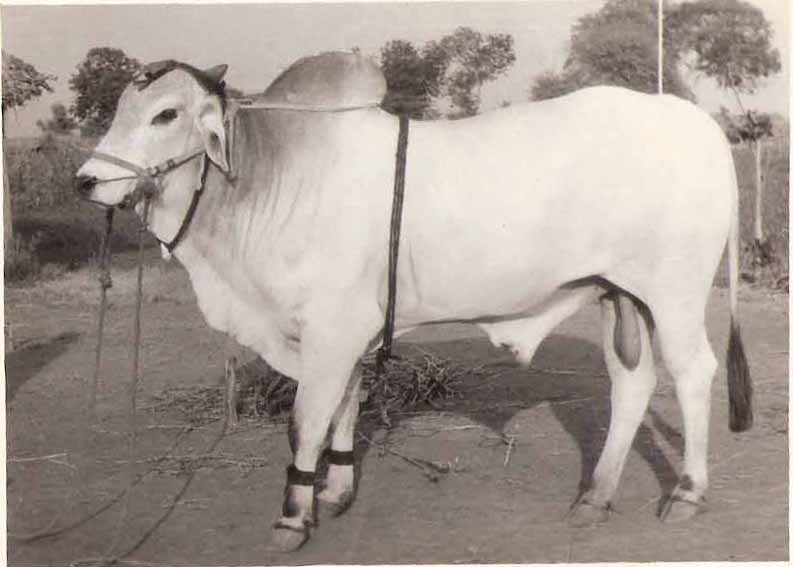 🇮🇳 India and 5 moreOngole
A short-horned zebu breed from Andhra Pradesh, white with dark markings, used for work and milk.Zebu · Draught · Heat-tolerant
🇮🇳 India and 5 moreOngole
A short-horned zebu breed from Andhra Pradesh, white with dark markings, used for work and milk.Zebu · Draught · Heat-tolerant
 🇮🇳 IndiaKhillari
A draft breed from Maharashtra and Karnataka, compact with sweeping horns and grey-white coats.Zebu · Draught · Heat-tolerant
🇮🇳 IndiaKhillari
A draft breed from Maharashtra and Karnataka, compact with sweeping horns and grey-white coats.Zebu · Draught · Heat-tolerant
 🇮🇳 India and 2 moreKankrej
A grey zebu from the dry Rann of Kutch, kept for milk and for work oxenZebu · Dual-purpose · Heat-tolerant
🇮🇳 India and 2 moreKankrej
A grey zebu from the dry Rann of Kutch, kept for milk and for work oxenZebu · Dual-purpose · Heat-tolerant
 🇮🇳 IndiaJavariಜವಾರಿ
A medium-built dual-purpose zebu from Kalyana-Karnataka, gentle and heat-tolerantZebu · Dairy · Heat-tolerant
🇮🇳 IndiaJavariಜವಾರಿ
A medium-built dual-purpose zebu from Kalyana-Karnataka, gentle and heat-tolerantZebu · Dairy · Heat-tolerant
Photo credits on this page
The small pictures above come from Wikimedia Commons under free licences. Some are cropped to fit.
- Kankrej: Pavanaja, CC BY-SA 3.0, source
- Khillari: Pavanaja, CC BY-SA 3.0, source
- Sahiwal: Harvinder Chandigarh, CC BY-SA 4.0, source
- Ongole: DMR Sekhar, CC BY-SA 3.0, source
- Zebu: A. J. T. Johnsingh, WWF-India and NCF, CC BY-SA 4.0, source
- Javari: Pavanaja, CC BY-SA 3.0, source
The weekly digest
Every Monday: seven cattle breeds you may not know, the cattle days of the week ahead, and one product explained step by step.