Dung, hide and horn
Drinking horn
A horn hollowed, cleaned and polished into a cup, used at feasts from the ancient world to the Georgian supra.
A drinking horn is the horn of a bovine, hollowed and cleaned, often mounted with metal at the rim and tip. Horns of the aurochs and of domestic cattle were used as cups across ancient and medieval Europe, especially in the Germanic and Norse world. In Georgia, horns called kantsi are still raised for toasts at the supra, the formal feast.
What goes in
- Cattle horn1077%, The keratin sheath.
- Beeswax or food-safe sealant18%, Lines the inside.
- Metal mounts215%, Silver or brass at rim and tip.
Rough parts by weight. The ring shows each input's share of the product.
Made step by step
Each drawing shows the operation for that step. Quantities and timings differ from house to house and herd to herd; this is one traditional way, in outline.
Step 1: Boil Boil or soak the horn to loosen and remove the bony core. Step 2: Shape Scrape and file the sheath inside and out. Step 3: Dry Dry the horn and polish it with fine abrasives. Step 4: Shape Seal the inside and fit mounts to the rim and tip. Step 5: Serve Raise it at the feast and pass it on. Finished Drinking horn, by share.
Feast and ritual
Julius Caesar wrote that the Germans hunted the aurochs and used its horns, rimmed with silver, as cups at their feasts. Anglo-Saxon burials such as Sutton Hoo held horns with silver mounts. In Scandinavia horns were passed at feasts and later carved and mounted by guilds. A horn cannot be put down until it is empty, which shaped drinking customs.
Working horn
Horn is keratin over a bony core. After slaughter the core is loosened and removed, and the sheath is cleaned, scraped and polished. Horn can be softened with heat and shaped, and was also made into spoons, combs, lantern panes and powder flasks. Breeds with long horns, such as the Hungarian Grey and the Highland, give the largest horns.
Where it is used
The breeds behind it
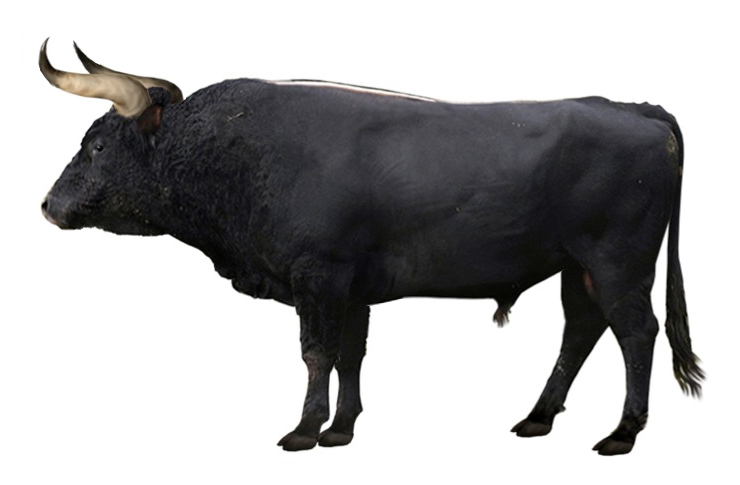 AurochsThe wild ancestor whose horns Caesar described as cups.
 Hungarian GreyGrey steppe breed with long, upswept horns.
Also part of it, and being written: Highland cattle (Long-horned Scottish breed.), Georgian Mountain cattle (Native cattle of Georgia.).
More on EveryCow
No breeds here yet. New pages are added every day.
Sources and further reading
Original text and drawings by the EveryCow desk, written with AI assistance and checked against the sources above. The shares are a rough, illustrative ratio, not a recipe: every family and dairy makes it differently. If we have something wrong, tell us.
Photo credits on this page
The small pictures above come from Wikimedia Commons under free licences. Some are cropped to fit.
- Aurochs: Jaap Rouwenhorst (photograph) DFoidl (GIMP modifications), CC BY-SA 3.0, source
- Hungarian Grey: The original uploader was Faludi at Hungarian Wikipedia ., CC BY-SA 3.0, source