Conservation grazing
Highland, Galloway and Heck cattle: kept to graze heath, marsh and wild land back into shape.
Conservation grazing uses cattle to manage land for wildlife. Grazing and trampling keep grass short, open up scrub, create bare patches for seeds and insects, and stop heath, marsh and meadow from turning into thicket. Hardy native breeds that do well on rough forage are the usual choice: Highland, Galloway, Belted Galloway, Dexter, English Longhorn, Exmoor-type hill cattle and, in rewilding projects, Heck and Tauros cattle. In India, the old practice of free grazing by herding breeds such as Pulikulam shapes grasslands in a similar way.
Why cattle
Cattle graze differently from sheep. They wrap their tongues around tall, coarse grass and pull it, rather than nibbling close to the ground, so they open up rank grassland and leave a mosaic of tall and short patches. Their weight breaks up bracken and dead litter, and their dung feeds beetles and the birds and bats that eat them. Nature reserves in Britain, the Netherlands, Germany and Scandinavia use small herds of cattle in exactly this way, often all year round.
The breeds that suit
A conservation grazier wants cattle that live outdoors in winter, find a living on poor and wet ground, calve without help and are calm with walkers. The Highland, with its shaggy double coat, and the Galloway, Belted Galloway and Welsh Black are favourites in Britain. The English Longhorn is used at the rewilding estate of Knepp in Sussex. In the Netherlands, Heck cattle grazed the Oostvaardersplassen, and Tauros cattle now roam rewilding areas in several European countries.
Herding and grazing in India
India has its own traditions of grazing with native breeds. In southern Tamil Nadu, Pulikulam herds move from village to village and are penned on fields at night so their dung fertilises the soil before planting. The Banni grasslands of Kutch support Maldhari herders whose cattle include Kankrej. These long-standing systems are now studied by ecologists as examples of how grazing can sit within a wider landscape.
Worth knowing
- Highland: Shaggy Scottish cattle used on heath and wetland reserves
- Galloway: Polled, double-coated breed of south-west Scotland
- Belted Galloway: Galloway with a white belt, used on many reserves
- English Longhorn: Old English breed used in rewilding projects
- Heck cattle: German back-bred cattle used in wild grazing schemes
- Pulikulam: Tamil Nadu herding breed penned on fields for manure
- Dexter: Small Irish breed for wet or light ground
Good to know
- Conservation herds still need daily or regular checks, clean water and access to handling yards.
- Calm breeds and well-placed gates matter where cattle share land with walkers and dogs.
- Stocking rates are usually low, set by a grazing plan for the habitat rather than for weight gain.
Sources and further reading
- Conservation grazing on Wikipedia
- Highland cattle, Wikipedia
- Heck cattle, Wikipedia
- Rewilding, Wikipedia
- Pulikulam, Wikipedia
Original text by the EveryCow desk, written with AI assistance and checked against the sources above. Customs are described as tradition, not as advice. If we have something wrong, tell us.
Grazing on EveryCow
The breeds written up so far, best known first.
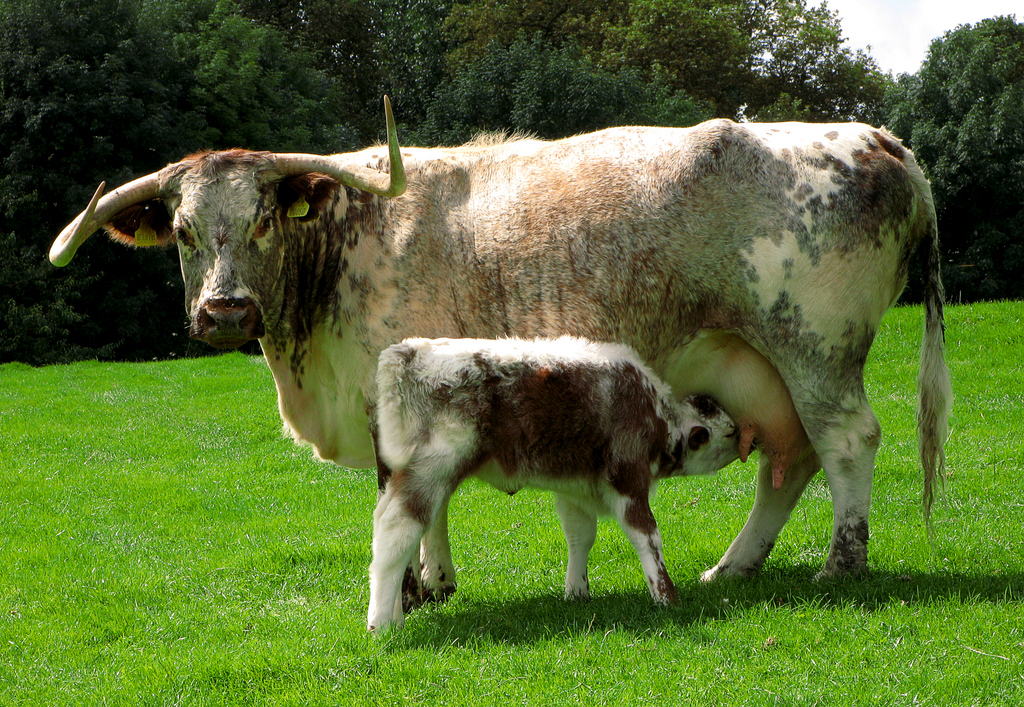 🇬🇧 United Kingdom and 3 moreEnglish Longhorn
A large horned beef breed from northern England, marked by a white line along the spineTaurine · Beef · Long-horned
🇬🇧 United Kingdom and 3 moreEnglish Longhorn
A large horned beef breed from northern England, marked by a white line along the spineTaurine · Beef · Long-horned
 🇦🇹 AustriaTux-ZillertalTux-Zillertaler
A stocky Alpine breed from Tirol, black or red, once bred for cow-fighting contests.Taurine · Beef · Spirited
🇮🇪 IrelandDroimeann
A small Irish dual-purpose cow with a white stripe down its backTaurine · Dual-purpose · Docile
🇦🇹 AustriaTux-ZillertalTux-Zillertaler
A stocky Alpine breed from Tirol, black or red, once bred for cow-fighting contests.Taurine · Beef · Spirited
🇮🇪 IrelandDroimeann
A small Irish dual-purpose cow with a white stripe down its backTaurine · Dual-purpose · Docile
Photo credits on this page
The small pictures above come from Wikimedia Commons under free licences. Some are cropped to fit.
- English Longhorn: Dave, CC BY-SA 2.0, source
- Tux-Zillertal: Böhringer Friedrich, CC BY-SA 2.5, source