
Tux-Zillertal
In its own language: Tux-Zillertaler
A stocky Alpine breed from Tirol, black or red, once bred for cow-fighting contests.
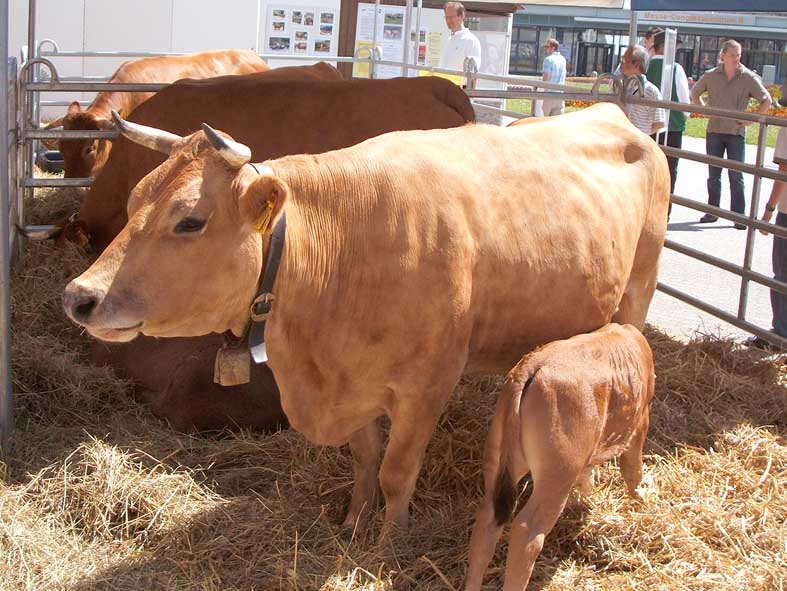
An Austrian Alpine breed assembled in 1982 from the last Tux and Zillertal cattle; stocky, with black-tipped horns and a black or red coat marked with white on the lower body. Cows were long bred to fight each other; it now provides meat, fatty milk and grazing work.
- Formed in 1982 from the last of the Tux and Zillertal breeds
- Only 30 animals remained in 1970; a 2002 count found 471
- Cows are matched against each other, as with the Swiss Hérens
- The milk is unusually fatty, though yields are low
- Black coats trace to the Tux line, red ones to the Zillertal
What do Tux-Zillertal cattle look like?
The Tux-Zillertal is a mid-sized Alpine cow, sturdy through the body with a powerful neck. Bulls stand near 130 cm and weigh around 1100 kg; cows reach about 125 cm at the withers, the ridge between the shoulders, and some 600 kg. Both sexes carry horns, each tipped in black. The coat is either black or red, and low on the body it carries white: across the hindquarters, at the tail head, beneath the belly and over the udder. The black version traces to the Tux parent stock, the red to the Zillertal. The skin is dark, and the muzzle and hooves are black.
Where does the Tux-Zillertal come from?
This is a young name for old stock. In 1982 the last animals of two kindred Tyrolean breeds, the Tux and Zillertal, were combined into one. The name pairs the municipality of Tux, which lies in the Tuxertal valley, with the neighbouring Zillertal, in Austria's Tirol. The Tux strain once ranged across Tyrol and other parts of the country, but its survivors ended up mainly in the Zillertal. Swiss links run deep: the breed resembles the Hérens, and some consider it a descendant of that Swiss stock.
What the Tux-Zillertal is known for
Generations of choice-making shaped its character. Herders kept cows that would stand their ground and fight, so boldness runs in the line, while milk yield was allowed to slip. At the same time the breed is frugal, meaning it stays in condition on modest feed, and it copes well with the tough grazing found high in the mountains. Its strength lies in a sturdy frame rather than in production figures.
How the Tux-Zillertal is bred and kept
Breeding aims here were unusual. Rather than pushing milk or beef output, keepers chose their cows for success in contests of strength, and productivity paid the price; the thin milk yield traces to that habit. When numbers collapsed in the twentieth century, organised rescue work began, and in 1982 the surviving Tux and Zillertal cattle were combined so that one breed would carry both lines. The modern Tux-Zillertal descends from that union.
Tux-Zillertal, drawn
What the Tux-Zillertal is kept for
Today the breed earns its keep chiefly through meat and through grazing work: herds are turned out to keep plant growth in check on rough ground. Milk remains part of the picture, and it is notable for fat, with a level that is unusually high; yields, though, fell during the long stretch when cows were judged on their fighting rather than on output. Fighting contests still involve the cows, after the fashion of the Swiss Hérens and Évolène, but they are no longer the headline purpose.
The land and climate of the Tux-Zillertal
High Alpine pasture is its home ground. The breed thrives on the rough grazing of the mountains, and its frugal nature means it makes do where hungrier animals would struggle. Its main herd today lives in the Zillertal, a valley in Tirol, where mountain grazing shapes the farming year.
At a glance: where it belongs
Land and climate
Celebrations


The Tux-Zillertal at fairs and festivals
The best-known event linked to this breed is a contest between cows. As in Switzerland with the Hérens and Évolène breeds, cows are matched against one another, and for generations keepers picked breeding animals with these fights in mind. The tradition places the Tux-Zillertal alongside its Swiss relatives among the fighting cattle of the Alps.
Numbers, conservation and the herd book
The breed is classed as endangered. Its numbers tell the story: some 4500 head existed in 1930, yet by 1970 only thirty animals remained, which is what prompted organised rescue work. A count in 2002 recorded 471 cattle, and by 2014 the reported figure stood between 1117 and 2500. Recovery is under way, but the breed remains on the endangered list.
Questions people ask about Tux-Zillertal
Where does the Tux-Zillertal come from?
It comes from Tirol in Austria. The name joins the municipality of Tux, in the Tuxertal valley, to the neighbouring Zillertal. The breed was assembled in 1982 from the last of the Tux and Zillertal breeds, and it may descend from the Swiss Hérens.
What is it kept for?
These days it is kept for beef and for managing plant growth, with herds grazing rough ground. Milk is also drawn, and it is notably high in fat, though yields are modest. Formerly the breed was valued chiefly for cows that fought in contests.
What does it look like?
It is a stocky, mid-sized animal with a powerful neck, and both sexes carry horns tipped in black. Coats are black or red, with white low on the body at the hindquarters, tail head, belly and udder. The skin is dark and the muzzle and hooves black.
How rare is it?
It is endangered. Numbers fell from about 4500 head in 1930 to thirty in 1970, when rescue work started. A 2002 count found 471, and in 2014 between 1117 and 2500 were reported, so the breed is recovering but remains at risk.
Do the cows really fight?
Yes. As with the Swiss Hérens and Évolène breeds, cows are matched against each other in contests, and keepers long preferred bold fighters when choosing breeding animals. That preference came at a cost: productive traits, especially milk yield, were allowed to weaken.
Good reading and sources
- Tux-Zillertal on WikipediaEncyclopedia
- More photos on Wikimedia CommonsPhotos and video
- Wikidata recordOpen data
The facts on this page come from the Wikipedia article "Tux-Zillertal", written by its contributors and used under the CC BY-SA 4.0 licence, and from its Wikidata record (CC0). EveryCow rewrote the text in its own words, with AI assistance, and compares every page with the article to make sure no passage is copied. It may be reused under the same CC BY-SA 4.0 licence with a link back.
It may contain mistakes. Sizes, colours and customs differ from one herd, valley or breeder to the next. Folk beliefs are described as tradition, never as advice. If something is wrong, tell us. Last refreshed 2026-10-16.
More from Austria
All the breeds of Austria 🇨🇭 Switzerland and 5 moreBraunvieh
A large Alpine brown dairy breed from Switzerland, known for its strength and high milk yield.Taurine · Dairy · Rich milk
🇨🇭 Switzerland and 5 moreBraunvieh
A large Alpine brown dairy breed from Switzerland, known for its strength and high milk yield.Taurine · Dairy · Rich milk
 🇦🇹 Austria and 1 morePinzgauer
Chestnut Austrian cattle with a broad white stripe along the back and bellyTaurine · Triple-purpose
🇦🇹 Austria and 1 morePinzgauer
Chestnut Austrian cattle with a broad white stripe along the back and bellyTaurine · Triple-purpose
 🇩🇪 Germany and 1 moreMurnau-Werdenfels
A long-lived brown dairy breed of the Bavarian uplands, milk and beefTaurine · Dairy · Long-lived
🇩🇪 Germany and 1 moreMurnau-Werdenfels
A long-lived brown dairy breed of the Bavarian uplands, milk and beefTaurine · Dairy · Long-lived
 🇦🇹 Austria and 5 moreFleckvieh
A large Central European dual-purpose breed, red and white pied or solid red, kept for milk and beef.Composite · Dual-purpose · Docile
🇦🇹 Austria and 5 moreFleckvieh
A large Central European dual-purpose breed, red and white pied or solid red, kept for milk and beef.Composite · Dual-purpose · Docile
Its cousins elsewhere
All beef breeds 🇲🇳 Mongolia and 4 moreYakགཡག་
A shaggy, cold-hardy highland bovine kept across the Himalayas and Tibetan PlateauYak · Triple-purpose · Cold-hardy
🇲🇳 Mongolia and 4 moreYakགཡག་
A shaggy, cold-hardy highland bovine kept across the Himalayas and Tibetan PlateauYak · Triple-purpose · Cold-hardy
 🇵🇰 Pakistan and 5 moreZebu
Humped, heat-tolerant cattle of South Asia, kept for milk, meat, work and ridingZebu · Dairy · Heat-tolerant
🇵🇰 Pakistan and 5 moreZebu
Humped, heat-tolerant cattle of South Asia, kept for milk, meat, work and ridingZebu · Dairy · Heat-tolerant
 🇮🇩 Indonesia and 4 moreBali cattle
A small humped breed from Indonesia, descended from wild banteng, kept for meat and plowing.Banteng · Beef · Disease-resistant
🇮🇩 Indonesia and 4 moreBali cattle
A small humped breed from Indonesia, descended from wild banteng, kept for meat and plowing.Banteng · Beef · Disease-resistant
 🇨🇳 China and 2 moreWild yak
A massive, shaggy wild bovine native to the high plateaux and peaks of the HimalayasYak · Beef · Cold-hardy
🇨🇳 China and 2 moreWild yak
A massive, shaggy wild bovine native to the high plateaux and peaks of the HimalayasYak · Beef · Cold-hardy