Droimeann
A small Irish dual-purpose cow with a white stripe down its back
A small to medium taurine cow from the south west of Ireland, kept for milk and beef and used in conservation grazing. Coats may be black, red or roan, most animals carry a white stripe along the back and a white belly, and the breed is hardy, quiet and fertile.
- Granted rare breed status on 8 January 2020 after DNA testing showed it was distinct
- Herd book listed 243 breeding cows and 23 breeding bulls in January 2020
- Coats run from near black to red to white, usually with a white stripe on the back
- Cows stand 115-125 cm and weigh 400-550 kg; bulls weigh 600-750 kg
- Droimeann Cattle Society formed in 2016; herd book launched in 2018
What do Droimeann cattle look like?
The Droimeann is a small to medium cow of dairy build. Cows stand about 115 to 125 cm at the withers, the bony ridge between the shoulders, and weigh 400 to 550 kg; bulls reach 125 to 135 cm and 600 to 750 kg. Both sexes carry horns, and the skin under the coat is darkly pigmented. Coats vary. Some animals are nearly all black, others red, others close to white; the sides are often black, red or blue roan, while a white stripe runs along the spine and the belly is white too. Ears and muzzle are usually darker than the body. A hump is not part of the build: this is a taurine breed.
Where does the Droimeann come from?
The breed belongs to the south west of Ireland, and cattle of this kind appear in early Irish writing and folklore. Its Irish name, Droimeann, means white-backed, which describes the stripe along the spine. DNA profiling later showed that the population was genetically separate from other breeds, and on 8 January 2020 the Droimeann was granted rare breed status by the Department of Agriculture, Food and the Marine. The minister at the time, Michael Creed, called the decision a boost for the breed, giving farmers recognition and incentives as they work to keep it.
What the Droimeann is known for
The cattle are quiet to handle and easy to keep. They hold condition on poor quality forage, turning rough grazing into milk and meat rather than needing rich pasture. Cows mature early and are highly fertile, which helps a small population grow. Owners describe a placid disposition, and hardiness is the quality most often noted: these animals suit land and weather that would test a heavier, more demanding cow.
How the Droimeann is bred and kept
The Droimeann Cattle Society was set up on 11 September 2016, when breeders and others interested in saving the breed met. A herd book followed on 22 August 2018. Entry is not automatic: every animal must be genetically tested, and calves have to be tested before they can be added. By January 2020 the book held 243 breeding females and 23 breeding males. That testing policy is what keeps the breed distinct, since it separates true Droimeann stock from cattle that merely look similar.
Droimeann, drawn
What the Droimeann is kept for
The breed works as a dual-purpose animal, giving both milk and beef. Solids in the milk run high, and the beef marbles well and has a flavour of its own. Droimeanns are also kept for conservation grazing, where cattle are put on land to keep the vegetation in check. Early maturity and high fertility mean a herd can be built up without long waits, and the modest size of the cows keeps feed costs down.
The land and climate of the Droimeann
The breed's home is the south west of Ireland, and most of the cattle are kept in Munster. Droimeanns cope with land that offers little: rough, low-value grazing is enough to keep them in condition and to produce milk and beef on ground that many cattle would find poor. Hardiness is the trait that carries them, and the dark skin under the coat goes with it.
Who keeps the Droimeann
Farmers in the south west of Ireland keep the breed, and it was their meeting in 2016 that created the society. Breeders, and others with an interest in preserving the cattle, look after the herd book and arrange the genetic testing that registration requires. Numbers are small, so most keepers know each other and the cows they breed from. Keeping a Droimeann is, in practice, a joint effort between individual farms and the breed body that holds the records.
At a glance: where it belongs
Land and climate
Custom and folk tradition
The old Irish name does the describing for you: Droimeann means white-backed, and the pale stripe down the spine is the mark people looked for. Cattle of this type turn up in early Irish literature and in folklore. Alongside Droimeann, the breed has been called Droimeannach and Irish White-backed in English. Those names record a local cow known to farmers in Munster long before any herd book existed.
Keeping Droimeann cattle
Feeding is simple: the breed does well on poor quality forage and does not need heavy concentrates to produce milk or beef. Handling is straightforward because the cows are placid. Fertility is high and the cattle mature early, which helps a small herd grow. Horns mean care is needed when animals are held in a crush, the narrow pen used for handling cattle, and newborn calves must be genetically tested before they can be registered.
Numbers, conservation and the herd book
In January 2020 the herd book listed 243 breeding females and 23 breeding males, a small base for any breed. The Department of Agriculture, Food and the Marine classed the Droimeann as at risk in 2020, and it is described as endangered. Rare breed status, granted on 8 January 2020 after DNA work, brought official recognition and incentives for keepers. The Droimeann Cattle Society, formed in September 2016, keeps the records and the herd book, which opened in August 2018. The cattle are found almost entirely in Ireland, chiefly in Munster.
Questions people ask about Droimeann
Where does the Droimeann come from?
The south west of Ireland, and the cattle are kept mainly in Munster. Cattle of this type are referred to in early Irish literature and folklore, and the breed's Irish name means white-backed.
What is the Droimeann kept for?
Milk and beef, since it is a dual-purpose breed, and also for conservation grazing, where cattle are put on land to keep vegetation in check. Solids in the milk run high and the beef marbles well.
How many Droimeann cattle are there?
In January 2020 the herd book held 243 breeding females and 23 breeding males. The Department of Agriculture, Food and the Marine rates the breed as at risk, and it is described as endangered.
What colour is a Droimeann?
Coats differ from animal to animal. Some are almost entirely black, some red, some nearly white, and blue roan sides are common. Most have a white stripe along the spine and a white underside, with darker ears and muzzle.
Why are Droimeann cattle DNA tested?
Because entry to the herd book rests on genetics rather than looks. Every animal, including newborn calves, must be tested before it can be registered, which keeps the breed apart from cattle that only resemble it.
Good reading and sources
The facts on this page come from the Wikipedia article "Droimeann", written by its contributors and used under the CC BY-SA 4.0 licence, and from its Wikidata record (CC0). EveryCow rewrote the text in its own words, with AI assistance, and compares every page with the article to make sure no passage is copied. It may be reused under the same CC BY-SA 4.0 licence with a link back.
It may contain mistakes. Sizes, colours and customs differ from one herd, valley or breeder to the next. Folk beliefs are described as tradition, never as advice. If something is wrong, tell us. Last refreshed 2026-10-16.
More from Ireland
All the breeds of Ireland 🇬🇧 United Kingdom and 5 moreShorthorn
A historic British breed from north-east England, kept for milk and meat with red, white or roan coats.Taurine · Dual-purpose · Docile
🇬🇧 United Kingdom and 5 moreShorthorn
A historic British breed from north-east England, kept for milk and meat with red, white or roan coats.Taurine · Dual-purpose · Docile
 🇮🇪 Ireland and 2 moreDexter
A small Irish dual-purpose breed, usually black or red, kept for milk and beef on poor land.Taurine · Dual-purpose · Thrifty foragers
🇮🇪 Ireland and 2 moreDexter
A small Irish dual-purpose breed, usually black or red, kept for milk and beef on poor land.Taurine · Dual-purpose · Thrifty foragers
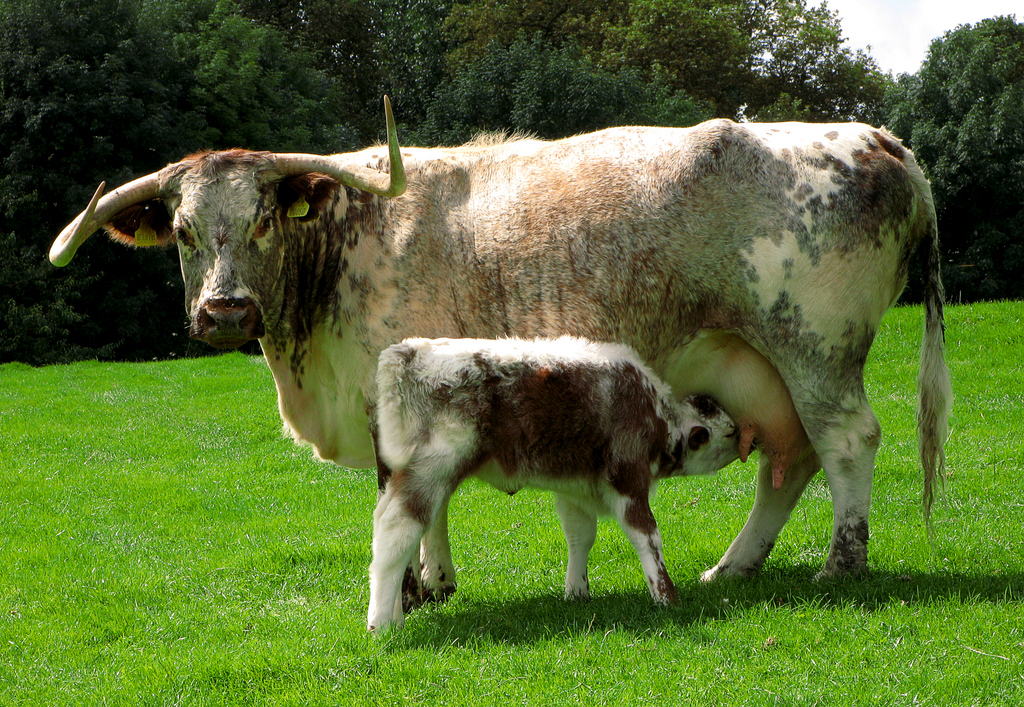 🇬🇧 United Kingdom and 3 moreEnglish Longhorn
A large horned beef breed from northern England, marked by a white line along the spineTaurine · Beef · Long-horned
🇬🇧 United Kingdom and 3 moreEnglish Longhorn
A large horned beef breed from northern England, marked by a white line along the spineTaurine · Beef · Long-horned
 🇮🇪 IrelandIrish MoiledBó Maol
A rare hornless Irish breed, red with a white back stripe, used for milk and beefTaurine · Dual-purpose · Polled
🇮🇪 IrelandIrish MoiledBó Maol
A rare hornless Irish breed, red with a white back stripe, used for milk and beefTaurine · Dual-purpose · Polled
Its cousins elsewhere
All dual-purpose breeds 🇮🇩 Indonesia and 4 moreBali cattle
A small humped breed from Indonesia, descended from wild banteng, kept for meat and plowing.Banteng · Beef · Disease-resistant
🇮🇩 Indonesia and 4 moreBali cattle
A small humped breed from Indonesia, descended from wild banteng, kept for meat and plowing.Banteng · Beef · Disease-resistant
 🇵🇰 Pakistan and 5 moreZebu
Humped, heat-tolerant cattle of South Asia, kept for milk, meat, work and ridingZebu · Dairy · Heat-tolerant
🇵🇰 Pakistan and 5 moreZebu
Humped, heat-tolerant cattle of South Asia, kept for milk, meat, work and ridingZebu · Dairy · Heat-tolerant