Adamawa
A multipurpose humped breed from Adamawa in Nigeria, with crescent-curled horns
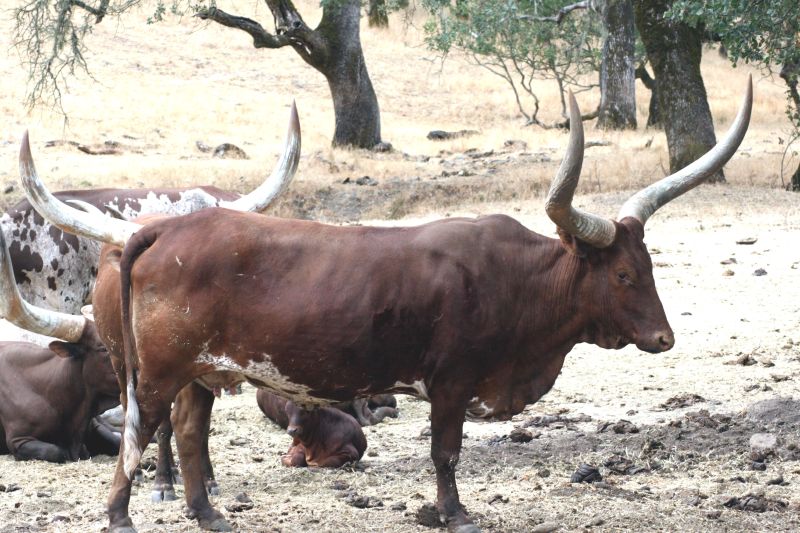
The Adamawa is a humped breed from Adamawa in Nigeria, kept for draught work, milk and beef. It stands medium to large, has a pendulous hump and medium horns curled into a crescent, and looks much like White Fulani.
- Native to Adamawa, in Nigeria, and named after that area
- Kept for draught work, for milk and for beef, so it is a multipurpose breed
- Horns are medium in length and curl into a crescent
- It looks like White Fulani, or Bunaji, but its hump is pendulous
- Two animals in every hundred in Nigeria's herd are of this breed
What do Adamawa cattle look like?
Adamawa cattle belong to the humped, or zebu, side of cattle keeping. They stand medium to large in build. The horns are of medium length and bend round into a crescent. Their hump is the feature that draws the eye: it is pendulous, which means it hangs loosely instead of standing upright and firm. In ordinary appearance they come close to White Fulani, also called Bunaji, and the two can be taken for one another. The shape of the hump is the point where they part company, and that is the mark used to tell the breeds apart.
Where does the Adamawa come from?
The breed takes its name from Adamawa, the part of Nigeria where it is native. It is a local population rather than an animal brought in from elsewhere. Adamawa cattle form part of the national herd of Nigeria, and within that herd they hold a two per cent share. They are therefore a recognised but limited presence in Nigerian cattle keeping, sharing their country with the better known White Fulani, the breed they most closely resemble in appearance.
Adamawa, drawn
What the Adamawa is kept for
These cattle work, and they also feed people. Oxen are put to draught work. Milk is taken from the cows, and the same herd is reared for beef. One animal serves more than one end, which is why the breed is described as multipurpose. A farmer who keeps Adamawa cattle is not tied to a single product, since power, dairy produce and meat all come from the same group of animals.
Numbers, conservation and the herd book
Adamawa cattle hold a modest place among the cattle of their home country. Their share of Nigeria's herd is two per cent, so two animals in every hundred are of this breed. The rest belong to other Nigerian breeds and types. That percentage is the measure used to describe how common the breed is, and it places Adamawa cattle among the smaller parts of the national herd.
Questions people ask about Adamawa
Where does the Adamawa come from?
From Adamawa, in Nigeria. The breed is native to that part of the country and takes its name from it, so it is a Nigerian breed rather than one brought in from elsewhere.
What is the Adamawa kept for?
It does three jobs: oxen are used for draught work, the cows are milked, and the animals are also reared for beef. That is what makes the breed a multipurpose one.
How can I tell an Adamawa from a White Fulani?
The two look much alike. The hump shape is the difference. In the Adamawa the hump is pendulous, which means it hangs loosely, and that is what separates the breed from White Fulani.
How many Adamawa cattle are there?
They account for two per cent of the herd in Nigeria. That is the share given for the breed, and it puts them among the smaller parts of the country's cattle numbers.
What do Adamawa cattle look like?
Medium to large in build, with horns of medium length that curve into a crescent, and a hump that hangs loosely. Their general appearance is close to that of White Fulani, also called Bunaji.
Good reading and sources
The facts on this page come from the Wikipedia article "Adamawa cattle", written by its contributors and used under the CC BY-SA 4.0 licence, and from its Wikidata record (CC0). EveryCow rewrote the text in its own words, with AI assistance, and compares every page with the article to make sure no passage is copied. It may be reused under the same CC BY-SA 4.0 licence with a link back.
It may contain mistakes. Sizes, colours and customs differ from one herd, valley or breeder to the next. Folk beliefs are described as tradition, never as advice. If something is wrong, tell us. Last refreshed 2026-10-16.
More from Nigeria
All the breeds of Nigeria 🇬🇳 Guinea and 5 moreN'Dama
A West African breed that can live where tsetse flies carry trypanosomiasisTaurine · Disease-resistant
🇬🇳 Guinea and 5 moreN'Dama
A West African breed that can live where tsetse flies carry trypanosomiasisTaurine · Disease-resistant
 🇸🇩 Sudan and 4 moreSanga cattle
The umbrella name for native African cattle, mixing humpless taurine and zebu bloodTaurine · Disease-resistant
🇸🇩 Sudan and 4 moreSanga cattle
The umbrella name for native African cattle, mixing humpless taurine and zebu bloodTaurine · Disease-resistant
 🇲🇱 Mali and 5 moreRed Bororo
A red-brown Sanga cattle of the Sahel, with long lyre-shaped hornsSanga · Dairy · Heat-tolerant
🇲🇱 Mali and 5 moreRed Bororo
A red-brown Sanga cattle of the Sahel, with long lyre-shaped hornsSanga · Dairy · Heat-tolerant
Its cousins elsewhere
All triple-purpose breeds 🇲🇳 Mongolia and 4 moreYakགཡག་
A shaggy, cold-hardy highland bovine kept across the Himalayas and Tibetan PlateauYak · Triple-purpose · Cold-hardy
🇲🇳 Mongolia and 4 moreYakགཡག་
A shaggy, cold-hardy highland bovine kept across the Himalayas and Tibetan PlateauYak · Triple-purpose · Cold-hardy
 🇦🇹 Austria and 1 morePinzgauer
Chestnut Austrian cattle with a broad white stripe along the back and bellyTaurine · Triple-purpose
🇦🇹 Austria and 1 morePinzgauer
Chestnut Austrian cattle with a broad white stripe along the back and bellyTaurine · Triple-purpose
 🇭🇷 Croatia and 5 moreBuša
A little mountain cow of the Balkans with short horns, kept for milk, meat and workTaurine · Triple-purpose · Disease-resistant
🇭🇷 Croatia and 5 moreBuša
A little mountain cow of the Balkans with short horns, kept for milk, meat and workTaurine · Triple-purpose · Disease-resistant
 🇵🇹 PortugalRamo GrandeRaça Bovina Ramo Grande
A large red-brown cattle breed from Terceira in the Azores, once used for work and milkTaurine · Triple-purpose · Thrifty foragers
🇵🇹 PortugalRamo GrandeRaça Bovina Ramo Grande
A large red-brown cattle breed from Terceira in the Azores, once used for work and milkTaurine · Triple-purpose · Thrifty foragers