
Pinzgauer
Chestnut Austrian cattle with a broad white stripe along the back and belly
A breed of domestic cattle from the Pinzgau, a region in the Austrian state of Salzburg. It is deep chestnut red with a white band down the spine and white on the lower body, and it is kept mainly as a beef suckler, though it was once a triple-purpose animal worked for milk, meat and draught.
- Chestnut red with a white stripe along the spine and white underparts
- Called a breed from 1846; earlier names were Pinzgauer Fasel and Pinzgauer Schlag
- FAO did not count it at risk in 2007, yet numbers drop about 10% each year
- Fewer than fifty hornless Jochberger Hummel cattle remain in the world
- About 1.3 million Pinzgauer existed worldwide in 2001
What do Pinzgauer cattle look like?
The Pinzgauer is a taurine breed with no hump. The coat is a deep chestnut or mahogany red, broken by a broad band of white that runs the whole length of the spine, with white beneath the body, on the brisket, the udder and the tail. Breeders aim for a rich chestnut. This marking is called finched. Horns are normal, and a hornless strain also exists. Cows measure about 137 cm at the withers, the ridge between the shoulder blades, and weigh 600 to 700 kg; bulls average 147 cm and 1000 to 1100 kg. The frame is deep and solid, the build of an animal that once pulled loads as well as giving milk.
Where does the Pinzgauer come from?
The breed carries the name of the Pinzgau, a region in the Austrian state of Salzburg. It was first called a breed in 1846; before that it went by Pinzgauer Fasel or Pinzgauer Schlag. Studies of genes and of body shape place it nearest the lowland breeds of northern Germany. Through the 1800s farmers bred it as a sturdy working animal for farms, breweries and sugar-beet fields. It became the most popular breed of Austria-Hungary and spread into eastern Europe. Bavaria's breeding association for the breed dates from 1896, and in December 1890 the Bavarian herd numbered 101,880.
What the Pinzgauer is known for
Hard work shaped this breed. Old breeders wanted animals strong enough for the yoke and the plough, and the cattle served in breweries and beet fields as well as on ordinary farms. Numbers in Bavaria collapsed after the First World War as machinery spread and dairy farmers turned to heavier milking stock; Fleckvieh took much of its place, and by 1930 only 85,000 Pinzgauer were left there. The hornless strain, once dismissed as useless because it could not carry a yoke, is now regarded as well fitted to present-day housing.
How the Pinzgauer is bred and kept
Registration runs through herd books, and Italy keeps a standard for the breed. The hornless Jochberger Hummel was listed as a breed in its own right until 1997, when it was brought into the Pinzgauer herd book. It traces to one white calf born in Tyrol in 1834, and today fewer than fifty of these hornless cattle remain, so the strain is endangered. Only two hornless bulls have stood at the insemination centre near Salzburg since 1988. Most Pinzgauer are now run as suckler cows on pasture, so little pressure is put on milk yield. Black bulls were dropped from the breeding plan from 1900 onwards, and black calves stopped appearing.
Pinzgauer, drawn
What the Pinzgauer is kept for
Once this was a triple-purpose animal: milk, meat and draught work from the same herd. Today the accent is on beef. Cows are mostly run as sucklers, rearing a calf on grass, and crosses with local beef breeds are made. Milk is still taken, and in Austria Red Holstein blood has been introduced since 1969 to lift yield. The target there is 6,000 kg of milk a year at 4% butterfat and 3.5% protein. The Austrian average in 2005 came to 5,356 kg, with 3.89% fat and 3.28% protein.
The land and climate of the Pinzgauer
These are mountain cattle, at home in the Alps and on Alpine pasture. They are pictured grazing high ground in the Achental in Tyrol. They are kept outdoors on hill farms and moved with the season. The breed has travelled well beyond the Alps: herds are recorded in Australia, Botswana, Brazil, Germany, Honduras, Italy, Namibia, Romania, South Africa, Ukraine, the United Kingdom and the United States.
At a glance: where it belongs
Land and climate

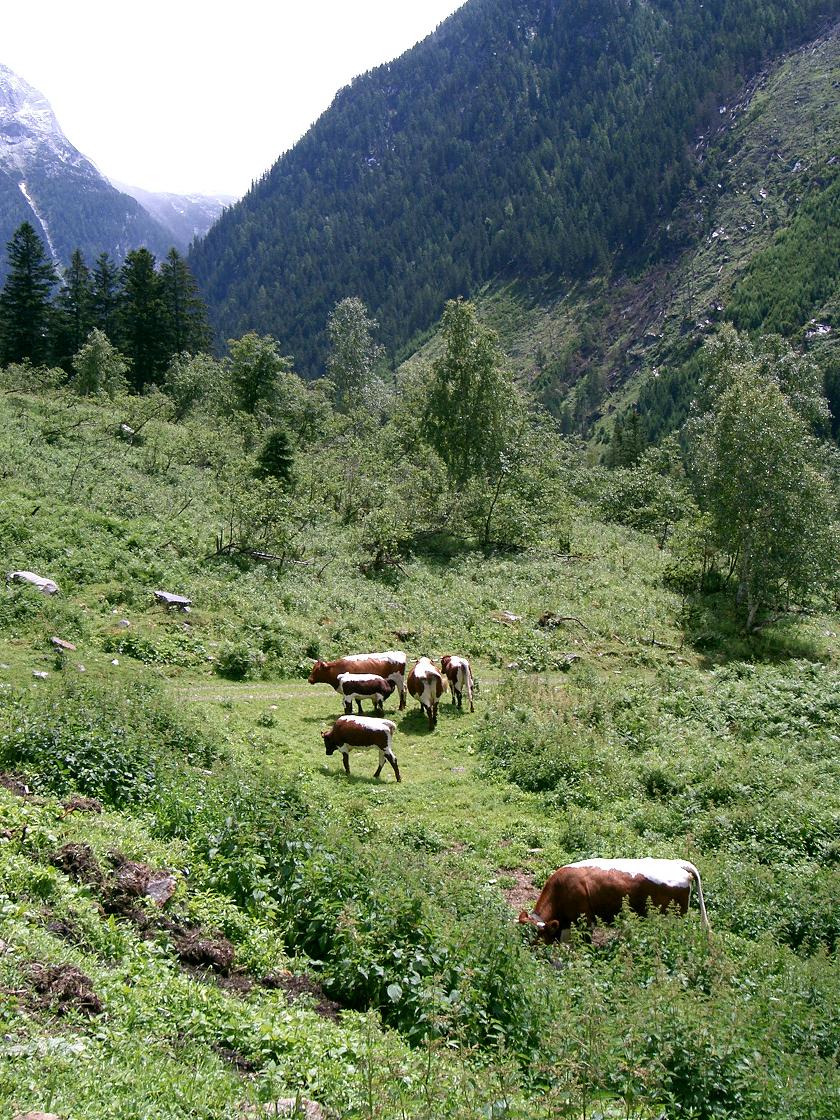

Custom and folk tradition
Old stories cling to the breed's colours. Farmers are said to have looked on the rare black calf as a sign of bad luck, which is one reason black bulls fell out of favour. The hornless line began with a single white calf born in Tyrol in 1834, and for generations such cattle were thought disabled because a yoke could not be laid on a neck without horns. Tradition also keeps the older names, Fasel and Schlag, alive in the breed's history.
Keeping Pinzgauer cattle
Pinzgauer are no longer yoked. The hornless strain is described as well fitted to present-day husbandry, and artificial insemination is used; a station near Salzburg has kept hornless bulls. Most cows run as sucklers on grass, rearing their own calves, and the breed suits mountain farms where pasture is the main feed. Selection for milk is light, since beef production matters more.
Numbers, conservation and the herd book
The FAO did not class the Pinzgauer as at risk in 2007, yet counts have fallen by roughly a tenth each year and the breed is described as endangered. In 2001 about 1.3 million head existed worldwide, 36,000 of them in Germany. Austria had 53,874 animals in 1995, of which 9,883 were entered in stud books. Only a handful of hornless cattle survive, fewer than fifty in the world. Herds are also kept in Africa, the Americas, Australia and Britain.
Questions people ask about Pinzgauer
Where does the Pinzgauer come from?
From the Pinzgau, a region in the Austrian state of Salzburg. It was first called a breed in 1846; before that it went by Pinzgauer Fasel or Pinzgauer Schlag. In its best years it was the favourite breed of Austria-Hungary and spread eastwards through Europe.
What is it kept for?
Once it was a triple-purpose breed: milk, meat and draught work. Now it is kept mainly as a beef suckler, grazing grass and rearing a calf. Milk is still taken, and since 1969 Red Holstein blood has been added in Austria to lift yield.
Why does it have a white stripe?
The marking is called finched. A wide white band runs right along the back, and white also covers the lower body, the brisket, the udder and the tail. Breeders judge the chestnut colour and this pattern closely.
Are they always horned?
Most Pinzgauer carry horns, but a hornless type exists, the Jochberger Hummel. It comes from a single nearly white calf born in Tyrol in 1834 and was treated as its own breed until 1997. Fewer than fifty survive.
How big is the breed?
Cows stand about 137 cm at the withers, the ridge between the shoulder blades, and weigh 600 to 700 kg. Bulls average 147 cm and weigh 1000 to 1100 kg.
Good reading and sources
- Pinzgauer cattle on WikipediaEncyclopedia
- More photos on Wikimedia CommonsPhotos and video
- Wikidata recordOpen data
The facts on this page come from the Wikipedia article "Pinzgauer cattle", written by its contributors and used under the CC BY-SA 4.0 licence, and from its Wikidata record (CC0). EveryCow rewrote the text in its own words, with AI assistance, and compares every page with the article to make sure no passage is copied. It may be reused under the same CC BY-SA 4.0 licence with a link back.
It may contain mistakes. Sizes, colours and customs differ from one herd, valley or breeder to the next. Folk beliefs are described as tradition, never as advice. If something is wrong, tell us. Last refreshed 2026-10-16.
More from Austria
All the breeds of Austria 🇨🇭 Switzerland and 5 moreBraunvieh
A large Alpine brown dairy breed from Switzerland, known for its strength and high milk yield.Taurine · Dairy · Rich milk
🇨🇭 Switzerland and 5 moreBraunvieh
A large Alpine brown dairy breed from Switzerland, known for its strength and high milk yield.Taurine · Dairy · Rich milk
 🇦🇹 AustriaTux-ZillertalTux-Zillertaler
A stocky Alpine breed from Tirol, black or red, once bred for cow-fighting contests.Taurine · Beef · Spirited
🇦🇹 AustriaTux-ZillertalTux-Zillertaler
A stocky Alpine breed from Tirol, black or red, once bred for cow-fighting contests.Taurine · Beef · Spirited
 🇩🇪 Germany and 1 moreMurnau-Werdenfels
A long-lived brown dairy breed of the Bavarian uplands, milk and beefTaurine · Dairy · Long-lived
🇩🇪 Germany and 1 moreMurnau-Werdenfels
A long-lived brown dairy breed of the Bavarian uplands, milk and beefTaurine · Dairy · Long-lived
 🇦🇹 Austria and 5 moreFleckvieh
A large Central European dual-purpose breed, red and white pied or solid red, kept for milk and beef.Composite · Dual-purpose · Docile
🇦🇹 Austria and 5 moreFleckvieh
A large Central European dual-purpose breed, red and white pied or solid red, kept for milk and beef.Composite · Dual-purpose · Docile
Its cousins elsewhere
All triple-purpose breeds 🇮🇩 Indonesia and 5 moreBantengbanṭéng (Javanese/Sundanese)
A wild Southeast Asian ox; its tame form, Bali cattle, runs feral in northern AustraliaBanteng · Beef · Drought-hardy
🇮🇩 Indonesia and 5 moreBantengbanṭéng (Javanese/Sundanese)
A wild Southeast Asian ox; its tame form, Bali cattle, runs feral in northern AustraliaBanteng · Beef · Drought-hardy
 🇮🇳 India and 4 moreGayal
A semi-domesticated bovine of the Eastern Himalayas, kept for meat, milk and ceremonyMithun · Beef
🇮🇳 India and 4 moreGayal
A semi-domesticated bovine of the Eastern Himalayas, kept for meat, milk and ceremonyMithun · Beef
 🇮🇩 Indonesia and 4 moreBali cattle
A small humped breed from Indonesia, descended from wild banteng, kept for meat and plowing.Banteng · Beef · Disease-resistant
🇮🇩 Indonesia and 4 moreBali cattle
A small humped breed from Indonesia, descended from wild banteng, kept for meat and plowing.Banteng · Beef · Disease-resistant
 🇲🇳 Mongolia and 4 moreYakགཡག་
A shaggy, cold-hardy highland bovine kept across the Himalayas and Tibetan PlateauYak · Triple-purpose · Cold-hardy
🇲🇳 Mongolia and 4 moreYakགཡག་
A shaggy, cold-hardy highland bovine kept across the Himalayas and Tibetan PlateauYak · Triple-purpose · Cold-hardy