
Dexter
A small Irish dual-purpose breed, usually black or red, kept for milk and beef on poor land.
The Dexter is a small Irish cattle breed from County Kerry, originally linked to the Kerry type. It is valued as a dual-purpose animal for both milk production and beef, thriving efficiently on rough grazing.
- Small Irish breed from County Kerry, averaging 325 kg for cows.
- Dual-purpose animal valued for milk and beef production.
- Carries a gene for chondrodysplasia, requiring DNA testing.
- Thrives on poor land as a hardy, efficient grazer.
- Originally a type within the Kerry breed before 1863.
What do Dexter cattle look like?
The Dexter is a compact breed of domestic cattle originating in Ireland. Bulls typically stand between 102 and 112 centimetres at the withers, while cows are slightly shorter, around 97 to 107 centimetres. An average cow weighs approximately 325 kilograms. The coat is most often solid black, though red and dun colours also occur. Traditionally horned, some modern individuals are naturally polled. A distinctive feature is their short legs, particularly noticeable from the knee to the fetlock. This build contributes to their hardiness but also links them to specific genetic traits affecting growth and skeletal structure.
Where does the Dexter come from?
This breed emerged in the eighteenth century within County Kerry in south-western Ireland. It appears to be named after a man called Dexter, who served as the factor for Lord Hawarden’s estates on Valentia Island. For much of the nineteenth century, these animals were viewed as a specific type within the broader Kerry cattle breed. Scottish agriculturalist David Low noted in 1842 that locals used the term 'Dexter' for Kerry cattle that appeared unusually round and short-legged. By 1863, they began appearing in separate show classes, leading to the establishment of a joint herd book with Kerry cattle in 1890 and a dedicated society in 1917.
What the Dexter is known for
Dexters are renowned for being hardy and efficient grazers. They thrive well on poor quality land where other breeds might struggle, making them suitable for rugged terrain. Their small size allows them to manage rough pastures effectively. While generally robust, they carry specific genetic risks. Some individuals possess a gene for chondrodysplasia, a form of dwarfism causing shorter limbs. Breeding two carriers can lead to non-viable pregnancies or stillborn calves with severe physical deformities, known locally as bulldogs. DNA testing is available to identify these carriers before breeding.
How the Dexter is bred and kept
Breeding programs must carefully manage genetic health due to the prevalence of the chondrodysplasia gene. Breeders use DNA tests on tail hairs to screen for this trait, avoiding mating two carriers to prevent abortion or malformed offspring. Another condition, pulmonary hypoplasia with anasarca, also requires DNA screening as it has no outward signs. Historically, the breed was managed through the Kerry and Dexter Cattle Society of Ireland, founded in 1917. The breed was introduced to England in 1882 and later spread to the United States and other regions, maintaining pure lines even as numbers fluctuated in its country of origin.
Dexter, drawn
What the Dexter is kept for
The Dexter is primarily a dual-purpose breed, raised for both milk and beef. Milk yields average around 2,250 kilograms per lactation, with some farms achieving up to 3,000 kilograms. The meat is considered good, though some note it may be less tender than other breeds, especially if the animal is extremely short-legged. Their ability to convert rough forage into high-quality products makes them valuable for smallholders and those farming on marginal land. They are not typically used for draught work in modern contexts, focusing instead on production efficiency.
The land and climate of the Dexter
These cattle are well-suited to temperate climates, particularly the cool, moist conditions of Ireland and similar regions. They excel in environments with poor soil and rough grazing, where their efficient metabolism allows them to maintain condition. Their hardiness enables them to withstand variable weather and limited feed resources. This adaptability has allowed the breed to establish populations in diverse locations, including parts of Europe, North America, and Oceania, provided the pasture quality supports their grazing needs.
Who keeps the Dexter
The breed is historically associated with farmers in County Kerry and Valentia Island. In the nineteenth century, local people identified specific physical types within Kerry herds as Dexters. The breed was maintained by small herds in England and the United States after facing decline in Ireland. Today, it is kept by smallholders and conservationists interested in dual-purpose livestock. The Dexter Cattle Society and other groups support breeding efforts to preserve genetic diversity and manage health risks associated with dwarfism genes.
At a glance: where it belongs
Land and climate


Faith and ritual
Unlike some traditional breeds linked to temple rituals or pastoral deities, the Dexter’s history is rooted in agricultural utility and estate management rather than sacred tradition. Its role remains firmly within the realm of practical farming and food production.
The Dexter at fairs and festivals
Dexter cattle have been featured in agricultural shows since the mid-nineteenth century. From 1863, they competed in separate classes at the Royal Dublin Society’s events. These shows serve as important venues for breeders to display quality animals, exchange genetics, and promote the breed’s characteristics. There are no specific festivals or fairs dedicated exclusively to Dexters, but they remain a staple at general livestock exhibitions in their range countries.
Custom and folk tradition
Local lore in Kerry distinguished Dexters by their compact, round appearance compared to standard Kerry cattle. The term was used colloquially by drovers and farmers to describe these short-legged animals. Over time, this descriptive label became formalized into a distinct breed identity. The tradition of keeping small, versatile cattle on marginal land persists among smallholders who value the breed’s self-sufficiency and low maintenance requirements.
Keeping Dexter cattle
Care involves managing the genetic risks of chondrodysplasia through DNA testing and selective breeding. Farmers must avoid mating two carriers to prevent bulldog calves or abortions. Regular health checks are advised, especially for conditions like pulmonary hypoplasia. Grazing management should focus on providing adequate roughage, as Dexters thrive on poor pasture. Housing needs are minimal due to their hardiness, but shelter from harsh weather is beneficial during winter months.
Numbers, conservation and the herd book
In 2023, sixteen countries reported Dexter populations to DAD-IS, with significant herds in Denmark and the United Kingdom. The global status is listed as not at risk, but Ireland considers the native population at risk or critical. Conservation efforts aim to maintain genetic diversity and manage health issues. The breed’s spread beyond Ireland highlights its adaptability, though maintaining pure lines requires careful record-keeping and breeding oversight.
From the Dexter
Questions people ask about Dexter
Where does the Dexter breed come from?
The Dexter originated in County Kerry, south-west Ireland, in the eighteenth century. It was likely named after a factor named Dexter who worked on Lord Hawarden’s estates on Valentia Island.
What is the Dexter breed kept for?
It is a dual-purpose breed kept for both milk and beef. Cows produce around 2,250 kg of milk per lactation, and the meat is valued for its quality, though tenderness can vary.
Are Dexter cattle prone to any health issues?
Yes, some carry a gene for chondrodysplasia, causing short legs and potential pregnancy loss. DNA testing is recommended to avoid breeding two carriers, which can result in non-viable bulldog calves.
How big do Dexter cattle get?
They are small cattle. Bulls stand 102–112 cm tall, and cows are about 97–107 cm. An average cow weighs approximately 325 kilograms.
What colours are Dexter cattle?
The most common coat colour is solid black. However, red and dun coats are also accepted and seen within the breed, with black being more prevalent in affected genetic cases.
Good reading and sources
- Dexter cattle on WikipediaEncyclopedia
- More photos on Wikimedia CommonsPhotos and video
- Wikidata recordOpen data
The facts on this page come from the Wikipedia article "Dexter cattle", written by its contributors and used under the CC BY-SA 4.0 licence, and from its Wikidata record (CC0). EveryCow rewrote the text in its own words, with AI assistance, and compares every page with the article to make sure no passage is copied. It may be reused under the same CC BY-SA 4.0 licence with a link back.
It may contain mistakes. Sizes, colours and customs differ from one herd, valley or breeder to the next. Folk beliefs are described as tradition, never as advice. If something is wrong, tell us. Last refreshed 2026-10-16.
More from Ireland
All the breeds of Ireland 🇬🇧 United Kingdom and 5 moreShorthorn
A historic British breed from north-east England, kept for milk and meat with red, white or roan coats.Taurine · Dual-purpose · Docile
🇬🇧 United Kingdom and 5 moreShorthorn
A historic British breed from north-east England, kept for milk and meat with red, white or roan coats.Taurine · Dual-purpose · Docile
 🇮🇪 IrelandIrish MoiledBó Maol
A rare hornless Irish breed, red with a white back stripe, used for milk and beefTaurine · Dual-purpose · Polled
🇮🇪 IrelandIrish MoiledBó Maol
A rare hornless Irish breed, red with a white back stripe, used for milk and beefTaurine · Dual-purpose · Polled
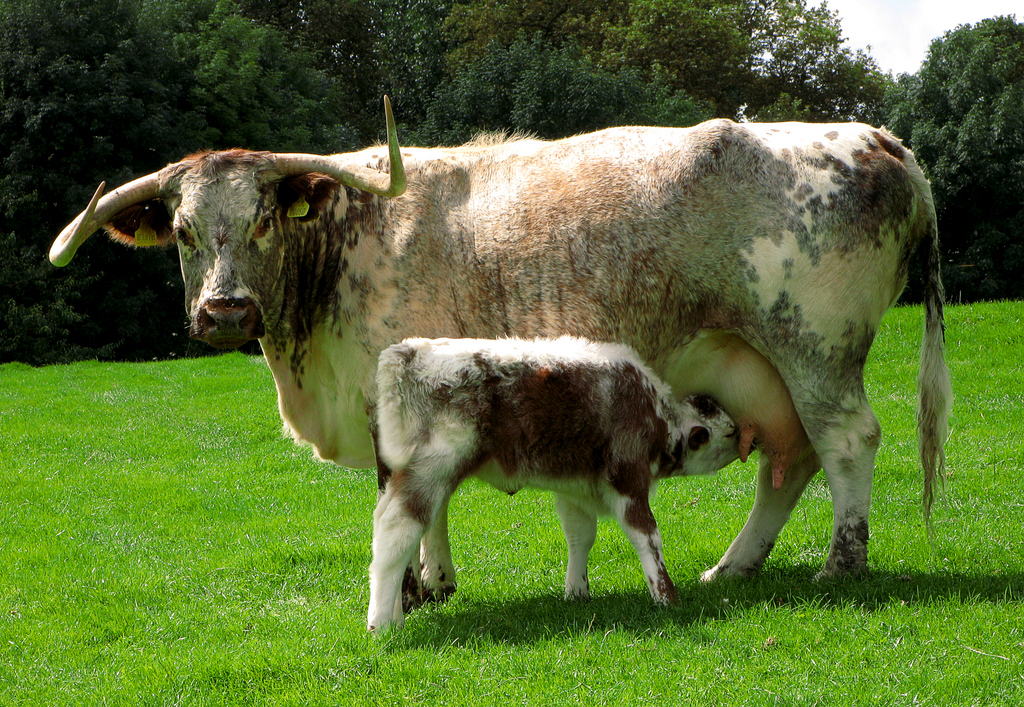 🇬🇧 United Kingdom and 3 moreEnglish Longhorn
A large horned beef breed from northern England, marked by a white line along the spineTaurine · Beef · Long-horned
🇬🇧 United Kingdom and 3 moreEnglish Longhorn
A large horned beef breed from northern England, marked by a white line along the spineTaurine · Beef · Long-horned
 🇮🇪 Ireland and 2 moreKerryBó Chiarraí
A rare black dairy breed from southwest Ireland, one of Europe's oldest milk cattleTaurine · Dairy · Thrifty foragers
🇮🇪 Ireland and 2 moreKerryBó Chiarraí
A rare black dairy breed from southwest Ireland, one of Europe's oldest milk cattleTaurine · Dairy · Thrifty foragers
Its cousins elsewhere
All dual-purpose breeds 🇲🇳 Mongolia and 4 moreYakགཡག་
A shaggy, cold-hardy highland bovine kept across the Himalayas and Tibetan PlateauYak · Triple-purpose · Cold-hardy
🇲🇳 Mongolia and 4 moreYakགཡག་
A shaggy, cold-hardy highland bovine kept across the Himalayas and Tibetan PlateauYak · Triple-purpose · Cold-hardy
 🇵🇰 Pakistan and 5 moreZebu
Humped, heat-tolerant cattle of South Asia, kept for milk, meat, work and ridingZebu · Dairy · Heat-tolerant
🇵🇰 Pakistan and 5 moreZebu
Humped, heat-tolerant cattle of South Asia, kept for milk, meat, work and ridingZebu · Dairy · Heat-tolerant
 🇮🇩 Indonesia and 4 moreBali cattle
A small humped breed from Indonesia, descended from wild banteng, kept for meat and plowing.Banteng · Beef · Disease-resistant
🇮🇩 Indonesia and 4 moreBali cattle
A small humped breed from Indonesia, descended from wild banteng, kept for meat and plowing.Banteng · Beef · Disease-resistant
 🇺🇸 United States and 5 moreBrahman
An American beef breed with a hump and grey or red coat, bred from Indian zebu cattleComposite · Beef · Heat-tolerant
🇺🇸 United States and 5 moreBrahman
An American beef breed with a hump and grey or red coat, bred from Indian zebu cattleComposite · Beef · Heat-tolerant