
Irish Moiled
In its own language: Bó Maol
A rare hornless Irish breed, red with a white back stripe, used for milk and beef
The Irish Moiled is a rare, hornless breed from Ireland and one of the island's oldest, with a red coat and a white stripe running along the back and belly. It gives both milk and beef, and herds now run in Ireland, Northern Ireland and parts of Britain.
- Hornless: the name comes from maol, an Irish word for bald.
- Red coat with a white finching stripe along the back and underside.
- The whole breed fell to 30 cows and two bulls in the late 1970s.
- Classed as endangered-maintained by the FAO in 2007.
- Beef with a distinct flavour is credited with saving the breed.
What do Irish Moiled cattle look like?
The Irish Moiled is a polled breed, so neither cows nor bulls grow horns. Its coat is red, marked with a white stripe called finching that runs along the spine and under the belly, and the face is mottled. The muzzle should be grey or bronze, and the skin is pigmented. The head has a domed shape that helps tell the breed apart. Cows stand about 125 to 135 cm and weigh roughly 550 to 650 kg; bulls are heavier, at 750 to 850 kg, and a little taller.
Where does the Irish Moiled come from?
The breed belongs to Ireland and is counted among the island's oldest kinds of cattle. It was kept widely during the 1800s, when farmers valued animals that could both give milk and fatten for meat. Once more specialised breeds took over, such as Friesians for dairying and Herefords and Angus for beef, numbers fell. In the late 1970s the whole population came down to 30 cows and two bulls, in the hands of two breeders. The Rare Breed Survival Trust listed the breed as critically endangered in 1979. The name is said to come from maol, an Irish word for bald, a nod to the absent horns. The breed's original heartland covers Leitrim, Sligo, Down and Donegal.
What the Irish Moiled is known for
Hardiness is the breed's strength. These cattle will fatten on poor grazing where more demanding animals would struggle, and at the same time the cows give milk, an unusual combination in one breed. The downside is that they lay on condition easily, so keepers take care not to let them grow overweight. A domed head makes them easy to pick out, and both sexes are naturally hornless.
How the Irish Moiled is bred and kept
In the 1970s the breed was down to two dairy herds, holding about 20 breeding females. Recovery came when keepers added bloodlines from Jersey, Ayrshire, Shorthorn and Friesian cattle. The Irish Moiled Cattle Society keeps the standard and registers the stock. A cow in reasonable health carries her calf for about nine months. The cattle graze grass, and beef that finishes well on poor land is what breeders look for.
Irish Moiled, drawn
What the Irish Moiled is kept for
The breed is reared for two jobs at once: milk and beef. Its meat is noted for its quality and for a flavour people describe as distinct. The cows milk well enough to make a dairy herd worthwhile, which is unusual in a breed that also fattens. Animals are also put to conservation grazing. Quality of beef, rather than any other product, is what kept the breed going when numbers were at their lowest.
The land and climate of the Irish Moiled
The breed belongs to Ireland and suits its temperate climate, and it is found across the island. Hardiness is the point: these cattle grow and fatten on poor pasture and rougher ground, which is what let them survive on marginal farms while better land went to more specialised breeds.
Who keeps the Irish Moiled
Two breeders kept the breed alive at its lowest point in the 1970s, when 30 cows and two bulls were all that remained. Those two people divided the surviving animals between them. A breed society later formed, and it now holds the standard and registers stock. Numbers have grown since, with herds spreading from Ireland into Northern Ireland and parts of Britain.
At a glance: where it belongs
Land and climate


Keeping Irish Moiled cattle
Keepers watch the condition of these cattle, because they put on fat easily and can become overweight if fed too well. Cows calve after about nine months of gestation, provided they are in reasonable health. In return the breed asks little: it is hardy, grazes ordinary pasture and fattens on land that more demanding breeds would find difficult.
Numbers, conservation and the herd book
Numbers collapsed during the twentieth century. In the late 1970s the breed counted 30 cows and two bulls, held by two breeders, and in 1979 the Rare Breed Survival Trust marked it as critically endangered. Official status has improved but stays serious: the FAO treated it as endangered-maintained in 2007, and both DAD-IS in 2023 and the RBST in 2021-22 list it at risk. Bloodlines from other breeds helped the population recover, and herds now stand in Ireland, Northern Ireland and parts of Britain.
From the Irish Moiled
Questions people ask about Irish Moiled
Where does the Irish Moiled come from?
From Ireland. The breed is tied to four counties, Leitrim, Sligo, Down and Donegal, and it now occurs across the island, with stock also kept in Northern Ireland and parts of Britain.
What is the Irish Moiled kept for?
Milk and beef together. Cows are milked, the animals fatten well, and they are also used for conservation grazing. The meat is noted for a distinct flavour, and the quality of that beef is what rescued the breed from extinction.
Does it have horns?
No. The Irish Moiled is polled, meaning it grows no horns at all, in either sex. That is where the name comes from, since maol is an Irish word meaning bald.
How many Irish Moiled cattle are left?
Numbers recovered from a low of 30 cows and two bulls in the late 1970s. The FAO classed the breed as endangered-maintained in 2007, and both DAD-IS in 2023 and the Rare Breed Survival Trust list it at risk.
What does an Irish Moiled look like?
Red, with a white stripe called finching down the back and under the belly, and a mottled face. The head is domed, the muzzle should be grey or bronze, and cows weigh around 550 to 650 kg.
Good reading and sources
- Irish Moiled on WikipediaEncyclopedia
- More photos on Wikimedia CommonsPhotos and video
- Wikidata recordOpen data
The facts on this page come from the Wikipedia article "Irish Moiled", written by its contributors and used under the CC BY-SA 4.0 licence, and from its Wikidata record (CC0). EveryCow rewrote the text in its own words, with AI assistance, and compares every page with the article to make sure no passage is copied. It may be reused under the same CC BY-SA 4.0 licence with a link back.
It may contain mistakes. Sizes, colours and customs differ from one herd, valley or breeder to the next. Folk beliefs are described as tradition, never as advice. If something is wrong, tell us. Last refreshed 2026-10-16.
More from Ireland
All the breeds of Ireland 🇬🇧 United Kingdom and 5 moreShorthorn
A historic British breed from north-east England, kept for milk and meat with red, white or roan coats.Taurine · Dual-purpose · Docile
🇬🇧 United Kingdom and 5 moreShorthorn
A historic British breed from north-east England, kept for milk and meat with red, white or roan coats.Taurine · Dual-purpose · Docile
 🇮🇪 Ireland and 2 moreDexter
A small Irish dual-purpose breed, usually black or red, kept for milk and beef on poor land.Taurine · Dual-purpose · Thrifty foragers
🇮🇪 Ireland and 2 moreDexter
A small Irish dual-purpose breed, usually black or red, kept for milk and beef on poor land.Taurine · Dual-purpose · Thrifty foragers
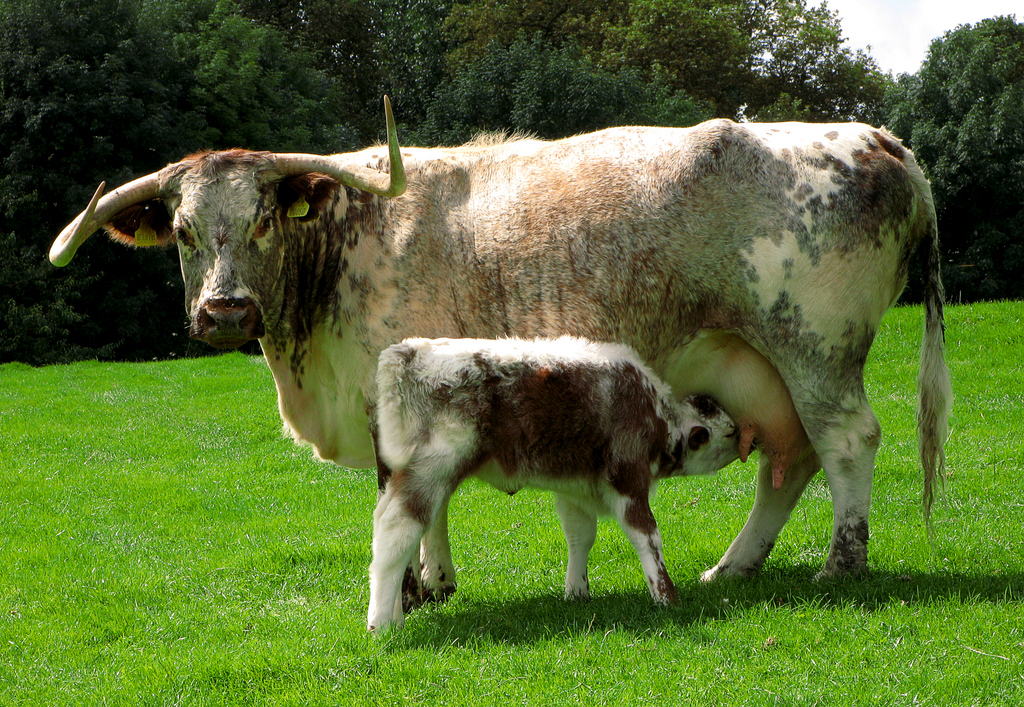 🇬🇧 United Kingdom and 3 moreEnglish Longhorn
A large horned beef breed from northern England, marked by a white line along the spineTaurine · Beef · Long-horned
🇬🇧 United Kingdom and 3 moreEnglish Longhorn
A large horned beef breed from northern England, marked by a white line along the spineTaurine · Beef · Long-horned
 🇮🇪 Ireland and 2 moreKerryBó Chiarraí
A rare black dairy breed from southwest Ireland, one of Europe's oldest milk cattleTaurine · Dairy · Thrifty foragers
🇮🇪 Ireland and 2 moreKerryBó Chiarraí
A rare black dairy breed from southwest Ireland, one of Europe's oldest milk cattleTaurine · Dairy · Thrifty foragers
Its cousins elsewhere
All dual-purpose breeds 🇵🇰 Pakistan and 5 moreZebu
Humped, heat-tolerant cattle of South Asia, kept for milk, meat, work and ridingZebu · Dairy · Heat-tolerant
🇵🇰 Pakistan and 5 moreZebu
Humped, heat-tolerant cattle of South Asia, kept for milk, meat, work and ridingZebu · Dairy · Heat-tolerant
 🇲🇳 Mongolia and 4 moreYakགཡག་
A shaggy, cold-hardy highland bovine kept across the Himalayas and Tibetan PlateauYak · Triple-purpose · Cold-hardy
🇲🇳 Mongolia and 4 moreYakགཡག་
A shaggy, cold-hardy highland bovine kept across the Himalayas and Tibetan PlateauYak · Triple-purpose · Cold-hardy
 🇮🇩 Indonesia and 4 moreBali cattle
A small humped breed from Indonesia, descended from wild banteng, kept for meat and plowing.Banteng · Beef · Disease-resistant
🇮🇩 Indonesia and 4 moreBali cattle
A small humped breed from Indonesia, descended from wild banteng, kept for meat and plowing.Banteng · Beef · Disease-resistant
 🇺🇸 United States and 5 moreBrahman
An American beef breed with a hump and grey or red coat, bred from Indian zebu cattleComposite · Beef · Heat-tolerant
🇺🇸 United States and 5 moreBrahman
An American beef breed with a hump and grey or red coat, bred from Indian zebu cattleComposite · Beef · Heat-tolerant