
Hinterwald
In its own language: Hinterwälder Rind
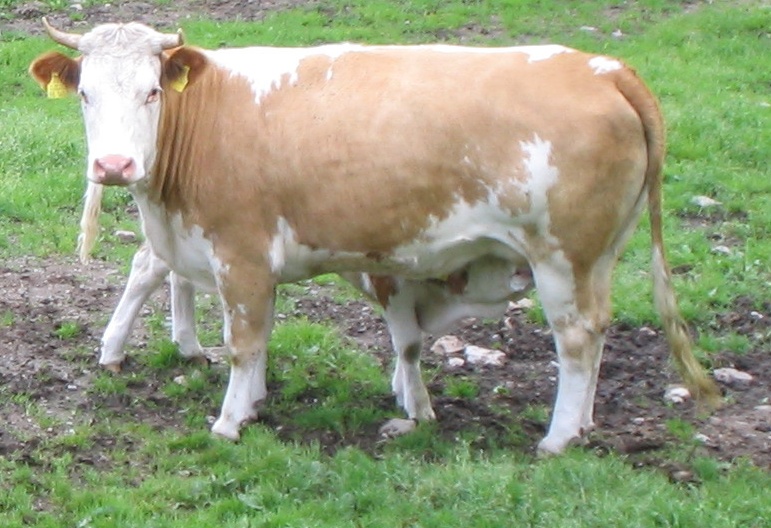
A small Black Forest cow, white head and pied coat, kept for both milk and beef
An old landrace from the Black Forest in south-west Germany, the Hinterwald is the smallest cattle breed still farmed in Central Europe. Cows stand 115 to 125 cm with a white head and a pied coat of yellow to dark red-brown, and are kept for both milk and beef.
- The smallest cattle breed still living in Central Europe
- Cows stand 115 to 125 cm and weigh 350 to 450 kg
- Named 'of the backwoods' when split from the larger Vorderwald about 150 years ago
- Swiss Alpine herds have grown under a breeding scheme run by ProSpecieRara
- Baden-Württemberg pays bonuses to keepers of the endangered breed
What do Hinterwald cattle look like?
This is a small cow by any measure. Full-grown cows measure 115 to 125 cm at the withers, the ridge between the shoulder blades, and weigh 350 to 450 kg, while bulls reach 130 to 135 cm and 700 to 800 kg. No other breed of cattle living in Central Europe is smaller. The face and forehead are white on most animals; behind the head the body carries a pied coat, patched in shades from pale yellow through to a deep red-brown. Horns are common rather than rare, and they tend to sweep outward in a way that catches the eye. Bulls are markedly heavier than the cows, roughly half as much again.
Where does the Hinterwald come from?
The name is German and means, word for word, 'from the backwoods'. It was taken up only around 150 years ago, when the smaller cattle of the deep forest began to be recorded separately from the Vorderwälder, whose name points to the woods at the front of the same range. Both are old local breeds of the Black Forest in south-west Germany, and the Hinterwald remains closely tied to that landscape. Zoologically it is classed as Bos primigenius f. taurus, the domestic descendant of the wild aurochs.
What the Hinterwald is known for
Hardship shaped this cow. Generations of selection produced an animal that stays sound through cold winters, copes with steep hill pasture and keeps condition on thin fare. Keepers praise three things above all: thrift, meaning it does well on little; longevity, meaning a long productive life; and easy calving, since difficulties at birth are seldom seen. Those same qualities are what drew Swiss Alpine farmers to the breed, and why German conservationists campaign for it. It is a practical hill cow first and foremost.
How the Hinterwald is bred and kept
Breed societies keep the registers: several operate in Germany, and Switzerland has one of its own. In Switzerland the charity ProSpecieRara, which works to save rare domestic breeds, began a breeding programme, and Swiss Alpine herds have grown noticeably since it did. In Germany, keepers in Baden-Württemberg receive husbandry bonuses, payments made by the state to help the breed survive rather than to reward output. Selection in earlier times favoured animals that could last out long winters on meagre grazing, and that frugal constitution still guides how the breed is raised.
Hinterwald, drawn
What the Hinterwald is kept for
Milk and beef come from the same animal. Cows are milked, while other stock is raised for meat, so one herd serves both ends. The breed's worth on a mountain farm lies in its economy: it stays productive on sparse fodder, lives a long time and calves without difficulty, so keeping costs stay low. For farms on steep ground, a single cow can fill the pail and the meat trade at once.
The land and climate of the Hinterwald
The breed belongs to hill country. Its home is the Black Forest of south-west Germany, where cold winters, steep slopes and thin grazing moulded its constitution. Those same gifts let it do well under an Alpine climate, and it is now established in the Swiss Alps too. It manages on a frugal diet, so it asks little of its pasture; what it needs is ground it can work, for its light frame suits sharp hillsides.
At a glance: where it belongs
Land and climate
Celebrations


Keeping Hinterwald cattle
An undemanding animal to keep. It was developed to live on a frugal diet, so hill pasture and modest feeding suit it, and heavy rations are unnecessary. Cold weather and steep ground cause it little trouble. Cows give birth with few complications, which spares keepers much worry and expense. Because the breed is rare, German keepers may qualify for husbandry bonuses in Baden-Württemberg, and Swiss breeders have the backing of a conservation programme.
Numbers, conservation and the herd book
The Hinterwald counts as endangered. Conservation, though, is active on both sides of the Rhine. Germany hosts several breed associations, and in 1992 the breed took the German title Haustier des Jahres, a national 'animal of the year' accolade. In Switzerland, ProSpecieRara, a non-profit devoted to saving rare domestic breeds, runs a breeding programme, and herds in the Swiss Alps have grown clearly since it began. Baden-Württemberg supports its keepers with husbandry bonuses intended to secure the breed's future.
Questions people ask about Hinterwald
Where does the Hinterwald come from?
It is an old local breed of the Black Forest in south-west Germany. Its name arose about 150 years ago, when the small backwoods type began to be recorded apart from the larger Vorderwald of the same forest.
What is it kept for?
Milk and beef. It is a dual-purpose hill cow: cows are milked and other animals are raised for meat. Its economy on sparse feed and its easy calving make it practical for mountain farms.
How big is a Hinterwald?
Very small for cattle. Cows reach 115 to 125 cm at the withers and 350 to 450 kg, while bulls reach 130 to 135 cm and 700 to 800 kg. No living Central European breed is smaller.
Is the breed rare?
Yes, it is classed as endangered. Numbers in the Swiss Alps have risen since ProSpecieRara started a breeding programme, and keepers in Baden-Württemberg receive state bonuses that help the breed survive.
What does it look like?
The head is mostly white, and the rest of the coat is pied, patched in shades from light yellow to dark red-brown. Horns are common and usually curve outward in a striking pattern.
Good reading and sources
- Hinterwald on WikipediaEncyclopedia
- More photos on Wikimedia CommonsPhotos and video
- Wikidata recordOpen data
The facts on this page come from the Wikipedia article "Hinterwald", written by its contributors and used under the CC BY-SA 4.0 licence, and from its Wikidata record (CC0). EveryCow rewrote the text in its own words, with AI assistance, and compares every page with the article to make sure no passage is copied. It may be reused under the same CC BY-SA 4.0 licence with a link back.
It may contain mistakes. Sizes, colours and customs differ from one herd, valley or breeder to the next. Folk beliefs are described as tradition, never as advice. If something is wrong, tell us. Last refreshed 2026-10-16.
More from Germany
All the breeds of Germany 🇨🇭 Switzerland and 5 moreSimmental
A large dual-purpose breed from the Swiss Simme valley, red and white with strong growth rates.Taurine · Dual-purpose · Docile
🇨🇭 Switzerland and 5 moreSimmental
A large dual-purpose breed from the Swiss Simme valley, red and white with strong growth rates.Taurine · Dual-purpose · Docile
 🇦🇹 Austria and 5 moreFleckvieh
A large Central European dual-purpose breed, red and white pied or solid red, kept for milk and beef.Composite · Dual-purpose · Docile
🇮🇹 Italy and 3 morePustertaler SprinzenPustertaler Schecken
Rare colour-sided Alpine cattle from South Tyrol: white with brown or black flank patchesTaurine · Dual-purpose
🇦🇹 Austria and 5 moreFleckvieh
A large Central European dual-purpose breed, red and white pied or solid red, kept for milk and beef.Composite · Dual-purpose · Docile
🇮🇹 Italy and 3 morePustertaler SprinzenPustertaler Schecken
Rare colour-sided Alpine cattle from South Tyrol: white with brown or black flank patchesTaurine · Dual-purpose
 🇵🇱 Poland and 5 moreAurochs
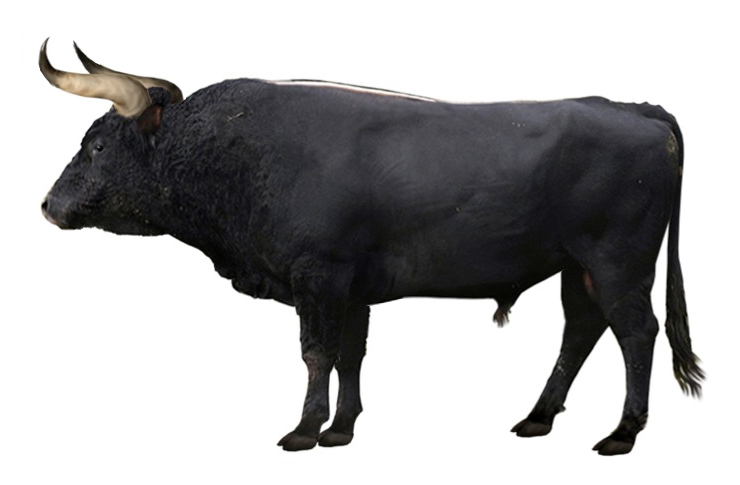
The wild ancestor of all domestic cattle, extinct since 1627Wild · Long-horned
🇵🇱 Poland and 5 moreAurochs
The wild ancestor of all domestic cattle, extinct since 1627Wild · Long-horned
Its cousins elsewhere
All dual-purpose breeds 🇲🇳 Mongolia and 4 moreYakགཡག་
A shaggy, cold-hardy highland bovine kept across the Himalayas and Tibetan PlateauYak · Triple-purpose · Cold-hardy
🇲🇳 Mongolia and 4 moreYakགཡག་
A shaggy, cold-hardy highland bovine kept across the Himalayas and Tibetan PlateauYak · Triple-purpose · Cold-hardy
 🇮🇩 Indonesia and 4 moreBali cattle
A small humped breed from Indonesia, descended from wild banteng, kept for meat and plowing.Banteng · Beef · Disease-resistant
🇮🇩 Indonesia and 4 moreBali cattle
A small humped breed from Indonesia, descended from wild banteng, kept for meat and plowing.Banteng · Beef · Disease-resistant
 🇵🇰 Pakistan and 5 moreZebu
Humped, heat-tolerant cattle of South Asia, kept for milk, meat, work and ridingZebu · Dairy · Heat-tolerant
🇵🇰 Pakistan and 5 moreZebu
Humped, heat-tolerant cattle of South Asia, kept for milk, meat, work and ridingZebu · Dairy · Heat-tolerant
 🇨🇳 China and 2 moreWild yak
A massive, shaggy wild bovine native to the high plateaux and peaks of the HimalayasYak · Beef · Cold-hardy
🇨🇳 China and 2 moreWild yak
A massive, shaggy wild bovine native to the high plateaux and peaks of the HimalayasYak · Beef · Cold-hardy