
Lourdaise
In its own language: Lordés
A rare white Pyrenean breed from near Lourdes, once milk, meat and draught in one
An endangered taurine breed from the country around Lourdes, in the Hautes-Pyrénées of south-western France. It is white or cream with lyre-shaped horns and cows about 135 cm tall, and was formerly kept for milk, meat and draught work; nowadays it is mainly a meat breed.
- Named for Lourdes in the Hautes-Pyrénées; in Gascon the breed is called Lordés
- Herd book opened in the 1890s and held 850 animals by 1896
- Down to 30 cows in 1983; 268 head reported in 2014
- Cows about 135 cm and 600 kg; bulls 900 to 1100 kg
- Formerly kept for milk, meat and draught work; now mainly a meat breed
What do Lourdaise cattle look like?
The Lourdaise is a taurine breed, humpless like the other cattle of Europe, from the valleys of south-western France. Its coat is white or cream over white skin. Pale colouring carries on across the muzzle and the soft skin around the nose, mouth and eyes, and the inside of the thigh is white as well. The horns are lyre-shaped, small and twisted. A cow stands about 135 cm at the withers, the ridge between the shoulders, and weighs around 600 kg. Bulls are far heavier, from 900 to 1100 kg.
Where does the Lourdaise come from?
The breed is named for Lourdes, a town in the Hautes-Pyrénées, in the Occitanie region of France, and it grew up in the farmland around it. Three districts were its heartland: Argelès, Bagnères-de-Bigorre and Ossun, though it spread widely through the Pyrenees. In the old districts of the Bigorre and the Lavedan it was the leading breed. A herd book was opened in the 1890s, with 850 animals listed in 1896, and some 25,000 head were kept early in the twentieth century. The fall came after 1945, and by 1983 only thirty cows remained.
What the Lourdaise is known for
The Lourdaise was prized for what it could do rather than for looks. Cows were worked in pairs, and a photograph from the 1970s shows two of them pulling in the Pyrenees. One animal gave milk, meat and muscle at the same time, which suited small mixed farms. The breed also showed how a tiny herd can hold on: from thirty cows in 1983, conservation work brought numbers back up.
How the Lourdaise is bred and kept
The breed had its own herd book from the 1890s, and bulls needed approval before serving the wider herd; over two hundred of them won that approval. When machines took over field work after the war, farmers turned to single-purpose cattle and the Lourdaise was almost abandoned. Conservation breeding began in the 1980s with backing from the Parc National des Pyrénées, the French agriculture ministry and the regional administration of Haute-Pyrénées. The herd has grown since, but selection still serves a breed classed as critical.
Lourdaise, drawn
What the Lourdaise is kept for
This was once a triple-purpose breed: a household milk cow, a source of meat, and the power for plough and cart. A lactation of 305 days produced roughly 3,000 litres, with about 3.8 per cent fat and 3.3 per cent protein, and the yield was enough to rear a calf for veal on the dam's own milk. Cows were still at work in the Pyrenees in the 1970s. Meat is now the main reason the breed is kept, with a few animals milked.
The land and climate of the Lourdaise
The Lourdaise belongs to the Pyrenees of south-western France, and that mountain country is still its home. It was once widely distributed through those high valleys, and it is in that part of France that the breed is found. Its neighbours on the same land are the dairy and beef breeds that arrived later. Because it was kept as a working cow as well as a milk and meat animal, it suited small mixed farms in hilly country, where one animal had to do several jobs.
Who keeps the Lourdaise
The breed belonged to the farming communities of the Bigorre and the Lavedan, two old districts in the Pyrenean foothills. For those households it was the main cattle, doing the work of the holding and filling the dairy and the larder at once. Later, when the breed was nearly lost, the help came from institutions rather than families: the Parc National des Pyrénées, the agriculture ministry and the regional administration of Haute-Pyrénées backed conservation breeding, and farmers in the region keep the line going.
At a glance: where it belongs
Land and climate
Celebrations


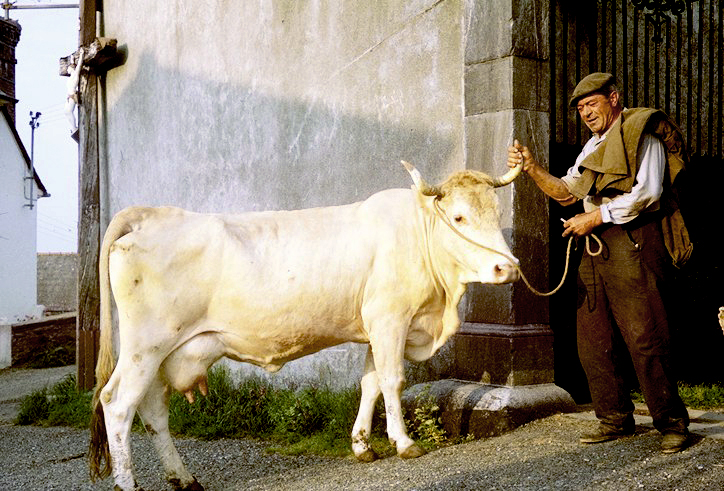
The Lourdaise at fairs and festivals
Lourdaise cattle are shown at the Salon international de l'agriculture in Paris, where a cow of the breed was photographed in 2013. National shows of that kind give a small population a public face and put breeders in touch with one another. Older pictures show the same animals in working dress: a pair at work in the Pyrenees, and cows photographed at Bourreac in the 1960s.
Custom and folk tradition
The breed's name is a piece of local speech: Lourdaise means of Lourdes, and in Gascon the cattle are called Lordés. Work lay at the centre of their lives. They were used in pairs, and a photograph from the 1970s shows two of them pulling in the Pyrenees, a memory of the years when cattle were the engines of Pyrenean farms. Mechanisation took that work away, and with it the reason for keeping so many of these animals.
Numbers, conservation and the herd book
Records swing a long way. The herd book listed 850 animals in 1896, and about 25,000 head were counted at the start of the twentieth century. After the collapse that followed the war, thirty cows were left in 1983. Conservation work lifted the figure to 268 head in 2014. In 2007 the FAO placed the breed in its critical-maintained class, and it is still described as critically endangered. The breed is French and regional, tied to the Hautes-Pyrénées and the wider Midi-Pyrénées area.
Questions people ask about Lourdaise
Where does the Lourdaise come from?
It comes from the farmland around Lourdes, in the Hautes-Pyrénées in the Occitanie region of France. It was strongest in three districts, Argelès, Bagnères-de-Bigorre and Ossun, and was once the main breed of the Bigorre and the Lavedan.
What is the breed kept for?
It was a triple-purpose animal: milk, meat and draught work from the same cow. A cow gave about 3,000 litres in a 305-day lactation, with 3.8 per cent fat, enough to rear a veal calf on her own milk. Today it is kept mainly for meat.
What does a Lourdaise look like?
The coat is white or cream over white skin, and the muzzle and the skin around the eyes and nose are pale. The horns are lyre-shaped, small and twisted. A cow measures roughly 135 cm at the withers, the ridge between the shoulders, and weighs about 600 kg.
Is the Lourdaise rare?
Yes. It almost died out: only thirty cows were left in 1983. Recovery work by the Parc National des Pyrénées, the agriculture ministry and the regional administration brought the total to 268 head by 2014, but the FAO still classes the breed as critical-maintained.
How many were there in the past?
The herd book registered 850 animals in 1896, and about 25,000 head were kept in the early twentieth century, with over two hundred bulls licensed as public sires. Numbers then fell away sharply after the Second World War as machines replaced working cattle.
Good reading and sources
- Lourdaise on WikipediaEncyclopedia
- More photos on Wikimedia CommonsPhotos and video
- Wikidata recordOpen data
The facts on this page come from the Wikipedia article "Lourdaise", written by its contributors and used under the CC BY-SA 4.0 licence, and from its Wikidata record (CC0). EveryCow rewrote the text in its own words, with AI assistance, and compares every page with the article to make sure no passage is copied. It may be reused under the same CC BY-SA 4.0 licence with a link back.
It may contain mistakes. Sizes, colours and customs differ from one herd, valley or breeder to the next. Folk beliefs are described as tradition, never as advice. If something is wrong, tell us. Last refreshed 2026-10-16.
More from France
All the breeds of France 🇫🇷 France and 3 moreCharolaisCharolaise
A large French taurine beef breed from eastern France, white to cream with pink noses and curved horns.Taurine · Beef · Docile
🇫🇷 France and 3 moreCharolaisCharolaise
A large French taurine beef breed from eastern France, white to cream with pink noses and curved horns.Taurine · Beef · Docile
 🇫🇷 France and 2 moreBlonde d'Aquitaine
A big wheat-coated beef breed from south-west France, born of three old draught linesTaurine · Beef
🇫🇷 France and 2 moreBlonde d'Aquitaine
A big wheat-coated beef breed from south-west France, born of three old draught linesTaurine · Beef
 🇫🇷 France and 2 moreAbondance
A red and white dairy breed from the French Alps, kept for milk and mountain grazing.Taurine · Dairy · Heat-tolerant
🇫🇷 France and 2 moreAbondance
A red and white dairy breed from the French Alps, kept for milk and mountain grazing.Taurine · Dairy · Heat-tolerant
 🇫🇷 France and 1 moreMaine-AnjouRouge des Prés
A red and white French beef breed from the Maine country, once a milk and meat animalTaurine · Beef
🇫🇷 France and 1 moreMaine-AnjouRouge des Prés
A red and white French beef breed from the Maine country, once a milk and meat animalTaurine · Beef
Its cousins elsewhere
All beef breeds 🇮🇩 Indonesia and 5 moreBantengbanṭéng (Javanese/Sundanese)
A wild Southeast Asian ox; its tame form, Bali cattle, runs feral in northern AustraliaBanteng · Beef · Drought-hardy
🇮🇩 Indonesia and 5 moreBantengbanṭéng (Javanese/Sundanese)
A wild Southeast Asian ox; its tame form, Bali cattle, runs feral in northern AustraliaBanteng · Beef · Drought-hardy
 🇮🇳 India and 4 moreGayal
A semi-domesticated bovine of the Eastern Himalayas, kept for meat, milk and ceremonyMithun · Beef
🇮🇳 India and 4 moreGayal
A semi-domesticated bovine of the Eastern Himalayas, kept for meat, milk and ceremonyMithun · Beef
 🇮🇩 Indonesia and 4 moreBali cattle
A small humped breed from Indonesia, descended from wild banteng, kept for meat and plowing.Banteng · Beef · Disease-resistant
🇮🇩 Indonesia and 4 moreBali cattle
A small humped breed from Indonesia, descended from wild banteng, kept for meat and plowing.Banteng · Beef · Disease-resistant
 🇲🇳 Mongolia and 4 moreYakགཡག་
A shaggy, cold-hardy highland bovine kept across the Himalayas and Tibetan PlateauYak · Triple-purpose · Cold-hardy
🇲🇳 Mongolia and 4 moreYakགཡག་
A shaggy, cold-hardy highland bovine kept across the Himalayas and Tibetan PlateauYak · Triple-purpose · Cold-hardy