Miniature Zebu
Tiny humped cattle from America, registered since 1991 and standing no taller than 107 cm
A very small humped breed put together in the United States in 1991 from little zebus of Brazil, the Dominican Republic and Sweden. Registration stops at 107 cm at the withers, and by 2016 the herd book held over 6,200 animals.
- Herd book opened in the United States in 1991 by the International Miniature Zebu Association
- Registration ceiling: 107 cm at the withers
- Founding stock traced back to Brazil, the Dominican Republic and Sweden
- Over 6,200 animals registered by 2016
- Nadudana is the collective name for India's very small zebu breeds, such as Vechur
What do Miniature Zebu cattle look like?
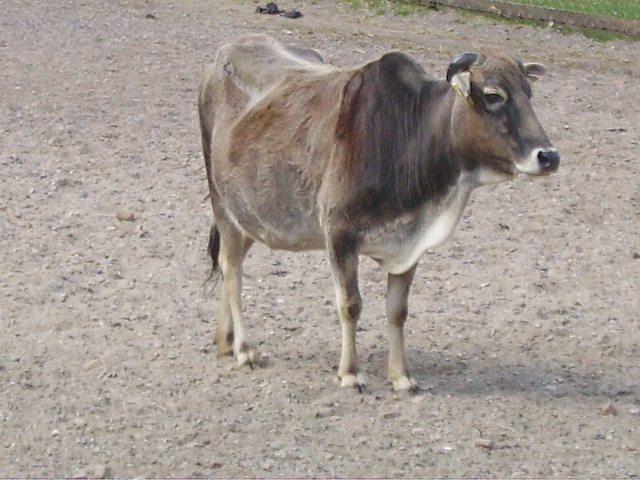
The Miniature Zebu is a zebu, that is a humped cow of the indicus kind, bred down to a very small body. The rule for the herd book is simple: to be registered, an animal may stand no more than 107 cm at the withers, the highest point of the shoulders, which puts a full-grown beast at about waist height on a grown person. Bulls weigh from 182 to 272 kg, cows from 136 to 227 kg, so even the heaviest bull is light next to ordinary farm cattle. Small as they are, they keep the zebu build, hump included.
Where does the Miniature Zebu come from?
Little humped cattle are an old sight in India, where many traditional breeds stay small; the Vechur of southern Kerala is one example, and such animals are spoken of together as nadudana, a word meaning small cattle. The American breed took shape from that same pool of tiny zebus. Its founding animals had been brought in from Brazil, the Dominican Republic and Sweden, and in 1991 the International Miniature Zebu Association opened a herd book for them. At the outset twenty-three American zoos held little zebus, and around fifty private owners kept more. From that base the register grew to over 6,200 animals by 2016.
How the Miniature Zebu is bred and kept
The International Miniature Zebu Association, formed in 1991, keeps the herd book and sets the entry rules. The main rule concerns height: an animal may measure no more than 107 cm at the withers to be written in. Breeders therefore choose their stock with a tape measure in hand, pairing animals whose calves will stay under the ceiling. The founding population was drawn from small zebus brought to the United States from Brazil, the Dominican Republic and Sweden, which gave early members a varied base to work from.
Miniature Zebu, drawn
What the Miniature Zebu is kept for
Size, not yield, is the reason this breed exists; it sits in the miniature-cattle group, animals kept because they are small. When the herd book opened, its stock was split between twenty-three American zoos, where the little zebus were on show to visitors, and some fifty private owners. The register's climb past 6,200 animals by 2016 shows how many more keepers have taken the breed on since.
Who keeps the Miniature Zebu
At the moment the breed was organised, the animals belonged to two kinds of keeper: institutions and individuals. Twenty-three zoos across the United States held little zebus, and some fifty private owners kept others. The International Miniature Zebu Association brought both groups under one herd book from 1991, giving private keepers a way to register their animals and follow a shared standard.
Numbers, conservation and the herd book
More than 6,200 animals were on the register by 2016, a notable figure for a breed only a quarter-century old. Its standing with official bodies is thin: the United States Department of Agriculture does not pass figures for it to DAD-IS, the FAO's breed database, and when the FAO published its world inventory of farm animal genetic resources in 2007, the breed did not appear on the annexed list. It exists chiefly through the records of its own association rather than through international reporting.
Questions people ask about Miniature Zebu
Where does the Miniature Zebu come from?
The breed was organised in the United States in 1991, when its association opened a herd book. Its founding animals were small zebus brought in from Brazil, the Dominican Republic and Sweden, and the type echoes the tiny zebu cattle long bred in India.
What are Miniature Zebus kept for?
They are kept for their small size, as members of the miniature-cattle group. Early on they were exhibited in twenty-three American zoos and kept by about fifty private owners, and the breed has since grown through private keeping, with over 6,200 animals registered by 2016.
How big is a Miniature Zebu?
An animal must stand 107 cm or less at the withers, the top of the shoulders, to be registered. Bulls weigh 182 to 272 kg and cows 136 to 227 kg, so a grown beast is far lighter than common farm cattle.
What does the name nadudana mean?
Nadudana means small cattle, and it is used for India's many traditional breeds of very small zebu, the Vechur of southern Kerala among them. It also serves as an alternative name for this American miniature breed.
Is the breed listed by international bodies?
No. The United States Department of Agriculture does not report it to DAD-IS, the FAO breed database, and FAO's 2007 world list of farm animal genetic resources left it out.
Good reading and sources
- Miniature Zebu on WikipediaEncyclopedia
- More photos on Wikimedia CommonsPhotos and video
- Wikidata recordOpen data
The facts on this page come from the Wikipedia article "Miniature Zebu", written by its contributors and used under the CC BY-SA 4.0 licence, and from its Wikidata record (CC0). EveryCow rewrote the text in its own words, with AI assistance, and compares every page with the article to make sure no passage is copied. It may be reused under the same CC BY-SA 4.0 licence with a link back.
It may contain mistakes. Sizes, colours and customs differ from one herd, valley or breeder to the next. Folk beliefs are described as tradition, never as advice. If something is wrong, tell us. Last refreshed 2026-10-16.
More from the United States
All the breeds of the United States 🇺🇸 United States and 5 moreBrahman
An American beef breed with a hump and grey or red coat, bred from Indian zebu cattleComposite · Beef · Heat-tolerant
🇺🇸 United States and 5 moreBrahman
An American beef breed with a hump and grey or red coat, bred from Indian zebu cattleComposite · Beef · Heat-tolerant
 🇺🇸 United StatesTexas Longhorn
American beef cattle, once feral on Texas ranges, with horn spreads beyond 2.4 mTaurine · Beef · Heat-tolerant
🇺🇸 United StatesTexas Longhorn
American beef cattle, once feral on Texas ranges, with horn spreads beyond 2.4 mTaurine · Beef · Heat-tolerant
 🇺🇸 United StatesAnkole-Watusi
A large-horned American breed derived from African Sanga cattle, kept for its distinctive horns and hardy build.Sanga · Heritage · Long-horned
🇺🇸 United StatesAnkole-Watusi
A large-horned American breed derived from African Sanga cattle, kept for its distinctive horns and hardy build.Sanga · Heritage · Long-horned
 🇺🇸 United States and 3 moreBrown Swiss
A medium-sized American dairy breed descended from the Alpine Braunvieh, kept for high milk yield and cheese-making.Composite · Dairy · Rich milk
🇺🇸 United States and 3 moreBrown Swiss
A medium-sized American dairy breed descended from the Alpine Braunvieh, kept for high milk yield and cheese-making.Composite · Dairy · Rich milk

