
Ankole-Watusi
A large-horned American breed derived from African Sanga cattle, kept for its distinctive horns and hardy build.
The Ankole-Watusi is a modern American breed created by crossing African Sanga cattle with local stock. It is known for its very large, thick horns and red coat, and is kept primarily as a novelty or heritage animal in North America.
- Horns have the largest circumference of any cattle breed.
- Created in 1960 in New York State from African and Canadian stock.
- Coat is usually red, with bulls averaging 590 kg.
- Population listed as 'recovering' by the Livestock Conservancy.
- Derived from the Ankole group of Sanga cattle from Africa.
What do Ankole-Watusi cattle look like?
This is a modern American breed of domestic cattle, distinct from its African ancestors due to its creation through cross-breeding. The animals are substantial, with bulls weighing up to 730 kg and cows around 550 kg. Their most striking feature is their horns, which are unusually large, thick, and have the widest spread and greatest circumference of any cattle breed. While the coat can vary, it is typically red. The breed retains the robust build of its Sanga lineage but has been adapted to North American conditions.
Where does the Ankole-Watusi come from?
The breed originates from the Ankole group of Sanga cattle found in east and central Africa. In the early twentieth century, some of these cattle were brought to Germany as zoo specimens and subsequently spread to other European zoos. From there, they were imported to the United States. In 1960, a herd was established in New York State by cross-breeding these African imports with an unrelated Canadian bull. This mixing created the unique American strain known today as the Ankole-Watusi.
What the Ankole-Watusi is known for
These cattle are noted for their exceptional horn size, which holds world records for circumference. They are generally docile enough for zoo and park settings but retain the hardiness of their African roots. First calving in heifers usually occurs at about 24 months, and calves are born weighing between 15 and 25 kg. The breed is considered resilient, though its population remains small and carefully managed by conservation groups.
How the Ankole-Watusi is bred and kept
The Ankole Watusi International Registry was established in 1983 to manage the breed's lineage. A formal breed standard was drawn up in 1989 to define acceptable traits. Breeding focuses on maintaining the large horn characteristics while preserving the genetic diversity introduced by the original Canadian cross. The registry tracks purebred animals to ensure the breed's integrity and support its recovery status.
Ankole-Watusi, drawn
What the Ankole-Watusi is kept for
Primarily kept as a heritage and novelty breed, often found in safari parks, zoos, and private collections where their distinctive appearance is valued. They are not typically raised for commercial dairy or beef production due to their small numbers and specific breeding goals. Their presence helps maintain genetic diversity within rare cattle lineages.
The land and climate of the Ankole-Watusi
The breed is now established in North America, particularly in the United States. Originally from the savannas and highlands of east and central Africa, the American strain has adapted to temperate climates. They are suited to pasture-based environments typical of North American ranches and zoological parks.
Who keeps the Ankole-Watusi
The breed is maintained by the Ankole Watusi International Registry and enthusiasts in the United States. Historically, the Ankole cattle were kept by pastoral communities in Africa, but the Watusi strain is now largely managed by conservationists, zoo curators, and private owners interested in rare breeds.


Keeping Ankole-Watusi cattle
Calves weigh 15 to 25 kg at birth, with heifers typically having their first calf at 24 months. Care involves managing their large horns and providing adequate pasture space. Health monitoring is important given the breed's small population and conservation status.
Numbers, conservation and the herd book
In 1984, the purebred population was estimated at 120 head. By 2016, it had grown to approximately 1,500 head, with 80% in the United States. As of 2025, DAD-IS lists the breed as 'at risk/critical maintained' based on a 2022 estimate of 100 to 500 animals. The American Livestock Conservancy lists it as 'recovering'.
Questions people ask about Ankole-Watusi
Where does the Ankole-Watusi come from?
It is a modern American breed created in 1960 in New York State by crossing African Ankole Sanga cattle with a Canadian bull.
What is the breed known for?
It is famous for its very large, thick horns, which hold the record for the widest circumference of any cattle breed.
What is the coat colour?
While coats can vary, the Ankole-Watusi is usually red. Bulls are larger, averaging 590 kg, compared to cows at 476 kg.
Is the breed endangered?
Yes, it is listed as 'at risk/critical maintained' by DAD-IS, though the American Livestock Conservancy considers it 'recovering'.
Good reading and sources
- Ankole-Watusi on WikipediaEncyclopedia
- More photos on Wikimedia CommonsPhotos and video
- Wikidata recordOpen data
The facts on this page come from the Wikipedia article "Ankole-Watusi", written by its contributors and used under the CC BY-SA 4.0 licence, and from its Wikidata record (CC0). EveryCow rewrote the text in its own words, with AI assistance, and compares every page with the article to make sure no passage is copied. It may be reused under the same CC BY-SA 4.0 licence with a link back.
It may contain mistakes. Sizes, colours and customs differ from one herd, valley or breeder to the next. Folk beliefs are described as tradition, never as advice. If something is wrong, tell us. Last refreshed 2026-10-16.
More from the United States
All the breeds of the United States 🇺🇸 United StatesTexas Longhorn
American beef cattle, once feral on Texas ranges, with horn spreads beyond 2.4 mTaurine · Beef · Heat-tolerant
🇺🇸 United StatesTexas Longhorn
American beef cattle, once feral on Texas ranges, with horn spreads beyond 2.4 mTaurine · Beef · Heat-tolerant
 🇺🇸 United StatesFlorida Cracker
A small Spanish-descended Criollo breed from Florida, varied in colour, kept for heritageTaurine · Triple-purpose
🇺🇸 United StatesFlorida Cracker
A small Spanish-descended Criollo breed from Florida, varied in colour, kept for heritageTaurine · Triple-purpose
 🇺🇸 United StatesRandall Lineback
A horned, colour-sided triple-purpose breed from Vermont, kept for milk, meat and workTaurine · Triple-purpose · Thrifty foragers
🇺🇸 United StatesRandall Lineback
A horned, colour-sided triple-purpose breed from Vermont, kept for milk, meat and workTaurine · Triple-purpose · Thrifty foragers
 🇺🇸 United States and 1 moreAmerican Milking Devon
A red American dual-purpose breed, kept for milk and beef and now critically rareTaurine · Dual-purpose · Thrifty foragers
🇺🇸 United States and 1 moreAmerican Milking Devon
A red American dual-purpose breed, kept for milk and beef and now critically rareTaurine · Dual-purpose · Thrifty foragers
Its cousins elsewhere
All heritage breeds 🇮🇩 Indonesia and 5 moreBantengbanṭéng (Javanese/Sundanese)
A wild Southeast Asian ox; its tame form, Bali cattle, runs feral in northern AustraliaBanteng · Beef · Drought-hardy
🇮🇩 Indonesia and 5 moreBantengbanṭéng (Javanese/Sundanese)
A wild Southeast Asian ox; its tame form, Bali cattle, runs feral in northern AustraliaBanteng · Beef · Drought-hardy
 🇲🇳 Mongolia and 4 moreYakགཡག་
A shaggy, cold-hardy highland bovine kept across the Himalayas and Tibetan PlateauYak · Triple-purpose · Cold-hardy
🇲🇳 Mongolia and 4 moreYakགཡག་
A shaggy, cold-hardy highland bovine kept across the Himalayas and Tibetan PlateauYak · Triple-purpose · Cold-hardy
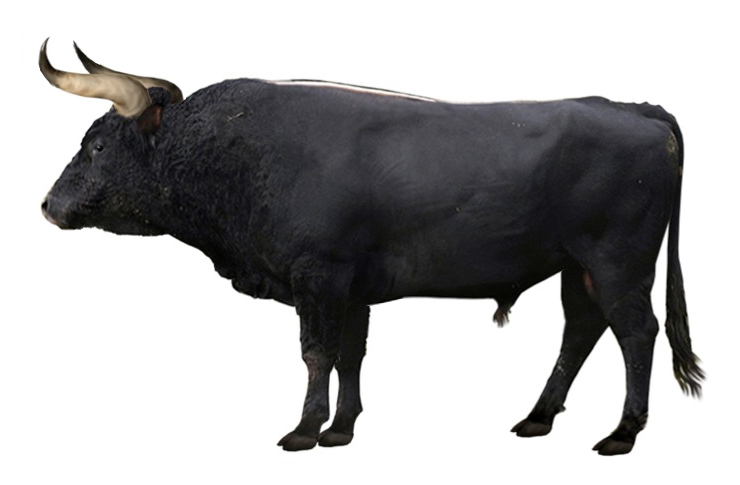 🇵🇱 Poland and 5 moreAurochs
The wild ancestor of all domestic cattle, extinct since 1627Wild · Long-horned
🇵🇱 Poland and 5 moreAurochs
The wild ancestor of all domestic cattle, extinct since 1627Wild · Long-horned
 🇭🇺 HungaryHungarian GreyMagyar Szürke
A tall, long-horned Podolic breed from the Hungarian plains, kept for beef and draught work.Taurine · Beef · Marbled beef
🇭🇺 HungaryHungarian GreyMagyar Szürke
A tall, long-horned Podolic breed from the Hungarian plains, kept for beef and draught work.Taurine · Beef · Marbled beef