
Miniature cattle
Small cattle from around the world: old small breeds and newly bred miniature strains
Miniature cattle are small breeds and strains kept in many countries. Some, like Ireland's Dexter and the Vechur of Kerala in India, are old breeds; others, such as the Australian Lowline, came from planned breeding or experiment, and a few carry a dwarfing gene.
- Some miniature lines show achondroplasia, a dwarfing condition; others are simply small
- The Australian Lowline appeared as an unforeseen outcome of a scientific experiment
- Miniature Jersey cows stand about 115 to 120 cm and weigh around 350 kg
- Eighteen separate strains of miniature cattle have been produced in the United States
- Small zebu-type cattle are Miniature Zebu in the United States, Nadudana in Australia
What do Miniature cattle cattle look like?
Miniature cattle are cattle that stay small, and the name covers a mixed bunch: whole breeds, single strains and registered types from several countries, with no single look. Some lines show achondroplasia, a dwarfing condition that shortens the legs; others are small without it. Among the better known are the Dexter and the Vechur, the Australian Lowline, miniature forms of Galloway, Hereford and Holstein, and small humped stock of zebu kind. One measured example gives a sense of scale: Miniature Jersey cows, that is island-type Jerseys, stand about 115 to 120 cm at the withers, the ridge between the shoulder blades, and weigh around 350 kg.
Where does the Miniature cattle come from?
The small cattle of the world have several different beginnings. Ireland's Dexter and Kerala's Vechur in India are old breeds that have always been small. Others were deliberately scaled down by people choosing the smallest animals to parent each new generation; miniature Galloway, Hereford and Holstein were made this way. The Australian Lowline has an odder story, appearing as an unforeseen outcome of a scientific experiment. In the United States one breeder has produced eighteen separate strains of miniature cattle. Ethiopia has small cattle of its own too: the Goffa and Guraghe, members of the Abyssinian Shorthorned Zebu group.
What the Miniature cattle is known for
Small size brings everyday advantages. Next to ordinary cattle, miniatures need less room and less food, and many keepers find them simpler to handle. Pasture land takes less punishment from them, so grazed ground holds up better. A fence need not be so tall or so strong to keep them in. They also release less methane, the greenhouse gas that cattle give off as they digest their food.
How the Miniature cattle is bred and kept
There is no single system behind these animals. The old small breeds, such as the Dexter and the Vechur, simply breed on as they always have. The newer miniatures exist because breeders selected the smallest animals generation after generation. Some small strains are also written into registers of their own. In the United States, small zebu-type cattle whose ancestors came from Brazil, the Dominican Republic and Sweden can be registered as Miniature Zebu; in Australia, much the same kind of animal may carry the name Nadudana. Island-type Jerseys can likewise be called Miniature Jersey. Registration gives a small strain a recorded identity separate from the big breeds it echoes.
Miniature cattle, drawn

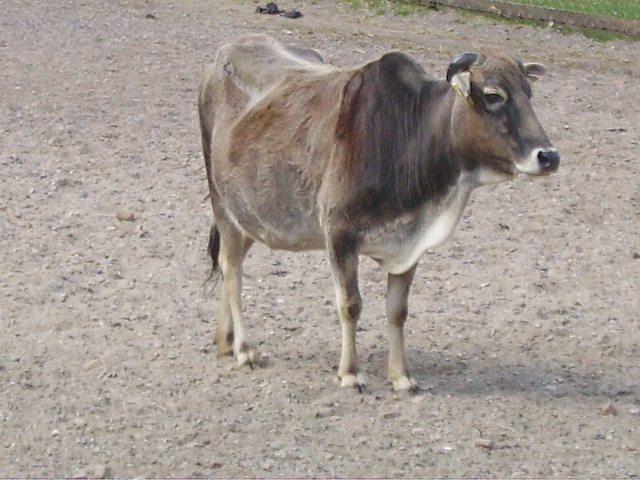


Keeping Miniature cattle cattle
Everyday keeping is on a smaller scale than with full-sized cattle. They eat less, so a modest paddock can carry them, and a lower, lighter fence will hold them in. Because they are gentler on the ground, grazed pasture recovers well. Handling is easier too, which helps people working with little land or light equipment.
Questions people ask about Miniature cattle
Where do miniature cattle come from?
They turn up in many countries. The Dexter comes from Ireland and the Vechur from Kerala in India as old small breeds; the Australian Lowline arose from a scientific experiment; miniature Galloway, Hereford and Holstein were bred down in size, and eighteen strains exist in the United States.
What are miniature cattle kept for?
Mainly for keeping on small places. A miniature needs less room and less feed than a full-sized cow, is often easier to handle, is kinder to pasture and needs only lower, lighter fencing, which suits people with modest land.
Are all miniature cattle dwarfs?
No. Some miniature breeds show achondroplasia, the dwarfing condition that shortens the legs, but not all do; several are small because breeders chose the smallest animals again and again until a consistently little strain emerged.
How big is a miniature cow?
Sizes differ between strains. One measured example is the Miniature Jersey, an island-type Jersey, whose cows stand about 115 to 120 cm at the withers and weigh around 350 kg. Small humped miniatures are registered separately in the United States and Australia.
Which small cattle come from Ethiopia?
The Goffa and the Guraghe, two small breeds from Ethiopia, belong to the Abyssinian Shorthorned Zebu group, a family of small, humped African zebu cattle of the kind also seen in miniature form elsewhere.
Good reading and sources
The facts on this page come from the Wikipedia article "Miniature cattle", written by its contributors and used under the CC BY-SA 4.0 licence, and from its Wikidata record (CC0). EveryCow rewrote the text in its own words, with AI assistance, and compares every page with the article to make sure no passage is copied. It may be reused under the same CC BY-SA 4.0 licence with a link back.
It may contain mistakes. Sizes, colours and customs differ from one herd, valley or breeder to the next. Folk beliefs are described as tradition, never as advice. If something is wrong, tell us. Last refreshed 2026-10-16.
More from Ireland
All the breeds of Ireland 🇬🇧 United Kingdom and 5 moreShorthorn
A historic British breed from north-east England, kept for milk and meat with red, white or roan coats.Taurine · Dual-purpose · Docile
🇬🇧 United Kingdom and 5 moreShorthorn
A historic British breed from north-east England, kept for milk and meat with red, white or roan coats.Taurine · Dual-purpose · Docile
 🇮🇪 Ireland and 2 moreDexter
A small Irish dual-purpose breed, usually black or red, kept for milk and beef on poor land.Taurine · Dual-purpose · Thrifty foragers
🇮🇪 Ireland and 2 moreDexter
A small Irish dual-purpose breed, usually black or red, kept for milk and beef on poor land.Taurine · Dual-purpose · Thrifty foragers
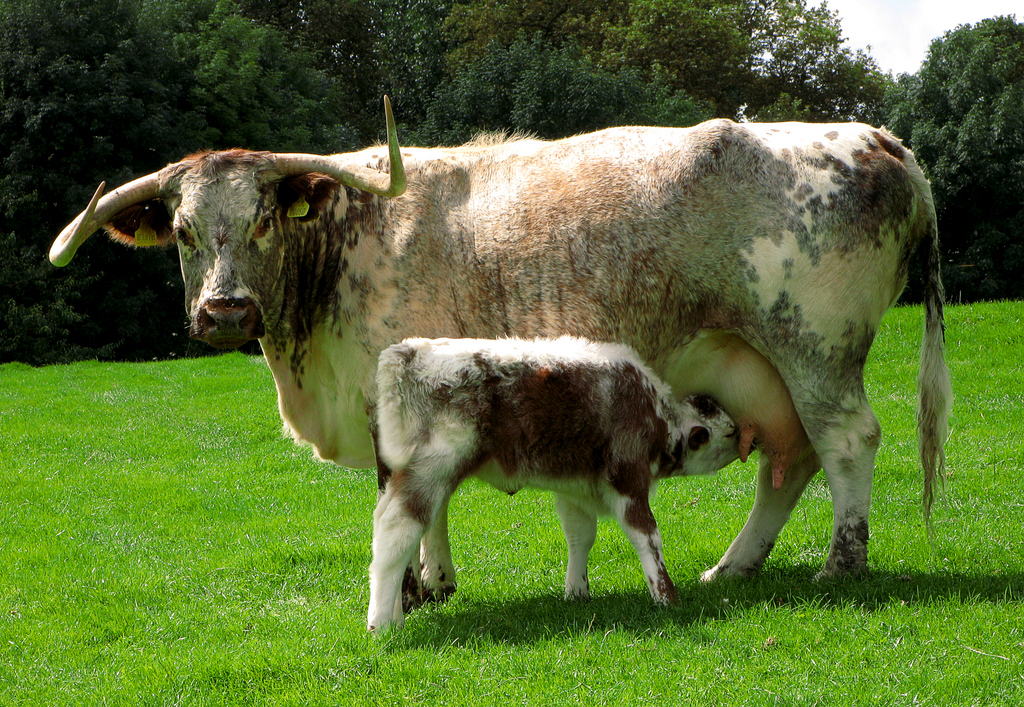 🇬🇧 United Kingdom and 3 moreEnglish Longhorn
A large horned beef breed from northern England, marked by a white line along the spineTaurine · Beef · Long-horned
🇬🇧 United Kingdom and 3 moreEnglish Longhorn
A large horned beef breed from northern England, marked by a white line along the spineTaurine · Beef · Long-horned
 🇮🇪 Ireland and 2 moreKerryBó Chiarraí
A rare black dairy breed from southwest Ireland, one of Europe's oldest milk cattleTaurine · Dairy · Thrifty foragers
🇮🇪 Ireland and 2 moreKerryBó Chiarraí
A rare black dairy breed from southwest Ireland, one of Europe's oldest milk cattleTaurine · Dairy · Thrifty foragers
Its cousins elsewhere
All miniature breeds 🇵🇰 Pakistan and 5 moreZebu
Humped, heat-tolerant cattle of South Asia, kept for milk, meat, work and ridingZebu · Dairy · Heat-tolerant
🇵🇰 Pakistan and 5 moreZebu
Humped, heat-tolerant cattle of South Asia, kept for milk, meat, work and ridingZebu · Dairy · Heat-tolerant
 🇲🇳 Mongolia and 4 moreYakགཡག་
A shaggy, cold-hardy highland bovine kept across the Himalayas and Tibetan PlateauYak · Triple-purpose · Cold-hardy
🇲🇳 Mongolia and 4 moreYakགཡག་
A shaggy, cold-hardy highland bovine kept across the Himalayas and Tibetan PlateauYak · Triple-purpose · Cold-hardy
 🇮🇩 Indonesia and 4 moreBali cattle
A small humped breed from Indonesia, descended from wild banteng, kept for meat and plowing.Banteng · Beef · Disease-resistant
🇮🇩 Indonesia and 4 moreBali cattle
A small humped breed from Indonesia, descended from wild banteng, kept for meat and plowing.Banteng · Beef · Disease-resistant
 🇺🇸 United States and 5 moreBrahman
An American beef breed with a hump and grey or red coat, bred from Indian zebu cattleComposite · Beef · Heat-tolerant
🇺🇸 United States and 5 moreBrahman
An American beef breed with a hump and grey or red coat, bred from Indian zebu cattleComposite · Beef · Heat-tolerant