Taurine cattle
Humpless cattle, Bos taurus, from the aurochs of the Near East: the breeds of Europe, West Africa and East Asia.
Taurine cattle, Bos taurus, are the humpless cattle. They descend from the aurochs of the Near East, tamed in the upper valleys of the Tigris and Euphrates roughly ten and a half thousand years ago, and they spread with early farmers into Europe, North Africa and East Asia. Almost every European breed is taurine, from the Holstein and Jersey to the Highland and Chianina, as are the Wagyu and Hanwoo of East Asia and the N'Dama and Kuri of Africa. In South Asia, the native cattle are zebu instead, though taurine blood has come in through crossbreeding.
Origins in the Near East
Archaeology and ancient DNA point to the northern Fertile Crescent, in what is now south-east Turkey, northern Syria and northern Iraq, as the place where aurochs were first kept and bred around ten and a half thousand years ago. The founding herd seems to have been small. From there, cattle travelled with farmers west along the Mediterranean and up the Danube into Europe, and south into Egypt. Wild aurochs bulls sometimes crossed with domestic cows along the way, leaving traces of local wild ancestry in some European breeds.
How to tell them
Taurine cattle have no hump over the shoulders and usually a small, tight dewlap, with shorter ears than zebu. Their coats are often thicker and they cope better with cold than with heat. They have fewer sweat glands than zebu. Within the taurine family, breeds range from the long-legged Podolic grey cattle to the compact Highland and the tiny Dexter, and from the black Angus to the white Charolais and the pied Holstein.
Taurine cattle in Africa and Asia
West Africa has old taurine breeds of its own: the long-horned N'Dama of Guinea and the short-horned Baoulé, Lagune and others. Many of them tolerate the trypanosomes carried by tsetse fly, which makes them vital where zebu struggle. The Kuri of Lake Chad is another African taurine. In East Asia, the Wagyu of Japan, the Hanwoo of Korea and Mongolian cattle are taurine or mostly so. In India, Holstein and Jersey crosses with native zebu now make up a large share of the dairy herd.
Worth knowing
- Holstein Friesian: The most numerous dairy breed in the world
- Aberdeen Angus: Black polled beef breed from north-east Scotland
- Highland: Shaggy, long-horned cattle of the Scottish Highlands
- Jersey: Small, fawn dairy cow from the island of Jersey
- Chianina: Very tall white breed of Tuscany
- N'Dama: Trypanotolerant West African taurine
- Wagyu: Japanese cattle bred for marbling
- Hanwoo: Native brown cattle of Korea
Sources and further reading
Original text by the EveryCow desk, written with AI assistance and checked against the sources above. Customs are described as tradition, not as advice. If we have something wrong, tell us.
Taurine on EveryCow
The breeds written up so far, best known first.
 🇩🇪 Germany and 3 moreHeck
A German type bred in the 1920s to recreate the extinct aurochsTaurine · Grazing · Cold-hardy
🇩🇪 Germany and 3 moreHeck
A German type bred in the 1920s to recreate the extinct aurochsTaurine · Grazing · Cold-hardy
 🇺🇸 United StatesTexas Longhorn
American beef cattle, once feral on Texas ranges, with horn spreads beyond 2.4 mTaurine · Beef · Heat-tolerant
🇺🇸 United StatesTexas Longhorn
American beef cattle, once feral on Texas ranges, with horn spreads beyond 2.4 mTaurine · Beef · Heat-tolerant
 🇫🇷 France and 2 moreAbondance
A red and white dairy breed from the French Alps, kept for milk and mountain grazing.Taurine · Dairy · Heat-tolerant
🇫🇷 France and 2 moreAbondance
A red and white dairy breed from the French Alps, kept for milk and mountain grazing.Taurine · Dairy · Heat-tolerant
 🇬🇧 United Kingdom and 5 moreBelted Galloway
A polled Scottish beef breed with a distinctive white belt around its black body.Taurine · Beef · Cold-hardy
🇬🇧 United Kingdom and 5 moreBelted Galloway
A polled Scottish beef breed with a distinctive white belt around its black body.Taurine · Beef · Cold-hardy
 🇨🇭 SwitzerlandHérens
A small black or red Swiss alpine breed kept for cow fighting and mountain grazing.Taurine · Sport · Quick and strong
🇨🇭 SwitzerlandHérens
A small black or red Swiss alpine breed kept for cow fighting and mountain grazing.Taurine · Sport · Quick and strong
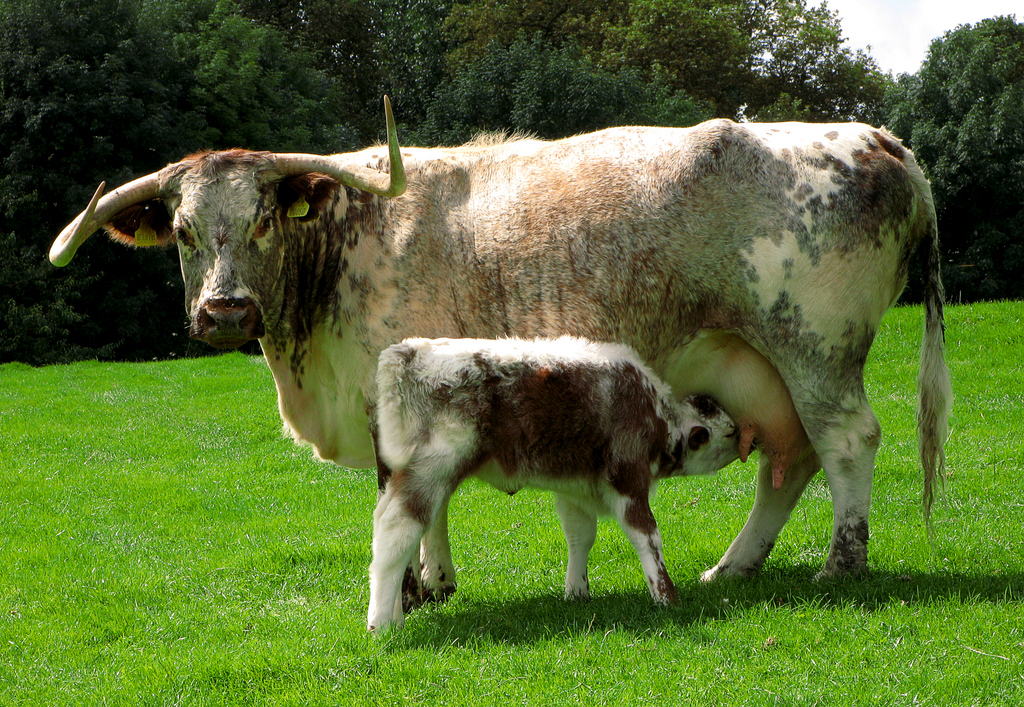 🇬🇧 United Kingdom and 3 moreEnglish Longhorn
A large horned beef breed from northern England, marked by a white line along the spineTaurine · Beef · Long-horned
🇬🇧 United Kingdom and 3 moreEnglish Longhorn
A large horned beef breed from northern England, marked by a white line along the spineTaurine · Beef · Long-horned
 🇸🇪 SwedenVäneko
An endangered Swedish dairy breed, black or red with white, named for a villageTaurine · Dairy
🇸🇪 SwedenVäneko
An endangered Swedish dairy breed, black or red with white, named for a villageTaurine · Dairy
 🇦🇹 AustriaTux-ZillertalTux-Zillertaler
A stocky Alpine breed from Tirol, black or red, once bred for cow-fighting contests.Taurine · Beef · Spirited
🇦🇹 AustriaTux-ZillertalTux-Zillertaler
A stocky Alpine breed from Tirol, black or red, once bred for cow-fighting contests.Taurine · Beef · Spirited
 🇪🇸 Spain and 1 moreAlbera
A small cold-hardy breed of the Albera Massif, black or pale, used to clear scrubTaurine · Beef · Cold-hardy
🇪🇸 Spain and 1 moreAlbera
A small cold-hardy breed of the Albera Massif, black or pale, used to clear scrubTaurine · Beef · Cold-hardy
 🇮🇪 IrelandIrish MoiledBó Maol
A rare hornless Irish breed, red with a white back stripe, used for milk and beefTaurine · Dual-purpose · Polled
🇮🇪 IrelandIrish MoiledBó Maol
A rare hornless Irish breed, red with a white back stripe, used for milk and beefTaurine · Dual-purpose · Polled
Photo credits on this page
The small pictures above come from Wikimedia Commons under free licences. Some are cropped to fit.
- Belted Galloway: Jamain, CC BY-SA 3.0, source
- Tux-Zillertal: Böhringer Friedrich, CC BY-SA 2.5, source
- Heck: 4028mdk09, CC BY-SA 3.0, source
- Väneko: Philaweb, CC BY-SA 3.0, source
- Abondance: Walpole, CC BY-SA 3.0, source
- Irish Moiled: No machine-readable author provided. Malcolm Morley~commonswiki assume, Public domain, source
- Hérens: Joe Byrne, CC BY-SA 4.0, source
- English Longhorn: Dave, CC BY-SA 2.0, source
- Texas Longhorn: Clinton & Charles Robertson, CC BY 2.0, source
- Albera: Tylwyth Eldar, CC BY-SA 4.0, source