
Heck
A German type bred in the 1920s to recreate the extinct aurochs
A German breed of domestic cattle, developed from the 1920s when two zoo director brothers set out to breed back the extinct aurochs. The animals vary greatly in colour, horn shape and size, stand about 1.3 to 1.4 m at the withers, and are now kept mostly in nature reserves and zoos across Europe.
- Bred in Germany in the 1920s by the Heck brothers as a stand-in for the aurochs
- Cows stand about 1.3 m and weigh 400 to 600 kg; bulls about 1.4 m and 600 to 900 kg
- Coats run from black to red and brown, and no two herds look quite alike
- About 2,000 in Europe, around 600 of them free-roaming in a Dutch polder reserve
- Critics doubt the breeding-back worked; other breeds resemble the aurochs at least as closely
What do Heck cattle look like?
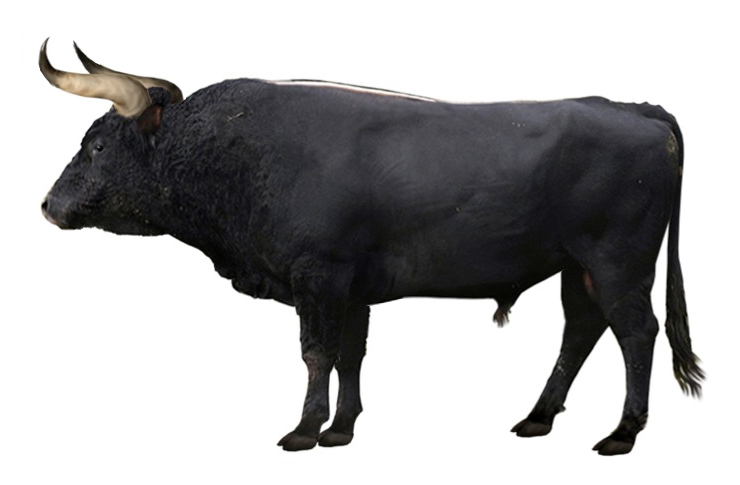
Heck cattle are domestic cattle of medium to large build, standing roughly 1.3 m at the withers for a cow and 1.4 m for a bull. Weights run from about 400 to 600 kg in cows and 600 to 900 kg in bulls. The body is thick-set, with a long trunk on short legs and a small, short head. Coats come in shades of red, brown and black; bulls often carry a pale stripe along the spine, cows are commonly reddish-brown, and grey, beige or white-patched animals turn up. Horns differ in shape, size and direction. The breed is unusually variable, even within one herd.
Where does the Heck come from?
Two brothers, Heinz and Lutz Heck, began separate breeding-back schemes in Germany in the 1920s, early in the Weimar Republic. Heinz ran the Hellabrunn zoo in Munich and Lutz the Berlin zoo. Both wanted to bring back the aurochs, the wild ox of Holocene Europe, which they felt was being confused with the European bison, and so to undo the loss of the species. Each declared success about eleven years later. Lutz worked with Spanish fighting bulls; his animals were released in the Romincka Forest in Poland, and they were wiped out at the end of the Second World War. Every Heck animal alive now descends from Heinz's stock.
What the Heck is known for
Herds differ widely, but the cattle are hardy. They cope with cold weather and with grazing that offers little nutrition, which is why they were put into nature reserves. Lutz Heck's line was aggressive, and objections to releasing it were raised from the start, partly because its effect on local wildlife could not be predicted. Accounts of the breed describe a great spread of shapes and colours rather than one fixed type; variation is greater than in most other domestic breeds, and greater than in wild animals.
How the Heck is bred and kept
Heinz Heck built his herd from a set list of breeds: Hungarian Grey, Highland, Corsican, Murnau-Werdenfels, Angeln, German Black Pied, White Park and Brown Swiss. In 1932 a bull named Glachl was born, 75% Corsican with the rest a mix of Grey, Lowland, Highland and Angeln blood, and he was judged to look like an aurochs. Glachl and his sire were later crossed into other breeds to add weight. Most modern Heck cattle therefore trace back to Central European dairy and beef cattle, with blood from other regions mixed in. Some supporters say the Munich and Berlin results matched closely; in fact they did not.
Heck, drawn
What the Heck is kept for
The breed exists mainly for conservation grazing and for display. Heck cattle are kept in German zoos, where the claim that they are resurrected aurochs still draws visitors, and they graze in nature reserves in the Netherlands, Germany and Ukraine. Putting them into reserves to recreate old landscapes gave ideas to the Rewilding Europe movement. They have also been drawn into further breeding-back work, the Taurus project in Germany and the Tauros programme in the Netherlands. A small number went to Devon in the United Kingdom in 2009.
The land and climate of the Heck
The breed lives outdoors all year in European reserves, woods and polders, and it manages on poor forage and in frost. Oostvaardersplassen in Flevoland, a Dutch polder reserve, holds a free-roaming herd; other groups are at the Falkenthaler Rieselfelder near Berlin, the Nesseaue reserve near Erfurt in Thuringia, and the Grubenfelder Leonie reserve at Auerbach in Bavaria. A small number are also held in Ukraine, at the Beremytske nature park in Chernihiv. Heck cattle stand cold better than many domestic breeds, though other robust breeds do as well.
At a glance: where it belongs
Land and climate


Keeping Heck cattle
In reserves the cattle are largely left to find their own food, and they get through cold spells and poor grazing. At Oostvaardersplassen a hands-off policy once applied, but hunters now shoot weak animals so that they do not suffer. After heavy losses in the winters of 2005 and 2010, public support fell away and that policy was dropped in 2018.
Numbers, conservation and the herd book
Roughly 2,000 Heck cattle live in Europe, with a few outside it. About 600 run free at Oostvaardersplassen in the Netherlands. Around 100 were registered in France in 2000, and there are German herds near Berlin, Erfurt and Auerbach, plus a small group in Ukraine. A herd went to Devon in the United Kingdom in 2009. Their place in zoos rests on the claim that they represent the aurochs, a claim many scientists reject. There is no single fixed type, and the breed's variability is itself often noted.
Questions people ask about Heck
Where does Heck cattle come from?
It was developed in Germany, starting in the 1920s, by the zoo director brothers Heinz and Lutz Heck. Heinz worked in Munich, Lutz in Berlin. Every living Heck animal descends from Heinz Heck's herd.
What are Heck cattle kept for?
Mainly conservation grazing and display. They graze in nature reserves in the Netherlands, Germany and Ukraine, and stand in German zoos as supposed aurochs. They are also used in further breeding-back work such as the Taurus project and the Tauros programme.
Do they really look like aurochs?
Partly, and not closely. Bulls are often black with a pale back stripe and cows reddish-brown, but size, build, head shape and horns differ from the aurochs, which was taller and more athletic. Many other breeds resemble the aurochs at least as much.
How hardy are they?
Very. They winter outdoors in European reserves, eat coarse, low-value grazing and need little help. Only weak animals are shot, at Oostvaardersplassen at least, so that they do not suffer. Several other robust cattle breeds cope with hard conditions just as well.
How many are there?
About 2,000 in Europe and a few elsewhere, with roughly 600 free-roaming at Oostvaardersplassen in the Netherlands, about 100 registered in France in 2000, and small herds in Germany, Ukraine and the United Kingdom.
Good reading and sources
- Heck cattle on WikipediaEncyclopedia
- More photos on Wikimedia CommonsPhotos and video
- Wikidata recordOpen data
The facts on this page come from the Wikipedia article "Heck cattle", written by its contributors and used under the CC BY-SA 4.0 licence, and from its Wikidata record (CC0). EveryCow rewrote the text in its own words, with AI assistance, and compares every page with the article to make sure no passage is copied. It may be reused under the same CC BY-SA 4.0 licence with a link back.
It may contain mistakes. Sizes, colours and customs differ from one herd, valley or breeder to the next. Folk beliefs are described as tradition, never as advice. If something is wrong, tell us. Last refreshed 2026-10-16.
More from Germany
All the breeds of Germany 🇩🇪 Germany and 2 moreTaurus cattle
Long-legged cross-bred cattle bred in Germany to stand in for the extinct aurochsComposite · Grazing
🇩🇪 Germany and 2 moreTaurus cattle
Long-legged cross-bred cattle bred in Germany to stand in for the extinct aurochsComposite · Grazing
 🇵🇱 Poland and 5 moreAurochs
The wild ancestor of all domestic cattle, extinct since 1627Wild · Long-horned
🇵🇱 Poland and 5 moreAurochs
The wild ancestor of all domestic cattle, extinct since 1627Wild · Long-horned
 🇨🇭 Switzerland and 5 moreSimmental
A large dual-purpose breed from the Swiss Simme valley, red and white with strong growth rates.Taurine · Dual-purpose · Docile
🇨🇭 Switzerland and 5 moreSimmental
A large dual-purpose breed from the Swiss Simme valley, red and white with strong growth rates.Taurine · Dual-purpose · Docile
 🇨🇭 Switzerland and 5 moreBraunvieh
A large Alpine brown dairy breed from Switzerland, known for its strength and high milk yield.Taurine · Dairy · Rich milk
🇨🇭 Switzerland and 5 moreBraunvieh
A large Alpine brown dairy breed from Switzerland, known for its strength and high milk yield.Taurine · Dairy · Rich milk
Its cousins elsewhere
All grazing breeds 🇲🇳 Mongolia and 4 moreYakགཡག་
A shaggy, cold-hardy highland bovine kept across the Himalayas and Tibetan PlateauYak · Triple-purpose · Cold-hardy
🇲🇳 Mongolia and 4 moreYakགཡག་
A shaggy, cold-hardy highland bovine kept across the Himalayas and Tibetan PlateauYak · Triple-purpose · Cold-hardy
 🇵🇰 Pakistan and 5 moreZebu
Humped, heat-tolerant cattle of South Asia, kept for milk, meat, work and ridingZebu · Dairy · Heat-tolerant
🇵🇰 Pakistan and 5 moreZebu
Humped, heat-tolerant cattle of South Asia, kept for milk, meat, work and ridingZebu · Dairy · Heat-tolerant
 🇮🇩 Indonesia and 4 moreBali cattle
A small humped breed from Indonesia, descended from wild banteng, kept for meat and plowing.Banteng · Beef · Disease-resistant
🇮🇩 Indonesia and 4 moreBali cattle
A small humped breed from Indonesia, descended from wild banteng, kept for meat and plowing.Banteng · Beef · Disease-resistant
 🇨🇳 China and 2 moreWild yak
A massive, shaggy wild bovine native to the high plateaux and peaks of the HimalayasYak · Beef · Cold-hardy
🇨🇳 China and 2 moreWild yak
A massive, shaggy wild bovine native to the high plateaux and peaks of the HimalayasYak · Beef · Cold-hardy