
Kerry
In its own language: Bó Chiarraí
A rare black dairy breed from southwest Ireland, one of Europe's oldest milk cattle
A rare dairy breed native to Ireland and counted among the oldest cattle breeds in Europe, the Kerry is black almost all over, with a little white at the udder. Cows give 3,000 to 3,700 kg of milk per lactation, with tiny fat globules that suit cheese and butter.
- Counted among the oldest cattle breeds in Europe
- Said to be the earliest breed kept mainly for milking
- Cows give 3,000 to 3,700 kg of milk per lactation
- Only about 200 pedigree animals were left worldwide in 1983
- Tiny fat globules suit the milk to cheese, butter and yoghurt
What do Kerry cattle look like?
A Kerry is a small dairy cow, black almost all over, with the only white showing as a little at the udder. Her horns are whitish and tipped with dark, though most animals have them removed young, since the breed is usually dehorned. A grown cow weighs about 350 to 450 kg, an easy size for a small farm. The milk is her other signature: its fat sits in very small globules rather than large ones, a detail that decides how well the milk turns into cheese, butter and yoghurt.
Where does the Kerry come from?
Kerry cattle belong to Ireland, and students of the breed count them among the oldest milk cattle in Europe. The story told of them is that they spring from small black cattle carried across the sea by people of the Neolithic age, the first farming era. A second thread ties them to the Celtic Shorthorn, thought to have reached Ireland as long ago as 2000 BC. If those accounts hold, they were among the first cattle anywhere to be bred chiefly for milk rather than for work or meat. The damp southwest of the country suited milking all year round, and people of Celtic times made the surplus keep as butter and cheese. From these beginnings the breed was shaped for the small family farms of Ireland's south and west.
What the Kerry is known for
What sets the Kerry apart is its light touch on the land. Being small, it disturbs wet soil far less than heavier breeds do, which matters in rainy country where hooves can ruin a field. The breed was shaped for small subsistence farms, places where milk for the household came before anything else. It is classed as a rare breed, though its numbers have climbed back from a very low point in the 1980s.
How the Kerry is bred and kept
Kerrys are kept as pedigree stock, meaning animals whose descent is written down and tracked. That record-keeping came into its own when the breed nearly slipped away in the early 1980s; patient pedigree breeding has since built the numbers up again. A herd is kept at Farmleigh, an estate that belongs to the Irish state, so the breed stays on show to visitors. On the small farms it was made for, a Kerry serves as the house cow, giving a family its milk.
Kerry, drawn
What the Kerry is kept for
Milk is what the Kerry is for; from early on it was bred for the pail, while other breeds were being shaped for work in harness and for meat. A cow gives about 3,000 to 3,700 kg of milk over one lactation, the milking span between two calvings. The fat in that milk sits in very small globules, and it is that quality which makes the milk so good for cheese, butter and yoghurt. In Celtic times the steady supply was stored as butter and cheese to keep it.
The land and climate of the Kerry
Kerry cattle come from the southwest of Ireland, where the climate allows cows to be milked all year. The breed was shaped for the small farms of the south and west, country of steady rain and soft fields. There its light build earns its keep: in high-rainfall areas a Kerry damages the soil less than a larger cow would, so wet pasture holds up. It is a creature of temperate, rain-fed country.
At a glance: where it belongs
Land and climate
Peoples

Numbers, conservation and the herd book
Kerry cattle are counted as rare. In 1983 the world held only about 200 pedigree animals, though numbers have since grown. An 1818 import took the breed across the Atlantic to the United States, where it flourished through the nineteenth century before thinning to scarcity by the 1930s. Today North America has only a few herds, most of them built on more recent imports into Canada.
From the Kerry
Questions people ask about Kerry
Where do Kerry cattle come from?
They are native to Ireland. Breed history holds that they descend from small black cattle brought by Neolithic people, and probably from the Celtic Shorthorn, thought to have reached Ireland as long ago as 2000 BC. They are counted among the oldest cattle breeds in Europe.
What are Kerry cattle kept for?
Milk, above all. A cow yields about 3,000 to 3,700 kg per lactation, and the very small fat globules make the milk especially good for cheese, butter and yoghurt. The breed was developed for milking while others were shaped for draught and meat.
What does a Kerry cow look like?
She is black almost all over, with a little white at the udder. The horns are whitish, tipped with dark, though most animals are dehorned. She is small for a dairy cow, weighing about 350 to 450 kg when fully grown.
How rare are Kerry cattle?
They are classed as rare. The world held only some 200 pedigree animals in 1983, and numbers have grown since but stay low. A herd is kept at Farmleigh, an Irish state estate, and North America has just a few herds, mostly from newer imports into Canada.
Would a Kerry suit a small wet farm?
Yes, that is the setting it was bred for. In wet, rainy country a Kerry damages the soil less than a bigger cow would, and the breed was developed for small farms where the cow's main job was feeding the household with milk.
Good reading and sources
- Kerry cattle on WikipediaEncyclopedia
- More photos on Wikimedia CommonsPhotos and video
- Wikidata recordOpen data
The facts on this page come from the Wikipedia article "Kerry cattle", written by its contributors and used under the CC BY-SA 4.0 licence, and from its Wikidata record (CC0). EveryCow rewrote the text in its own words, with AI assistance, and compares every page with the article to make sure no passage is copied. It may be reused under the same CC BY-SA 4.0 licence with a link back.
It may contain mistakes. Sizes, colours and customs differ from one herd, valley or breeder to the next. Folk beliefs are described as tradition, never as advice. If something is wrong, tell us. Last refreshed 2026-10-16.
More from Ireland
All the breeds of Ireland 🇬🇧 United Kingdom and 5 moreShorthorn
A historic British breed from north-east England, kept for milk and meat with red, white or roan coats.Taurine · Dual-purpose · Docile
🇬🇧 United Kingdom and 5 moreShorthorn
A historic British breed from north-east England, kept for milk and meat with red, white or roan coats.Taurine · Dual-purpose · Docile
 🇮🇪 Ireland and 2 moreDexter
A small Irish dual-purpose breed, usually black or red, kept for milk and beef on poor land.Taurine · Dual-purpose · Thrifty foragers
🇮🇪 Ireland and 2 moreDexter
A small Irish dual-purpose breed, usually black or red, kept for milk and beef on poor land.Taurine · Dual-purpose · Thrifty foragers
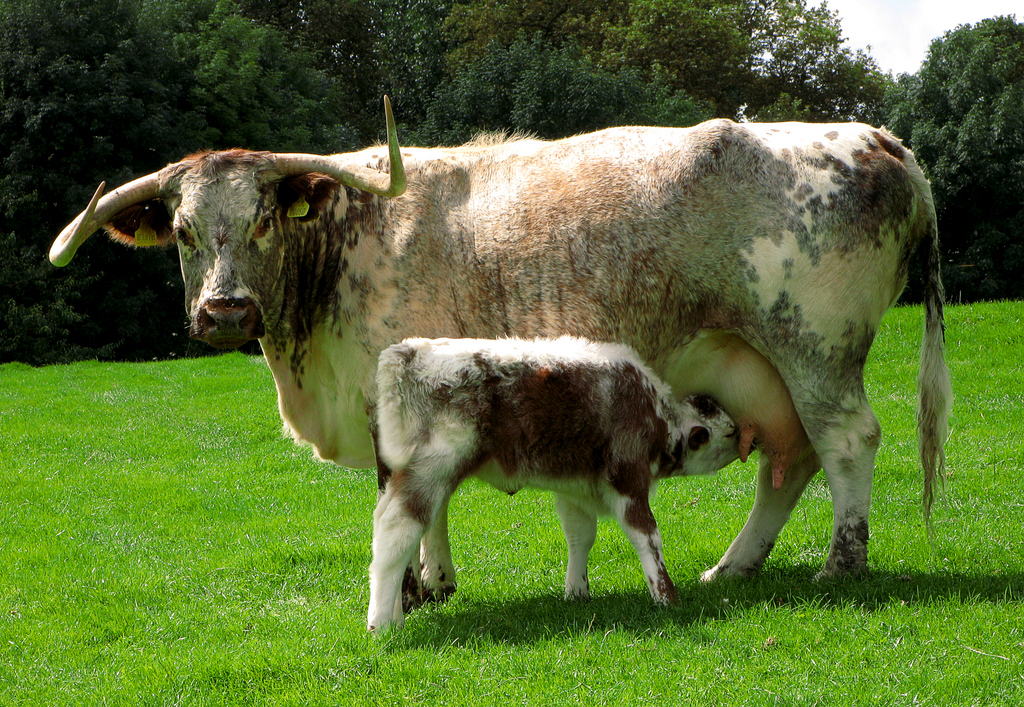 🇬🇧 United Kingdom and 3 moreEnglish Longhorn
A large horned beef breed from northern England, marked by a white line along the spineTaurine · Beef · Long-horned
🇬🇧 United Kingdom and 3 moreEnglish Longhorn
A large horned beef breed from northern England, marked by a white line along the spineTaurine · Beef · Long-horned
 🇮🇪 IrelandIrish MoiledBó Maol
A rare hornless Irish breed, red with a white back stripe, used for milk and beefTaurine · Dual-purpose · Polled
🇮🇪 IrelandIrish MoiledBó Maol
A rare hornless Irish breed, red with a white back stripe, used for milk and beefTaurine · Dual-purpose · Polled
Its cousins elsewhere
All dairy breeds 🇵🇰 Pakistan and 5 moreZebu
Humped, heat-tolerant cattle of South Asia, kept for milk, meat, work and ridingZebu · Dairy · Heat-tolerant
🇵🇰 Pakistan and 5 moreZebu
Humped, heat-tolerant cattle of South Asia, kept for milk, meat, work and ridingZebu · Dairy · Heat-tolerant
 🇮🇩 Indonesia and 4 moreBali cattle
A small humped breed from Indonesia, descended from wild banteng, kept for meat and plowing.Banteng · Beef · Disease-resistant
🇮🇩 Indonesia and 4 moreBali cattle
A small humped breed from Indonesia, descended from wild banteng, kept for meat and plowing.Banteng · Beef · Disease-resistant
 🇲🇳 Mongolia and 4 moreYakགཡག་
A shaggy, cold-hardy highland bovine kept across the Himalayas and Tibetan PlateauYak · Triple-purpose · Cold-hardy
🇲🇳 Mongolia and 4 moreYakགཡག་
A shaggy, cold-hardy highland bovine kept across the Himalayas and Tibetan PlateauYak · Triple-purpose · Cold-hardy
 🇺🇸 United States and 5 moreBrahman
An American beef breed with a hump and grey or red coat, bred from Indian zebu cattleComposite · Beef · Heat-tolerant
🇺🇸 United States and 5 moreBrahman
An American beef breed with a hump and grey or red coat, bred from Indian zebu cattleComposite · Beef · Heat-tolerant