
Taurus cattle
Long-legged cross-bred cattle bred in Germany to stand in for the extinct aurochs
Taurus cattle are a cross-bred population of long-legged, slender animals, put together in Germany to look like the extinct aurochs. They graze reserves in Germany, Denmark, Hungary and Latvia as conservation animals, and the largest herd lives on the Hungarian plain at Hortobágy.
- Started in 1996 at the Lippeaue reserve near Soest in Germany
- German herd averages 47% Sayaguesa, 29% Heck, 20% Chianina and 4% Lidia
- Large Taurus bulls about 165 cm at the withers; Heck bulls about 140 cm
- Hortobágy National Park in Hungary held 500 to 600 head in 2012
- Danish herd, begun as Projekt Urokse, reached 56 animals by 2010
What do Taurus cattle cattle look like?
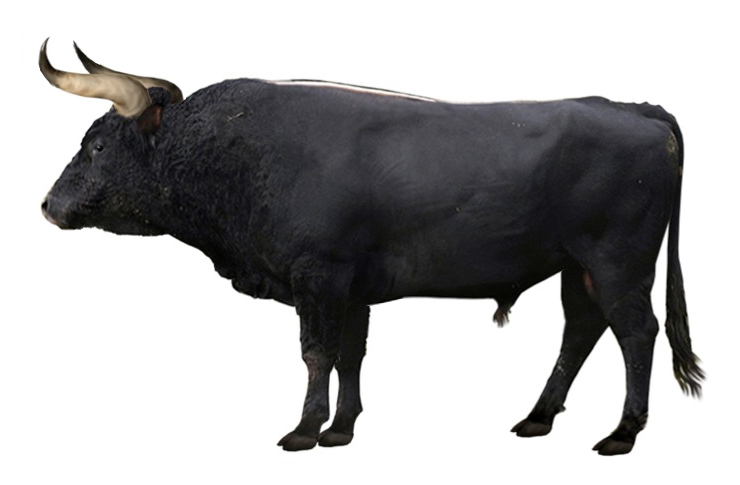
Taurus cattle are a cross-bred population rather than a settled breed. They are built for open country: long in the leg and fairly slender, with a longer muzzle than ordinary farm cattle, a feature that shows most strongly in animals carrying much Sayaguesa blood. A large Taurus bull stands about 165 cm at the withers, where a Heck bull measures only around 140 cm. The coat is expected to keep the wild colour pattern the founding stock already had, and the heads are meant to grow horns that sweep forwards. Because several parent breeds go into them, the animals differ quite a lot from herd to herd.
Where does the Taurus cattle come from?
In 1996 a German conservation group, the Arbeitsgemeinschaft Biologischer Umweltschutz, began crossing Heck cattle with primitive southern European breeds at the Lippeaue reserve near Soest. Heck cattle themselves had been assembled in the 1920s and 1930s as an attempt at rebuilding the aurochs, the wild ox from which domestic cattle descend. The group found those animals too small and too short in the leg, and disliked their horns, so the aim became bigger, taller, longer-faced cattle with forward-curving horns. Breeding herds were set up in Hungary and Denmark in 2003 and in Latvia in 2004. The long-term goal is an animal that can stand in for the extinct aurochs.
What the Taurus cattle is known for
The cattle live outdoors all year in reserves, but they are not the toughest grazers on those sites. Work at Hortobágy National Park found them less suited to dry, cold grassland than the Przewalski horses kept there, and for several years the herd received extra feed in winter. The winter of 2011 was the first the cattle came through without it. Their value lies in how closely they resemble the aurochs and in the way heavy grazing shapes vegetation, not in unusual hardiness.
How the Taurus cattle is bred and kept
Mixing breeds is the whole point of the scheme, and each herd combines different ingredients. The German animals at Lippeaue average roughly 47 per cent Sayaguesa, 29 per cent Heck, 20 per cent Chianina and 4 per cent Lidia, the Spanish fighting breed; Chianina and Sayaguesa bring height, and Lidia was used at the start for its build. Hungarian stock came from Germany and was then crossed further with Ankole-Watusi and Hungarian Grey animals, and one cow there is half Holstein Friesian. That herd is split in two, a main group at Pentezug and a second at Karácsonyfok. Denmark's founders were four Heck cows, a Chianina cross bull and a Sayaguesa cross cow; three Sayaguesa bulls joined in 2009.
Taurus cattle, drawn
What the Taurus cattle is kept for
These animals work as landscape managers. Herds graze reserves in Germany, Denmark, Hungary and Latvia, where the task is to hold natural landscapes and their biodiversity in good order, much as the wild ox did before it disappeared. That is the main purpose, and milk or meat are not the point of the scheme. The Hungarian herd is the biggest and grazes the dry grasslands of Hortobágy National Park. In Germany, breeders of Heck cattle have grown interested in Taurus animals because they look more like the aurochs, so pure Heck stock and Taurus crosses now shade into one another.
The land and climate of the Taurus cattle
Taurus cattle live outdoors in central and northern European reserves, on floodplain pasture, bog and dry grassland, in a temperate climate with cold winters. Conditions on the Hungarian plain are harsh and dry, and the cattle there coped less easily than the park's horses until they grew used to it. The idea is grazing that needs no housing, no ploughing and little human help, so the animals must make their own living from whatever the reserve grows.
Who keeps the Taurus cattle
The keepers are conservation bodies rather than farming families. The Arbeitsgemeinschaft Biologischer Umweltschutz, a German nature group, runs the project and the breeding herd at Lippeaue. WWF Latvia breeds the animals in that country, at the Pape reserve. In Hungary the herd belongs to Hortobágy National Park, and in Denmark the work began in Lille Vildmose under its own name, Projekt Urokse, or Project Aurochs. Beside them sit Heck cattle breeders, whose association lists Taurus animals and whose interest in aurochs-like stock has grown.
At a glance: where it belongs
Land and climate


Keeping Taurus cattle cattle
Management is deliberately light. The herds stay out on the reserves and graze what grows there. At Hortobágy the cattle were given extra feed for years because they found the dry, cold grassland hard going, and that herd has around 200 mature cows. Keepers record pedigrees and watch how the stock stands up to winter; the season of 2011 showed that the Hungarian animals could get through without supplementary food.
Numbers, conservation and the herd book
The largest herd is Hungarian: 500 to 600 animals at Hortobágy in 2012, of which some 200 were mature cows. Denmark's herd in Lille Vildmose grew from six founders to 56 head by 2010, after three Sayaguesa bulls were added the previous year. Latvia's herd began in February 2004 with two German animals and 21 Dutch Heck cattle brought to Pape, followed that October by 18 more. The breeders' association for Heck cattle in Germany, the VFA, lists them in a register called X.
Questions people ask about Taurus cattle
Where does Taurus cattle come from?
The population was started in 1996 in Germany, at the Lippeaue reserve near Soest, by the Arbeitsgemeinschaft Biologischer Umweltschutz. Herds were later founded in Hungary and Denmark in 2003 and in Latvia in 2004, and all four countries still keep animals.
What are Taurus cattle kept for?
They graze nature reserves, keeping natural landscapes and their biodiversity in order in place of the wild ox that once did the same job. Milk and meat are not the aim of the scheme, and the cattle are not run as ordinary farm stock.
How do they differ from Heck cattle?
They are taller and longer in the leg, with longer muzzles and horns meant to curve forwards. A large Taurus bull reaches about 165 cm at the withers against roughly 140 cm for a Heck bull. Some breeders now cross the two.
Where are the biggest herds?
Hortobágy National Park in Hungary holds the largest group, 500 to 600 animals in 2012, with around 200 mature cows, divided between Pentezug and Karácsonyfok. Denmark's herd at Lille Vildmose numbered 56 by 2010.
Is Taurus cattle a breed?
No. It is a cross-bred population built from Heck cattle, Chianina, Sayaguesa and other breeds, so the composition varies between herds. Animals in Germany are listed in a register, X, kept by the Heck breeders' association.
Good reading and sources
- Taurus Project on WikipediaEncyclopedia
- More photos on Wikimedia CommonsPhotos and video
- Wikidata recordOpen data
The facts on this page come from the Wikipedia article "Taurus Project", written by its contributors and used under the CC BY-SA 4.0 licence, and from its Wikidata record (CC0). EveryCow rewrote the text in its own words, with AI assistance, and compares every page with the article to make sure no passage is copied. It may be reused under the same CC BY-SA 4.0 licence with a link back.
It may contain mistakes. Sizes, colours and customs differ from one herd, valley or breeder to the next. Folk beliefs are described as tradition, never as advice. If something is wrong, tell us. Last refreshed 2026-10-16.
More from Germany
All the breeds of Germany 🇩🇪 Germany and 3 moreHeck
A German type bred in the 1920s to recreate the extinct aurochsTaurine · Grazing · Cold-hardy
🇩🇪 Germany and 3 moreHeck
A German type bred in the 1920s to recreate the extinct aurochsTaurine · Grazing · Cold-hardy
 🇩🇪 Germany and 4 moreGerman Black Pied
A dairy breed of the North Sea coast, black and white, smaller than the HolsteinTaurine · Dairy · Long-lived
🇩🇪 Germany and 4 moreGerman Black Pied
A dairy breed of the North Sea coast, black and white, smaller than the HolsteinTaurine · Dairy · Long-lived
 🇵🇱 Poland and 5 moreAurochs
The wild ancestor of all domestic cattle, extinct since 1627Wild · Long-horned
🇵🇱 Poland and 5 moreAurochs
The wild ancestor of all domestic cattle, extinct since 1627Wild · Long-horned
 🇨🇭 Switzerland and 5 moreSimmental
A large dual-purpose breed from the Swiss Simme valley, red and white with strong growth rates.Taurine · Dual-purpose · Docile
🇨🇭 Switzerland and 5 moreSimmental
A large dual-purpose breed from the Swiss Simme valley, red and white with strong growth rates.Taurine · Dual-purpose · Docile
Its cousins elsewhere
All grazing breeds 🇺🇸 United StatesTexas Longhorn
American beef cattle, once feral on Texas ranges, with horn spreads beyond 2.4 mTaurine · Beef · Heat-tolerant
🇺🇸 United StatesTexas Longhorn
American beef cattle, once feral on Texas ranges, with horn spreads beyond 2.4 mTaurine · Beef · Heat-tolerant
 🇺🇸 United StatesAnkole-Watusi
A large-horned American breed derived from African Sanga cattle, kept for its distinctive horns and hardy build.Sanga · Heritage · Long-horned
🇺🇸 United StatesAnkole-Watusi
A large-horned American breed derived from African Sanga cattle, kept for its distinctive horns and hardy build.Sanga · Heritage · Long-horned