
Holstein Friesian
A black and white dairy breed kept worldwide, with red and white lines too
A dairy breed, or group of dairy breeds, kept for milk in many countries, with the Netherlands and Germany as its home. Cows are usually black and white pied, some are red and white, and they stand about 145 to 165 cm; the breed is horned, though most calves are dehorned.
- Usually black and white pied; red and white Holsteins are also bred
- A US cow gives about 10,000 litres of milk a year on average
- European cows average 7,000 to 8,000 litres a year
- Lifetime yield averages about 30,000 litres a cow
- Bull Round Oak Rag Apple Elevation sired more than 70,000 calves
What do Holstein Friesian cattle look like?
A Holstein Friesian is a dairy breed, or a group of dairy breeds, found in many countries. It belongs to the taurine line of cattle, which are humpless. The coat is pied: mostly black and white, with red and white animals also bred. The animals are horned, and most are dehorned as calves. A full-grown one stands about 145 to 165 cm at the shoulder and weighs between 680 and 770 kg. The breed started out as a dual-purpose type, kept for beef as well as milk, and today it is spread worldwide.
Where does the Holstein Friesian come from?
The breed's home countries are the Netherlands and Germany. The name Holstein has meant two different things over the years. In Britain, Holstein and Dutch were both used for imported cattle that stood behind the Shorthorn, and a good share of that stock came from Holstein. In American English today the word means cattle descended almost entirely from Dutch stock. That usage comes from Winthrop W. Chenery, a Massachusetts man who in 1852 bought the first Holland cow in the United States from the master of a Dutch sailing ship and used Holstein in the title of a much-read article.
What the Holstein Friesian is known for
The Holstein is known for milk rather than muscle, and for the breadth of its gene pool. That pool is one of the largest of any breed, so breeders have been able to make genetic gains faster than with other dairy types, and most dairy farmers around the world pick it when they can. One bull shows what selection can do: Round Oak Rag Apple Elevation, born in the United States in 1965, fathered more than 70,000 young through artificial insemination.
How the Holstein Friesian is bred and kept
Holsteins are bred for milk volume and for conformity to breed standards, and artificial insemination sits at the centre of the work. Round Oak Rag Apple Elevation, a bull born in the United States in 1965, left over 70,000 offspring, and his genes turn up in a large share of the world population. In some countries breeders cross Holsteins with other breeds to gain hybrid vigour; New Zealand is named as an example. In the United Kingdom the Friesian and the Holstein are treated as two breeds, yet they are so alike that figures cannot separate them, and Friesian is the commoner word there.
Holstein Friesian, drawn
What the Holstein Friesian is kept for
The breed is kept for milk, and was once kept for beef as well. In the United States an average cow gives about 22,000 pounds of milk a year, roughly 2,650 US gallons or 10,000 litres. European cows average 7,000 to 8,000 litres. The gap is put down to hormones given to dairy cattle in America, a practice that is banned in Europe. Over a whole life a Holstein cow averages about 30,000 litres, regardless of where the herd is kept or how it is milked.


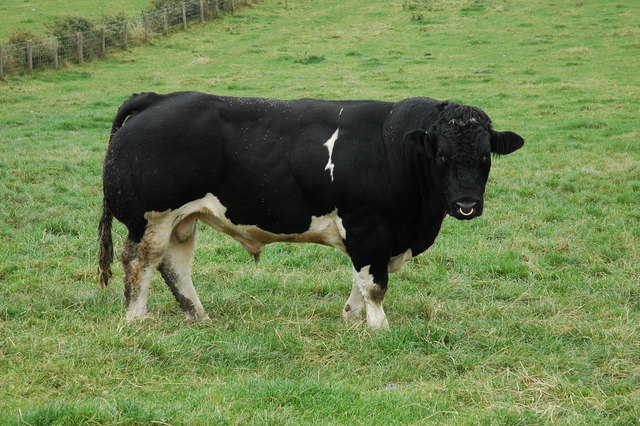

Keeping Holstein Friesian cattle
Calves are usually dehorned when young, though the breed is horned by nature. On many American dairy farms cows are given hormones to lift milk output, something that is not permitted in Europe. Breeding is mostly done by artificial insemination rather than by running a bull with the herd, which is how a single sire can leave tens of thousands of calves.
Numbers, conservation and the herd book
The Holstein is kept worldwide, and no total herd size is given. Its gene pool is one of the largest of any breed, so genetic progress in it has been quicker than in other dairy breeds and it is the first choice for most dairy farmers. The American cow Ubre Blanca, kept by Fidel Castro, and Pauline Wayne, who belonged to US president William Howard Taft, are named as notable animals. Two bulls are also noted: Kian, the first red Holstein whose semen passed a million units, and Toystory, whose semen passed 2.4 million units.
From the Holstein Friesian
Questions people ask about Holstein Friesian
Where does the Holstein Friesian come from?
Its home countries are the Netherlands and Germany. Dutch stock shaped the American herd, while in Britain the word Holstein, said with Dutch, described imported cattle that stood behind the Shorthorn. Winthrop W. Chenery of Massachusetts brought the first Holland cow to the United States in 1852.
What is the Holstein Friesian kept for?
Milk above all. A cow in the United States averages roughly 10,000 litres a year, and European cows average 7,000 to 8,000. The breed was once dual-purpose, giving beef as well as milk, and it remains the dairy breed most farmers worldwide choose.
Is the Holstein the same as the Friesian?
In the United Kingdom they are treated as two breeds, yet they are so alike that figures cannot separate them, and Friesian is much the commoner word there. Elsewhere the two names are often run together as Holstein Friesian.
Why is milk yield higher in the United States?
American herds average about 10,000 litres a cow each year against 7,000 to 8,000 in Europe. The difference is put down to hormones given to dairy cattle in the United States, a practice that is not allowed in Europe.
Are Holsteins horned?
They are horned by nature, though most calves are dehorned while young. The coat is pied, usually black and white, and red and white animals are bred as well. The breed is now kept in many countries and is the dairy type most farmers pick.
Good reading and sources
- Holstein Friesian on WikipediaEncyclopedia
- More photos on Wikimedia CommonsPhotos and video
- Wikidata recordOpen data
The facts on this page come from the Wikipedia article "Holstein Friesian", written by its contributors and used under the CC BY-SA 4.0 licence, and from its Wikidata record (CC0). EveryCow rewrote the text in its own words, with AI assistance, and compares every page with the article to make sure no passage is copied. It may be reused under the same CC BY-SA 4.0 licence with a link back.
It may contain mistakes. Sizes, colours and customs differ from one herd, valley or breeder to the next. Folk beliefs are described as tradition, never as advice. If something is wrong, tell us. Last refreshed 2026-10-16.
More from the Netherlands
All the breeds of the Netherlands 🇫🇷 France and 2 moreBlonde d'Aquitaine
A big wheat-coated beef breed from south-west France, born of three old draught linesTaurine · Beef
🇫🇷 France and 2 moreBlonde d'Aquitaine
A big wheat-coated beef breed from south-west France, born of three old draught linesTaurine · Beef
 🇩🇪 Germany and 4 moreGerman Black Pied
A dairy breed of the North Sea coast, black and white, smaller than the HolsteinTaurine · Dairy · Long-lived
🇩🇪 Germany and 4 moreGerman Black Pied
A dairy breed of the North Sea coast, black and white, smaller than the HolsteinTaurine · Dairy · Long-lived
 🇳🇱 Netherlands and 5 moreTauros
A breeding-back project building hardy cattle to stand in for the extinct aurochsWild · Grazing · Cold-hardy
🇳🇱 Netherlands and 5 moreTauros
A breeding-back project building hardy cattle to stand in for the extinct aurochsWild · Grazing · Cold-hardy
 🇩🇪 Germany and 3 moreHeck
A German type bred in the 1920s to recreate the extinct aurochsTaurine · Grazing · Cold-hardy
🇩🇪 Germany and 3 moreHeck
A German type bred in the 1920s to recreate the extinct aurochsTaurine · Grazing · Cold-hardy
Its cousins elsewhere
All dairy breeds 🇮🇳 India and 4 moreGayal
A semi-domesticated bovine of the Eastern Himalayas, kept for meat, milk and ceremonyMithun · Beef
🇮🇳 India and 4 moreGayal
A semi-domesticated bovine of the Eastern Himalayas, kept for meat, milk and ceremonyMithun · Beef
 🇮🇩 Indonesia and 4 moreBali cattle
A small humped breed from Indonesia, descended from wild banteng, kept for meat and plowing.Banteng · Beef · Disease-resistant
🇮🇩 Indonesia and 4 moreBali cattle
A small humped breed from Indonesia, descended from wild banteng, kept for meat and plowing.Banteng · Beef · Disease-resistant
 🇮🇩 Indonesia and 5 moreBantengbanṭéng (Javanese/Sundanese)
A wild Southeast Asian ox; its tame form, Bali cattle, runs feral in northern AustraliaBanteng · Beef · Drought-hardy
🇮🇩 Indonesia and 5 moreBantengbanṭéng (Javanese/Sundanese)
A wild Southeast Asian ox; its tame form, Bali cattle, runs feral in northern AustraliaBanteng · Beef · Drought-hardy
 🇵🇰 Pakistan and 5 moreZebu
Humped, heat-tolerant cattle of South Asia, kept for milk, meat, work and ridingZebu · Dairy · Heat-tolerant
🇵🇰 Pakistan and 5 moreZebu
Humped, heat-tolerant cattle of South Asia, kept for milk, meat, work and ridingZebu · Dairy · Heat-tolerant