🇳🇿 The cattle breeds of New Zealand
10 breeds from New Zealand, best known first, across 4 towns, fairs and pastures.
New Zealand's cattle are, above all, dairy animals: grass-fed cows milked outdoors through most of the year. From the first Shorthorns brought ashore by a missionary in 1814 the herd has grown to nearly five million, placing the country among the top seven milk producers worldwide. Co-operatives dominate the trade, and a single giant processor sends most of the milk to buyers in more than 140 countries.
- Shorthorn cows reached the Bay of Islands in 1814, a gift from the governor of New South Wales.
- Edendale's plant takes in more milk than any other dairy factory in the world.
- On 1 June, Moving Day, herds and sharemilkers travel the roads to new farms.
- Bovine tuberculosis hides in possums; only twenty infected herds remained by 2017/18.
- New Zealand milks about 21 billion litres a season, most of it exported.
Cattle in New Zealand
Cattle keeping in New Zealand is, at heart, dairy keeping. The industry grew from Shorthorn cows landed for missionaries in 1814 into a pasture-fed business of almost five million animals, run through farmer co-operatives. In the early colonial years most settlements kept a few milking cows, families milking one or two apiece, with bigger herds near towns where milk and butter could be sold. Co-operative factories, an export board and eventually a single dominant processor shaped the modern sector. The industry leans on grass rather than barns, and on exports rather than home markets. Australia enters the story only as the place those first cows came from.
The breeds
New Zealand's dairy herd begins with one breed: the Shorthorn, then often called the Durham. In 1814 the missionary Samuel Marsden received the first cows as a gift from Lachlan Macquarie, governor of New South Wales, drawn from that colony's Crown herd. They reached his mission stations in the Bay of Islands. Shorthorns spread with the settlers, and by the mid-1840s most districts kept some for milking. On ordinary family farms a cow or two supplied the household, the milking done by women and children. Larger herds clustered near towns, where fresh milk and butter found buyers.
Regions and communities
Dairying first flourished where rain was dependable: Waikato and Taranaki, the West Coast, plus Bay of Plenty, Manawatū, Nelson and Tasman. Irrigation has since carried cows into drier country, and Canterbury and Otago now milk as well. Weather has redrawn the map before: when Cyclone Bola hit in 1988, many Taranaki farms switched over to dairying. The industry's great factories rose inside these districts, close to the herds that supply them.
Milk, butter and beef
Before refrigerated ships arrived in the 1880s, butter and cheese were made on the farm and sold through local stores; factories then appeared in nearly every dairying village. Today a season yields about 21 billion litres of milk carrying 1.9 million tonnes of protein and milkfat, most of it exported to more than 140 countries, with China the largest single buyer since the 2010s. The four biggest plants in the Southern Hemisphere stand at Edendale and Te Rapa, Whareroa by Hāwera, and Clandeboye by Timaru, and Edendale takes in more milk than any other factory in the world.
Festivals, fairs and faith
The dairy calendar has one celebrated date: 1 June, the first day of the farming year. Once called Gypsy Day, and now usually Moving Day, or Mooving Day as a pun, it sends sharemilkers and contract milkers on the road with their families, herds and gear to begin contracts on new farms. Calving follows soon after, in late winter and early spring, and the season closes when the cows are dried off, rested from milking, in April and May.
Today
Almost five million cows put New Zealand among the top ranks of milk nations; it supplies about 3% of the world's milk, ranking seventh. A co-operative formed by mergers in 2001 now handles around 82% of the milk solids, while one of the last two independents was bought by a Chinese group in 2019. Herds have been tested by tuberculosis carried by possums and by a bacterial disease that arrived in 2017, and campaigners keep pressing the industry over rivers, emissions and land conversion.
The facts in this overview come from the Wikipedia article "Dairy farming in New Zealand", written by its contributors and used under the CC BY-SA 4.0 licence. EveryCow rewrote the text in its own words, with AI assistance, and compares every page with the article to make sure no passage is copied. It may be reused under the same CC BY-SA 4.0 licence with a link back.
Cattle towns and fairs of New Zealand
 🇳🇱 Netherlands and 3 moreHolstein Friesian
A black and white dairy breed kept worldwide, with red and white lines tooTaurine · Dairy
🇳🇱 Netherlands and 3 moreHolstein Friesian
A black and white dairy breed kept worldwide, with red and white lines tooTaurine · Dairy
 🇬🇧 United Kingdom and 5 moreHereford
A red and white beef breed from Herefordshire, England, known for its white face and hardiness.Taurine · Beef · Docile
🇬🇧 United Kingdom and 5 moreHereford
A red and white beef breed from Herefordshire, England, known for its white face and hardiness.Taurine · Beef · Docile
 🇬🇧 United Kingdom and 5 moreShorthorn
A historic British breed from north-east England, kept for milk and meat with red, white or roan coats.Taurine · Dual-purpose · Docile
🇬🇧 United Kingdom and 5 moreShorthorn
A historic British breed from north-east England, kept for milk and meat with red, white or roan coats.Taurine · Dual-purpose · Docile
 🇬🇧 United Kingdom and 5 moreBelted Galloway
A polled Scottish beef breed with a distinctive white belt around its black body.Taurine · Beef · Cold-hardy
🇬🇧 United Kingdom and 5 moreBelted Galloway
A polled Scottish beef breed with a distinctive white belt around its black body.Taurine · Beef · Cold-hardy
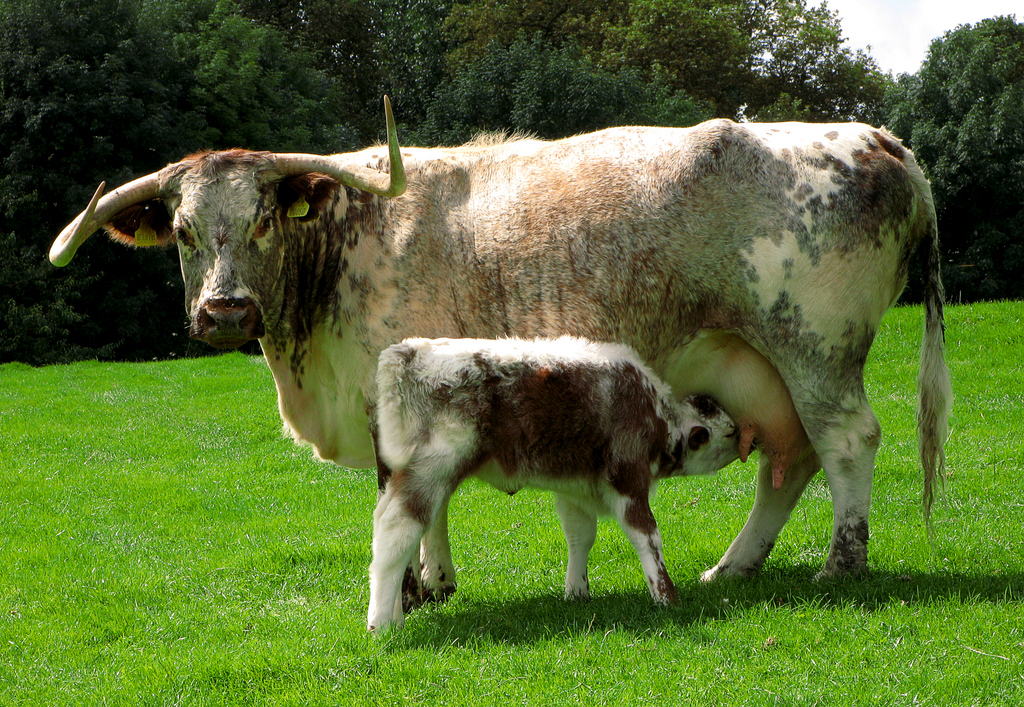 🇬🇧 United Kingdom and 3 moreEnglish Longhorn
A large horned beef breed from northern England, marked by a white line along the spineTaurine · Beef · Long-horned
🇬🇧 United Kingdom and 3 moreEnglish Longhorn
A large horned beef breed from northern England, marked by a white line along the spineTaurine · Beef · Long-horned
 🇬🇧 United Kingdom and 3 moreRed Poll
A naturally hornless red English breed, kept for milk and beefTaurine · Dual-purpose · Polled
🇬🇧 United Kingdom and 3 moreRed Poll
A naturally hornless red English breed, kept for milk and beefTaurine · Dual-purpose · Polled
 🇬🇧 United Kingdom and 2 moreLuing
A hardy red or dun beef cow from Luing, a Hebridean island, first made in 1947Composite · Beef · Cold-hardy
🇳🇿 New ZealandCampbell Island cattle
A feral herd on a New Zealand island, extinct by about 1984Taurine
🇳🇿 New ZealandEnderby Island cattle
A feral herd from a subantarctic island: small, long-barrelled, mostly black and whiteTaurine · Heritage · Cold-hardy
🇬🇧 United Kingdom and 2 moreLuing
A hardy red or dun beef cow from Luing, a Hebridean island, first made in 1947Composite · Beef · Cold-hardy
🇳🇿 New ZealandCampbell Island cattle
A feral herd on a New Zealand island, extinct by about 1984Taurine
🇳🇿 New ZealandEnderby Island cattle
A feral herd from a subantarctic island: small, long-barrelled, mostly black and whiteTaurine · Heritage · Cold-hardy
 🇫🇷 France and 3 moreJersey
A small brown dairy breed from the Channel Island of Jersey, known for rich yellow milkTaurine · Dairy · Heat-tolerant
🇫🇷 France and 3 moreJersey
A small brown dairy breed from the Channel Island of Jersey, known for rich yellow milkTaurine · Dairy · Heat-tolerant
Photo credits on this page
The small pictures above come from Wikimedia Commons under free licences. Some are cropped to fit.
- Belted Galloway: Jamain, CC BY-SA 3.0, source
- Luing: Andrew Wood, CC BY-SA 2.0, source
- English Longhorn: Dave, CC BY-SA 2.0, source
- Holstein Friesian: Vista Alegre baserria, CC BY-SA 3.0, source
- Shorthorn: Unknown author, CC BY-SA 2.0, source
- Hereford: Hayden Soloviev, CC BY 4.0, source
- Red Poll: Poinciana, CC BY-SA 3.0, source
- Jersey: Man vyi, Public domain, source
The weekly digest
Every Monday: seven cattle breeds you may not know, the cattle days of the week ahead, and one product explained step by step.