
Kuri
A heavy humpless longhorn from the shores of Lake Chad, kept for milk, meat and work
The Kuri is a humpless longhorn breed that has lived beside Lake Chad for many thousands of years and is kept for milk, meat and work. A heavy animal of 800 to 1,100 lb with unusual horns, it swims with ease yet wilts in heat, sun and drought.
- A humpless longhorn, kin to the N'dama breed
- Swims with ease and is often afloat in Lake Chad
- Weighs 800 to 1,100 lb despite its water-loving habits
- Cannot bear strong heat, sunlight or long droughts
- A 1953 to 1957 resettlement attempt outside the lake area failed
What do Kuri cattle look like?
The Kuri belongs to the humpless longhorn branch of cattle, so it carries no hump over the shoulders, unlike the humped zebu. Its most striking feature is a pair of large, unusual horns, which some keepers credit with a surprising job: helping the animal stay afloat. For a creature so fond of water it is a heavy one, tipping the scales anywhere between 800 and 1,100 lb, roughly 360 to 500 kg. It earns its keep three ways at once, giving milk, meat and labour, and it is bound to a single great body of water, Lake Chad, where it swims and paddles readily.
Where does the Kuri come from?
The Kuri comes from the country around Lake Chad, and it is treated as a breed specific to that region: at home there and, in practice, nowhere else. It sits in the humpless longhorn grouping of cattle, which places it alongside the N'dama as a near relation. The animals have lived beside the lake over many thousands of years. That long stay has shaped them: needing to adjust to nothing else, they cope poorly with new ground. Between 1953 and 1957 a group was taken away to see whether the breed could be established in a different home, but the project came to nothing, and the Kuri remains a creature of the lake's shores.
What the Kuri is known for
The Kuri's talents are watery ones. It swims readily and is often afloat in Lake Chad, and some people believe its odd horns help it stay up in the water. On land its constitution looks more delicate: the breed cannot bear strong heat or bright sun, and a long drought defeats it. That sensitivity shapes everything else about how it lives. Because the animals have dwelt by the lake for so long, they never had to toughen up for life elsewhere, so they take badly to new ground. A heavy, water-bound, heat-shy breed is not an easy one to resettle, as past attempts have shown.
How the Kuri is bred and kept
The main threat to the breed's purity comes from other cattle. Zebus, the humped kind, cross freely with Kuri, and this mixing is thought to be one reason the breed's numbers keep sliding. Counting them is difficult too: although the animals stay close to Lake Chad, no steady figure for the population has been arrived at, and the trend over recent decades points downwards. A test of the breed's flexibility was made in the 1950s, when a group was carried to a new area between 1953 and 1957 to see whether it could settle there. It could not. Millennia of life beside one lake left the Kuri with little need to adjust, and it failed to make itself at home anywhere else.
Kuri, drawn
What the Kuri is kept for
Kuri are milked, eaten and worked: meat, milk and labour are the three jobs listed for the breed. The cows give milk, the heavier stock are slaughtered for beef, and oxen, which are castrated males trained to pull, do the hauling. Weight counts for a good deal here. An animal running from 800 to 1,100 lb, or about 360 to 500 kg, carries plenty of meat, so the breed's heft is a real advantage on the beef side. Yet the same animal also milks and hauls, which is why it is counted as triple-purpose rather than as a specialist in any single trade.
The land and climate of the Kuri
Lake Chad defines the Kuri's home. The breed belongs to the lands ringing the lake, and it takes to the water freely, often remaining afloat in the lake itself. This habit suits it, because the breed has little tolerance for the harsher side of lakeside climates: heat bothers it, strong sunlight bothers it, and a long drought defeats it. Its way of coping with a hot day is simply to get wet. That deep attachment to one lake is also a weakness, for the animals have never had to adjust to other conditions across several millennia.
At a glance: where it belongs
Land and climate
Celebrations
Numbers, conservation and the herd book
Putting a firm figure on the Kuri population has defeated everyone who tried; no stable count exists. What the evidence does show is a downward trend across the last couple of decades. Two causes are pointed to. The first is crossing with zebus, which blurs the old longhorn blood. The second is the breed's own history: after thousands of years beside Lake Chad, the animals have not needed to adapt to anything else and cope poorly with change. Between 1953 and 1957 a group was moved to another area to see whether the breed could be established there; the attempt failed, and the Kuri stayed a lake breed.
From the Kuri
Questions people ask about Kuri
Where does the Kuri come from?
The breed belongs to the shores of Lake Chad, in Chad, and is specific to those lands. It has lived there for thousands of years, which is why moving it to a new home has proved so hard.
What is the Kuri kept for?
It is a triple-purpose breed. Owners milk the cows, use heavier animals for beef, and train oxen for work such as hauling. No single use dominates; the breed earns its keep in all three ways.
Does the Kuri cope with heat and drought?
It is intolerant of heat and strong sunlight, and long droughts defeat it. Water is its refuge: it swims readily, and Lake Chad is where it chooses to be on warm days.
How many Kuri are left?
A firm total has never been settled on. What is clear is that numbers have been going down for the past couple of decades, with zebu blood mixing in and the breed's deep roots at the lake both working against it.
Can a Kuri really swim?
Yes. It paddles readily in Lake Chad, where it passes a great deal of its life. Some keepers think its odd horns help it stay afloat, though that is a belief rather than a proven fact.
Good reading and sources
The facts on this page come from the Wikipedia article "Kuri cattle", written by its contributors and used under the CC BY-SA 4.0 licence, and from its Wikidata record (CC0). EveryCow rewrote the text in its own words, with AI assistance, and compares every page with the article to make sure no passage is copied. It may be reused under the same CC BY-SA 4.0 licence with a link back.
It may contain mistakes. Sizes, colours and customs differ from one herd, valley or breeder to the next. Folk beliefs are described as tradition, never as advice. If something is wrong, tell us. Last refreshed 2026-10-16.

Its cousins elsewhere
All triple-purpose breeds 🇲🇳 Mongolia and 4 moreYakགཡག་
A shaggy, cold-hardy highland bovine kept across the Himalayas and Tibetan PlateauYak · Triple-purpose · Cold-hardy
🇲🇳 Mongolia and 4 moreYakགཡག་
A shaggy, cold-hardy highland bovine kept across the Himalayas and Tibetan PlateauYak · Triple-purpose · Cold-hardy
 🇮🇩 Indonesia and 5 moreBantengbanṭéng (Javanese/Sundanese)
A wild Southeast Asian ox; its tame form, Bali cattle, runs feral in northern AustraliaBanteng · Beef · Drought-hardy
🇮🇩 Indonesia and 5 moreBantengbanṭéng (Javanese/Sundanese)
A wild Southeast Asian ox; its tame form, Bali cattle, runs feral in northern AustraliaBanteng · Beef · Drought-hardy
 🇵🇱 Poland and 5 moreAurochs
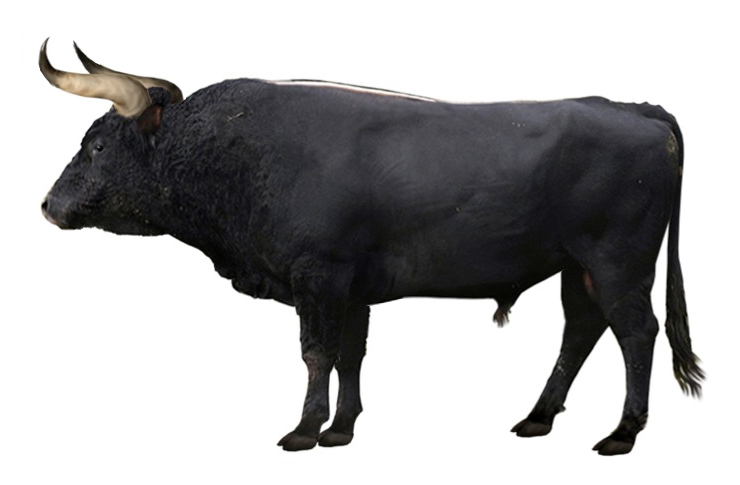
The wild ancestor of all domestic cattle, extinct since 1627Wild · Long-horned
🇵🇱 Poland and 5 moreAurochs
The wild ancestor of all domestic cattle, extinct since 1627Wild · Long-horned
 🇺🇸 United StatesTexas Longhorn
American beef cattle, once feral on Texas ranges, with horn spreads beyond 2.4 mTaurine · Beef · Heat-tolerant
🇺🇸 United StatesTexas Longhorn
American beef cattle, once feral on Texas ranges, with horn spreads beyond 2.4 mTaurine · Beef · Heat-tolerant