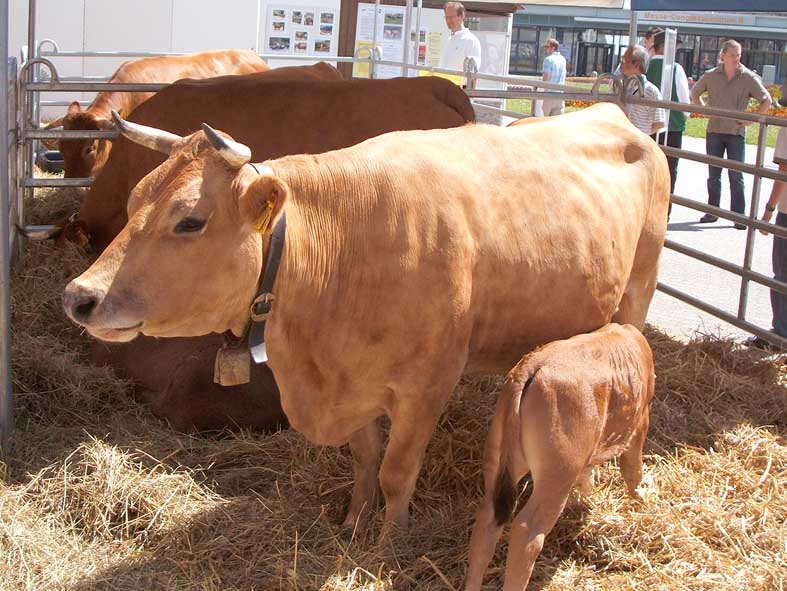
Murnau-Werdenfels
A long-lived brown dairy breed of the Bavarian uplands, milk and beef
The Murnau-Werdenfels is an old brown dairy breed from Upper Bavaria in southern Germany, kept for milk and beef. Cows stand about 128 to 130 cm and weigh 500 to 600 kg, with coats ranging from straw to reddish brown and black horn tips.
- Cows give about 4300 kg of milk a year, with 3.8% fat and 3.4% protein.
- The herd book holds around 130 cows; semen is stored from about eleven bulls.
- The breed began in Tyrol, Austria, and is now bred in Upper Bavaria.
- Cows stand 128 to 130 cm at the withers and weigh 500 to 600 kg.
- Bavaria keeps a suckler herd and a sperm bank for the breed.
What do Murnau-Werdenfels cattle look like?
The Murnau-Werdenfels is an old dairy breed of the brown Alpine type. Its coat runs from pale straw through brown-yellow to reddish brown, and a white ring circles the dark muzzle. The hooves and the tips of the horns are black. Cows stand about 128 to 130 cm at the withers, the ridge between the shoulders, and weigh 500 to 600 kg. Bulls are larger, reaching 138 to 145 cm and 850 to 950 kg. The cows are long-lived and fertile, and the breed is built for damp upland farms rather than for shows.
Where does the Murnau-Werdenfels come from?
The breed belongs to Upper Bavaria, the southernmost part of Germany, and takes its name from Murnau and the Werdenfels country around Garmisch-Partenkirchen. Its beginnings lie further south, in Tyrol in Austria. Farmers in that upland zone kept it for milk, and in time it became a type of its own. Today the main breeding area is small and centred on that one corner of Bavaria.
What the Murnau-Werdenfels is known for
Hardiness is the point of this breed. It was shaped for farms on boggy ground, where fussier cattle do badly. Cows live a long time and breed readily, which keeps a small herd productive for many years. The animals are described as old and robust rather than delicate.
How the Murnau-Werdenfels is bred and kept
Numbers are tiny, so breeding is carefully managed. The herd book holds roughly 130 cows, and semen is stored from about eleven bulls. The Federal State of Bavaria keeps a suckler herd of its own and a sperm bank, and it gives breeders money to carry on. Beyond that support, selection rests on a handful of farms in the Werdenfels country.
Murnau-Werdenfels, drawn
What the Murnau-Werdenfels is kept for
Milk is the main product, at about 4300 kg a year from a cow, testing 3.8 per cent fat and 3.4 per cent protein. Bulls and bullocks both go for beef. In the past bullocks were also worked as strong draught oxen, and that trade brought income to small farms. So the breed has served three ways: for the dairy, for meat, and for pulling carts and ploughs.
The land and climate of the Murnau-Werdenfels
The homeland is wet ground. These cattle were kept on boggy farms of the kind that suits few other types, in Upper Bavaria in southern Germany. Generations on that damp pasture gave them the toughness they are known for. The grazing area today is still the Werdenfels country around Murnau and Garmisch-Partenkirchen.
Who keeps the Murnau-Werdenfels
The keepers are small farmers in the Bavarian uplands, and the breed's survival rests on them. Bullocks once brought money into these smallholdings, which is one reason the breed was kept going. Today breeders work with support from the Federal State of Bavaria, which runs its own suckler herd and a sperm bank and gives financial help to those who continue.
At a glance: where it belongs
Land and climate

Custom and folk tradition
Work was the old tradition here. Bullocks were broken to the yoke and used as draught oxen, strong enough for the heavy going of boggy farms, and selling them brought in money for smallholdings. That practice has gone, but it shaped both the breed and the farm economy of the Werdenfels area.
Keeping Murnau-Werdenfels cattle
The cows run on damp pasture. When stock is needed, frozen semen from about eleven bulls is available, and Bavaria keeps a suckler herd of its own. The breed's long life and ready fertility hold down the cost of keeping a herd, which matters where numbers are so small.
Numbers, conservation and the herd book
Numbers are very low. The herd book lists about 130 females, and semen is frozen from roughly eleven bulls, so the breed is in danger of extinction. In 2007 a German organisation that works to save old farm breeds named it its Endangered Breed of the Year. Slow Food includes it among foods it considers worth protecting. Bavaria backs it with a suckler herd, a sperm bank and money for breeders.
Questions people ask about Murnau-Werdenfels
Where does the Murnau-Werdenfels come from?
It comes from Upper Bavaria in southern Germany, where it is still bred around Murnau and Garmisch-Partenkirchen in the Werdenfels country. Its beginnings lie in Tyrol, in Austria.
What is the breed kept for?
Mainly for milk. A cow gives about 4300 kg a year at 3.8% fat and 3.4% protein. Bulls and bullocks are also used for beef, and bullocks once worked as draught oxen.
How many are left?
Very few. The herd book lists around 130 females, and semen is frozen from about eleven bulls, so the breed is described as in danger of extinction. The state of Bavaria helps support it.
What does it look like?
A brown-yellow cow, ranging from straw to reddish brown, with a white ring around a dark muzzle and black hooves. Cows reach 128 to 130 cm at the withers and weigh 500 to 600 kg.
Is it a hardy breed?
Yes. It was kept on boggy, wet ground and is described as old and robust, with cows that live long and breed readily. That hardiness is one reason a few breeders still keep it.
Good reading and sources
- Murnau-Werdenfels on WikipediaEncyclopedia
- More photos on Wikimedia CommonsPhotos and video
- Wikidata recordOpen data
The facts on this page come from the Wikipedia article "Murnau-Werdenfels", written by its contributors and used under the CC BY-SA 4.0 licence, and from its Wikidata record (CC0). EveryCow rewrote the text in its own words, with AI assistance, and compares every page with the article to make sure no passage is copied. It may be reused under the same CC BY-SA 4.0 licence with a link back.
It may contain mistakes. Sizes, colours and customs differ from one herd, valley or breeder to the next. Folk beliefs are described as tradition, never as advice. If something is wrong, tell us. Last refreshed 2026-10-16.
More from Germany
All the breeds of Germany 🇬🇧 United Kingdom and 4 moreGalloway
A polled black beef breed from south-west Scotland with a thick double coatTaurine · Beef · Cold-hardy
🇬🇧 United Kingdom and 4 moreGalloway
A polled black beef breed from south-west Scotland with a thick double coatTaurine · Beef · Cold-hardy
 🇨🇭 Switzerland and 5 moreBraunvieh
A large Alpine brown dairy breed from Switzerland, known for its strength and high milk yield.Taurine · Dairy · Rich milk
🇨🇭 Switzerland and 5 moreBraunvieh
A large Alpine brown dairy breed from Switzerland, known for its strength and high milk yield.Taurine · Dairy · Rich milk
 🇦🇹 Austria and 1 morePinzgauer
Chestnut Austrian cattle with a broad white stripe along the back and bellyTaurine · Triple-purpose
🇦🇹 Austria and 1 morePinzgauer
Chestnut Austrian cattle with a broad white stripe along the back and bellyTaurine · Triple-purpose
 🇩🇪 Germany and 4 moreGerman Black Pied
A dairy breed of the North Sea coast, black and white, smaller than the HolsteinTaurine · Dairy · Long-lived
🇩🇪 Germany and 4 moreGerman Black Pied
A dairy breed of the North Sea coast, black and white, smaller than the HolsteinTaurine · Dairy · Long-lived
Its cousins elsewhere
All dairy breeds 🇲🇳 Mongolia and 4 moreYakགཡག་
A shaggy, cold-hardy highland bovine kept across the Himalayas and Tibetan PlateauYak · Triple-purpose · Cold-hardy
🇲🇳 Mongolia and 4 moreYakགཡག་
A shaggy, cold-hardy highland bovine kept across the Himalayas and Tibetan PlateauYak · Triple-purpose · Cold-hardy
 🇨🇳 China and 2 moreWild yak
A massive, shaggy wild bovine native to the high plateaux and peaks of the HimalayasYak · Beef · Cold-hardy
🇨🇳 China and 2 moreWild yak
A massive, shaggy wild bovine native to the high plateaux and peaks of the HimalayasYak · Beef · Cold-hardy
 🇺🇸 United States and 1 moreBeefalo
A cattle and bison hybrid raised for beef in the United StatesComposite · Beef · Cold-hardy
🇺🇸 United States and 1 moreBeefalo
A cattle and bison hybrid raised for beef in the United StatesComposite · Beef · Cold-hardy
 🇰🇷 South Korea and 1 moreHanwoo한우
A small, brown taurine breed from Korea, once used for work and now prized for its premium beef.Taurine · Beef · Docile
🇰🇷 South Korea and 1 moreHanwoo한우
A small, brown taurine breed from Korea, once used for work and now prized for its premium beef.Taurine · Beef · Docile