Enderby Island cattle
A feral herd from a subantarctic island: small, long-barrelled, mostly black and white
A small breed of cattle that lived wild on Enderby Island, in New Zealand's subantarctic Auckland Islands, for around eighty years. Most of the survivors are black and white, and the roughly seven that remain are held in captivity on the mainland as a conservation line.
- Nine cattle of unclear breeding were landed on Enderby Island in the 1890s
- The island was abandoned in 1910 and the herd ran wild for about eighty years
- In 1991 an expedition removed 47 head from a herd of roughly 53
- A 1992 rescue found a cow and her calf, the last two left on the island
- About seven animals remain today, all on mainland New Zealand
What do Enderby Island cattle cattle look like?
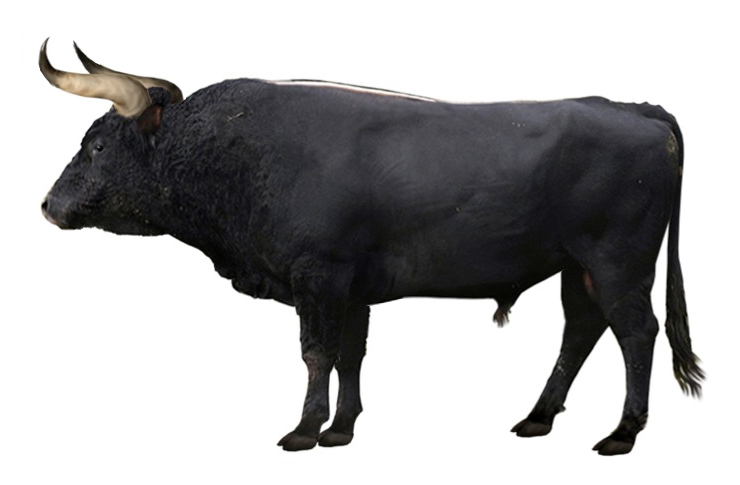
The animals are small, with a long barrel and legs that sit short beneath it, which gives them a shape of their own. Most are black and white; a few taken off the island in 1991 were red and white. The first herd was entered in a ship's log as Shorthorn, but today's cattle look little like modern Shorthorns and stand closer to Shetland cattle in build. They are taurine cattle of the northern European type.
Where does the Enderby Island cattle come from?
An attempt to farm Enderby Island, the northernmost island of the subantarctic Auckland Islands, was made in the 1890s. Nine cattle were landed there, though what breed they were is unclear. The climate defeated the venture, and in 1910 the island was given up with the cattle still on it. Cattle had also been put ashore earlier to feed castaways. The herd then spent about eighty years alone.
What the Enderby Island cattle is known for
Alone on the island, the herd did well in a cold, wet, windswept place. The animals lived on scrub vegetation, southern rātā and seaweed. Across eight decades without attention they became suited to those conditions, and that hardiness is what the breed is known for. Numbers held out until the Department of Conservation decided to clear introduced animals from the Auckland Islands.
How the Enderby Island cattle is bred and kept
Rescue came first, then breeding work. The Rare Breeds Conservation Society of New Zealand has run a programme to keep the line going in captivity, using in vitro fertilisation and cloning. Oocytes and epididymal sperm were collected in 1991 and stored. The programme continues, with the aim of a herd that carries on in captivity.
Enderby Island cattle, drawn
What the Enderby Island cattle is kept for
No working role is left for this breed; it is kept to preserve the line. Cattle were first taken to Enderby Island for a farming venture, and others had been released earlier to give castaways a source of food. Neither plan lasted. Today the animals are held on mainland New Zealand, where the breeding effort exists to keep the breed alive rather than to produce milk or meat.
The land and climate of the Enderby Island cattle
Enderby Island belongs to the Auckland Islands group, in the subantarctic, and is the northernmost of them. Farming there failed because of the weather. The cattle lived on scrub, southern rātā and seaweed rather than sown pasture, and it is that island setting, not a farm, that shaped them. Cold, wind and whatever the island grew made up their eighty years.
Who keeps the Enderby Island cattle
Two organisations are tied to the breed's story. The Department of Conservation decided in 1991 that introduced animals on the Auckland Islands, cattle and rabbits among them, had to go, so that the islands' own plants and wildlife could recover. The Rare Breeds Conservation Society of New Zealand sent an expedition in 1992 and brought out the last two live cattle, a cow and her calf. The society also runs the captive breeding programme.
At a glance: where it belongs
Land and climate
Numbers, conservation and the herd book
Around seven animals survive, all of them on mainland New Zealand. In 1991 an expedition removed 47 head from a herd thought to number about 53. Nine cattle had arrived in the 1890s. Genetic material collected that year was stored, and the Rare Breeds Conservation Society of New Zealand has since used in vitro fertilisation and cloning in its breeding programme.
Questions people ask about Enderby Island cattle
Where does the Enderby Island breed come from?
From Enderby Island, the northernmost island of New Zealand's subantarctic Auckland Islands. Nine cattle were taken there in the 1890s for a farming attempt. The island was abandoned in 1910 and the herd lived on alone for around eighty years.
What is the breed kept for today?
Only to save the line. The Rare Breeds Conservation Society of New Zealand led the rescue and the later breeding work, which has included in vitro fertilisation and cloning. The remaining animals live in captivity on mainland New Zealand rather than on a working farm.
What do the cattle look like?
Small animals with a long barrel and short legs. Most are black and white, and three of those culled in 1991 were red and white. Their build is nearer to Shetland cattle than to modern Shorthorns, though the first herd was logged as Shorthorn.
How many are left?
About seven, all on mainland New Zealand. A 1992 expedition found a cow and her calf, the last two on the island, and brought them out. Genetic material had also been stored, and it has been used in the breeding programme.
Why were the island cattle culled?
New Zealand's Department of Conservation wanted the Auckland Islands' own plants and wildlife to recover, so introduced species including cattle and rabbits were cleared. In 1991 an expedition removed 47 head from a herd estimated at about 53.
Good reading and sources
The facts on this page come from the Wikipedia article "Enderby Island cattle", written by its contributors and used under the CC BY-SA 4.0 licence, and from its Wikidata record (CC0). EveryCow rewrote the text in its own words, with AI assistance, and compares every page with the article to make sure no passage is copied. It may be reused under the same CC BY-SA 4.0 licence with a link back.
It may contain mistakes. Sizes, colours and customs differ from one herd, valley or breeder to the next. Folk beliefs are described as tradition, never as advice. If something is wrong, tell us. Last refreshed 2026-10-16.
More from New Zealand
All the breeds of New Zealand 🇳🇱 Netherlands and 3 moreHolstein Friesian
A black and white dairy breed kept worldwide, with red and white lines tooTaurine · Dairy
🇳🇱 Netherlands and 3 moreHolstein Friesian
A black and white dairy breed kept worldwide, with red and white lines tooTaurine · Dairy
 🇬🇧 United Kingdom and 5 moreHereford
A red and white beef breed from Herefordshire, England, known for its white face and hardiness.Taurine · Beef · Docile
🇬🇧 United Kingdom and 5 moreHereford
A red and white beef breed from Herefordshire, England, known for its white face and hardiness.Taurine · Beef · Docile
 🇬🇧 United Kingdom and 5 moreShorthorn
A historic British breed from north-east England, kept for milk and meat with red, white or roan coats.Taurine · Dual-purpose · Docile
🇬🇧 United Kingdom and 5 moreShorthorn
A historic British breed from north-east England, kept for milk and meat with red, white or roan coats.Taurine · Dual-purpose · Docile
Its cousins elsewhere
All heritage breeds 🇳🇱 Netherlands and 5 moreTauros
A breeding-back project building hardy cattle to stand in for the extinct aurochsWild · Grazing · Cold-hardy
🇳🇱 Netherlands and 5 moreTauros
A breeding-back project building hardy cattle to stand in for the extinct aurochsWild · Grazing · Cold-hardy
 🇨🇳 China and 2 moreWild yak
A massive, shaggy wild bovine native to the high plateaux and peaks of the HimalayasYak · Beef · Cold-hardy
🇨🇳 China and 2 moreWild yak
A massive, shaggy wild bovine native to the high plateaux and peaks of the HimalayasYak · Beef · Cold-hardy
 🇵🇱 Poland and 5 moreAurochs
The wild ancestor of all domestic cattle, extinct since 1627Wild · Long-horned
🇵🇱 Poland and 5 moreAurochs
The wild ancestor of all domestic cattle, extinct since 1627Wild · Long-horned
 🇲🇳 Mongolia and 4 moreYakགཡག་
A shaggy, cold-hardy highland bovine kept across the Himalayas and Tibetan PlateauYak · Triple-purpose · Cold-hardy
🇲🇳 Mongolia and 4 moreYakགཡག་
A shaggy, cold-hardy highland bovine kept across the Himalayas and Tibetan PlateauYak · Triple-purpose · Cold-hardy