
Ponwar
A small black-and-white zebu from Pilibhit, kept for cart work and quick to anger
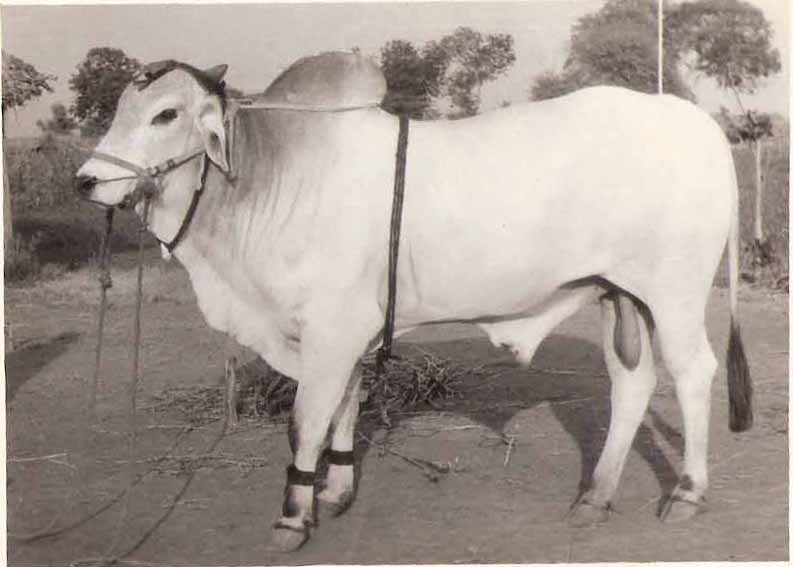
A small zebu draught breed from the country around Ponwar in Pilibhit district, Uttar Pradesh, India. Black and white in coat, with a hump that stays modest on a cow and grows well developed on a bull, it is kept above all for pulling carts and is known for a fiery temper.
- Native breed of India, named after the village of Ponwar in Pilibhit district
- Kept as a draught animal, mainly for pulling carts
- Coat is black and white, with the tail switch colour following the coat
- Small, compact, non-fleshy body with short horns curving inward
- Hump is small in cows and well developed in bulls
What do Ponwar cattle look like?
Ponwar is a zebu, so it carries a hump. That hump is modest on a cow but clearly raised on a bull. The frame is small and tight rather than fleshy. The head is slight, with a narrow muzzle and short ears. Horns run short to medium in length, turning inwards and finishing in a point. A long tail hangs below the hock, the joint on the back of the leg. The switch, the tuft of long hair at the tail's end, is white on a mostly black beast and black on one that is mostly white. Cows have a small udder with small teats.
Where does the Ponwar come from?
The breed is named after Ponwar, a place in Puranpur Taluk, Pilibhit district, Uttar Pradesh, India. That is where it is said to have begun, and it has stayed close to home, with herds found only in the small patch of country around the village. The breeding tract is narrow, lying between about 28°4' and 28°8' north and 79°0' and 80°4' east. Ponwar is counted among the native cattle breeds of India.
What the Ponwar is known for
These are lively cattle with a short fuse. The breed is described as very active, of fiery disposition, and aggressive in temperament, and that shapes the way it is handled. The body is compact and firm rather than soft and fleshy, which is what you would expect of an animal bred for the yoke. The small, hard frame and the quick way of moving fit a working animal.
How the Ponwar is bred and kept
Ponwar cattle are bred inside a very small area, the country around Ponwar in Pilibhit district, Uttar Pradesh. The breed is tied to that tract and to the villages in it. Selection has run along the lines of cart work, so animals that move well and keep going are the ones kept for breeding. The bull carries the heavier hump, the clearest outward mark of the zebu type in this population.
Ponwar, drawn
What the Ponwar is kept for
Ponwar is a draught breed, and its working role is cart pulling. Oxen draw loads along village roads and field tracks. Milk is not what the breed is known for, since cows carry a small udder and small teats. The value lies in an animal's ability to work, helped by a small, compact body and an active way of going. The same energy that makes the breed useful in harness is what gives it its reputation for a hot temper.
The land and climate of the Ponwar
The homeland is a compact stretch of country in Pilibhit district, Uttar Pradesh, around the village of Ponwar. It lies between roughly 28°4' and 28°8' north and 79°0' and 80°4' east. The breed is restricted to this tract and to the country adjoining it. Animals live and work within that area, in the villages of the district.

Questions people ask about Ponwar
Where does the Ponwar come from?
It comes from Ponwar, a place in Puranpur Taluk, Pilibhit district, Uttar Pradesh, India, and takes its name from there. Herds stay within a small area around that village, in a breeding tract that runs between about 28°4' and 28°8' north.
What is the Ponwar kept for?
It is a draught breed, kept mainly for pulling carts. Oxen do the hauling. It is not a dairy breed in the usual sense, since cows have small udders and small teats. Its build is small, compact and short of flesh, which suits work in harness.
What colour are Ponwar cattle?
They are black and white, in a mix of the two. The colour of the tail switch follows the coat: it is white on animals that are mostly black, and black on those with a larger share of white patches.
What is the temperament of the breed?
It has a name for a fiery, aggressive temper. The animals are described as very active, and that energy comes with a short fuse. The small, firm body and the lively way of moving suit draught work, but this is not a placid breed.
What do its horns and hump look like?
The horns are short to medium in length and curve inwards, ending in points. The hump is modest on a cow and well developed on a bull, which marks the breed as a zebu. The tail is long and reaches below the hock.
Good reading and sources
- Ponwar cattle on WikipediaEncyclopedia
- More photos on Wikimedia CommonsPhotos and video
- Wikidata recordOpen data
The facts on this page come from the Wikipedia article "Ponwar cattle", written by its contributors and used under the CC BY-SA 4.0 licence, and from its Wikidata record (CC0). EveryCow rewrote the text in its own words, with AI assistance, and compares every page with the article to make sure no passage is copied. It may be reused under the same CC BY-SA 4.0 licence with a link back.
It may contain mistakes. Sizes, colours and customs differ from one herd, valley or breeder to the next. Folk beliefs are described as tradition, never as advice. If something is wrong, tell us. Last refreshed 2026-10-16.
More from India
All the breeds of India 🇵🇰 Pakistan and 5 moreZebu
Humped, heat-tolerant cattle of South Asia, kept for milk, meat, work and ridingZebu · Dairy · Heat-tolerant
🇵🇰 Pakistan and 5 moreZebu
Humped, heat-tolerant cattle of South Asia, kept for milk, meat, work and ridingZebu · Dairy · Heat-tolerant
 🇵🇰 Pakistan and 4 moreSahiwal
A heat-tolerant zebu from the Punjab, kept for milk, meat and draught workZebu · Dairy · Heat-tolerant
🇵🇰 Pakistan and 4 moreSahiwal
A heat-tolerant zebu from the Punjab, kept for milk, meat and draught workZebu · Dairy · Heat-tolerant
 🇮🇳 India and 5 moreOngole
A short-horned zebu breed from Andhra Pradesh, white with dark markings, used for work and milk.Zebu · Draught · Heat-tolerant
🇮🇳 India and 5 moreOngole
A short-horned zebu breed from Andhra Pradesh, white with dark markings, used for work and milk.Zebu · Draught · Heat-tolerant
 🇮🇳 IndiaKhillari
A draft breed from Maharashtra and Karnataka, compact with sweeping horns and grey-white coats.Zebu · Draught · Heat-tolerant
🇮🇳 IndiaKhillari
A draft breed from Maharashtra and Karnataka, compact with sweeping horns and grey-white coats.Zebu · Draught · Heat-tolerant
Its cousins elsewhere
All draught breeds 🇩🇪 Germany and 3 moreHeck
A German type bred in the 1920s to recreate the extinct aurochsTaurine · Grazing · Cold-hardy
🇩🇪 Germany and 3 moreHeck
A German type bred in the 1920s to recreate the extinct aurochsTaurine · Grazing · Cold-hardy
 🇦🇹 AustriaTux-ZillertalTux-Zillertaler
A stocky Alpine breed from Tirol, black or red, once bred for cow-fighting contests.Taurine · Beef · Spirited
🇦🇹 AustriaTux-ZillertalTux-Zillertaler
A stocky Alpine breed from Tirol, black or red, once bred for cow-fighting contests.Taurine · Beef · Spirited
 🇮🇩 Indonesia and 4 moreBali cattle
A small humped breed from Indonesia, descended from wild banteng, kept for meat and plowing.Banteng · Beef · Disease-resistant
🇮🇩 Indonesia and 4 moreBali cattle
A small humped breed from Indonesia, descended from wild banteng, kept for meat and plowing.Banteng · Beef · Disease-resistant
 🇮🇩 Indonesia and 5 moreBantengbanṭéng (Javanese/Sundanese)
A wild Southeast Asian ox; its tame form, Bali cattle, runs feral in northern AustraliaBanteng · Beef · Drought-hardy
🇮🇩 Indonesia and 5 moreBantengbanṭéng (Javanese/Sundanese)
A wild Southeast Asian ox; its tame form, Bali cattle, runs feral in northern AustraliaBanteng · Beef · Drought-hardy